
What Is the Speed Distance Time Calculator?
This calculator solves the three classic motion quantities — speed, distance, and time — using a single relationship. Whenever you know two of the three values, the calculator instantly finds the third. It is useful for trip planning, running and cycling pace, vehicle travel estimates, physics homework, and any situation involving constant-speed motion.
How to Use It
First choose what you want to calculate: Speed, Distance, or Time. Then enter the two values you already know. For example, to find speed, enter the distance traveled (km) and the time taken (hours). The result appears immediately along with the correct unit (km/h, km, or hours).
The Formula Explained
All three formulas come from one core relationship between speed, distance, and time:
\(\text{Speed} = \dfrac{\text{Distance}}{\text{Time}}\). Rearranging this single equation gives \(\text{Distance} = \text{Speed} \times \text{Time}\) and \(\text{Time} = \dfrac{\text{Distance}}{\text{Speed}}\). The units must be consistent — if distance is in kilometers and time is in hours, speed comes out in kilometers per hour.
$$\text{Speed} = \dfrac{\text{Distance}}{\text{Time}}$$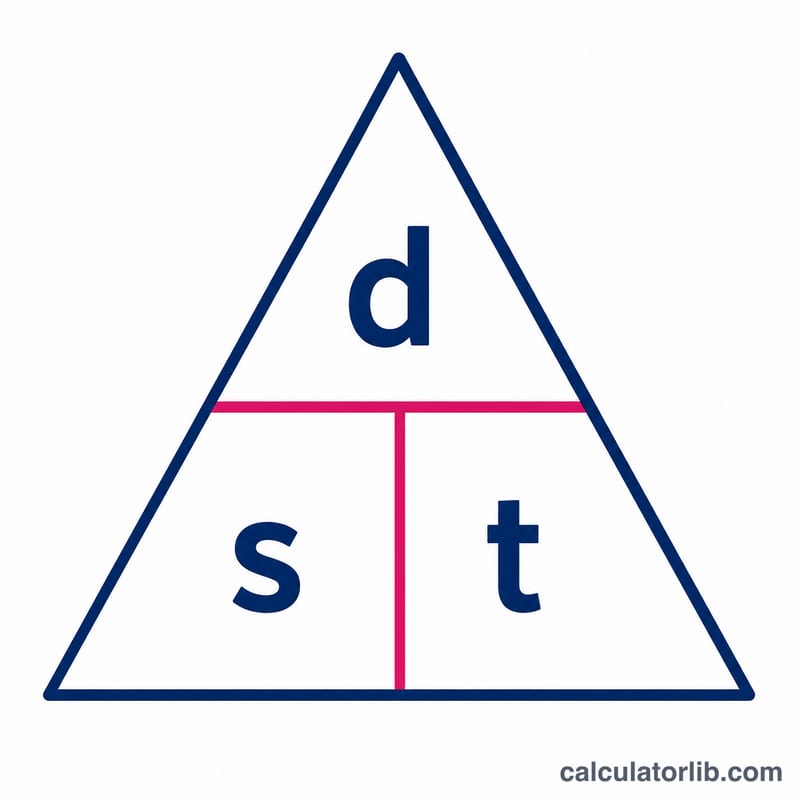
Worked Example
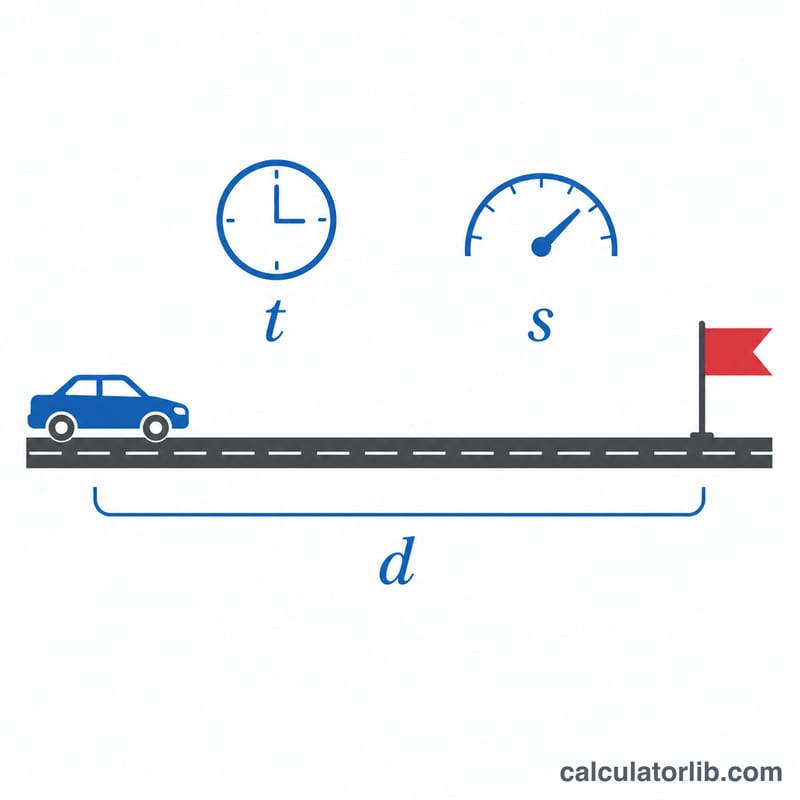
Suppose you drive 100 km and the trip takes 2 hours. Selecting "Speed" and entering distance = 100 and time = 2 gives Speed = \(100 \div 2\) = 50 km/h. Conversely, traveling at 50 km/h for 2 hours covers \(50 \times 2 = 100\) km.
FAQ
Can I use miles instead of kilometers? Yes — the math is identical. Just keep your units consistent and read the answer in your chosen unit (e.g., mph instead of km/h).
What if time is given in minutes? Convert minutes to hours first (divide by 60) so the speed result is in km/h, or treat the units consistently for your needs.
Does this assume constant speed? Yes. The formula gives the average speed over the journey; it does not account for acceleration or stops separately.