
What this calculator does
The Time From Speed and Distance Calculator tells you how long a journey will take when you know the distance to travel and your average speed. It works for any consistent unit system — kilometres with km/h or miles with mph — and breaks the answer down into hours, minutes, and seconds so it is easy to read.
How to use it
Enter the total distance, enter your average speed, and choose the matching unit pair (km & km/h or miles & mph). The calculator instantly returns the travel time. Use it for road trips, running and cycling pace planning, flight estimates, or any physics homework involving constant speed.
The formula explained
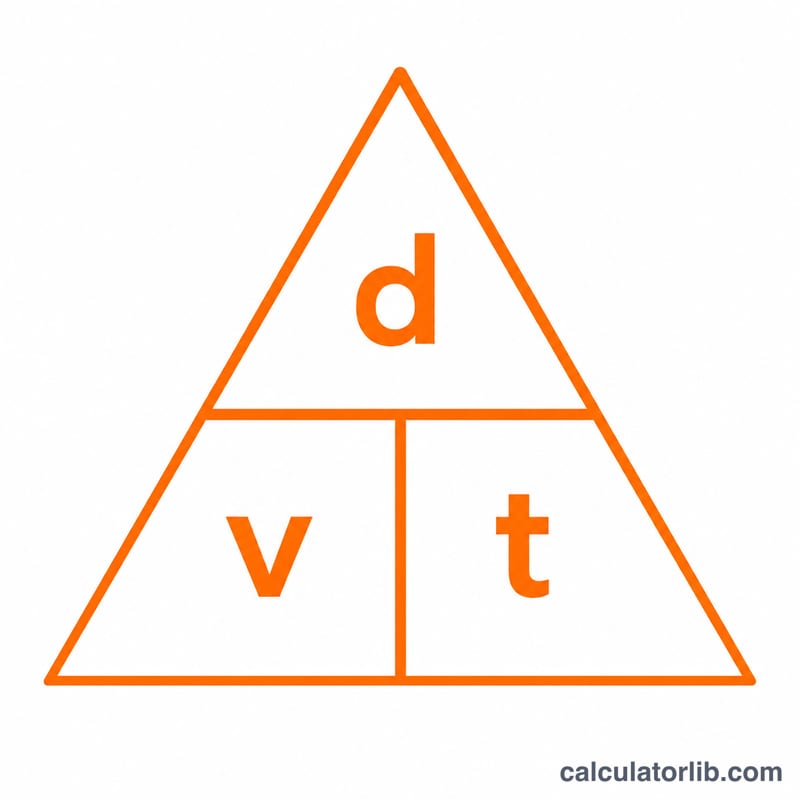
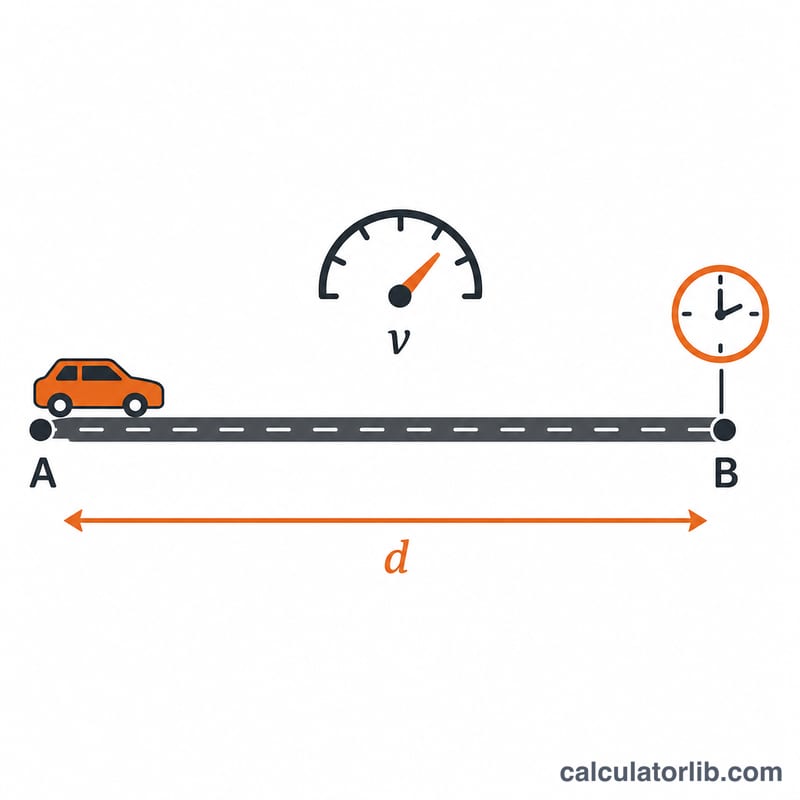
The relationship between distance, speed, and time is one of the most fundamental in physics: $$\text{Time} = \frac{\text{Distance}}{\text{Speed}}$$ If you cover 150 km at 60 km/h, you divide 150 by 60 to get \(2.5\) hours. The decimal portion of the answer is converted to minutes by multiplying by 60, and any remaining fraction becomes seconds. This assumes a constant average speed for the whole trip.
Worked example
Suppose you must drive 150 km and you average 60 km/h. $$\text{Time} = 150 \div 60 = 2.5 \text{ hours}$$ The 0.5 hour is \(0.5 \times 60 = 30\) minutes, so the trip takes 2 hours and 30 minutes (150 total minutes).
FAQ
Do the units have to match? Yes. Use kilometres with km/h, or miles with mph. Mixing units (km with mph) gives a wrong answer.
What if my speed varies? Use your average speed over the whole trip. For variable speeds, split the route into segments and add the times.
Why is the result in hours? Because speed is per hour, distance ÷ speed naturally yields hours; we then convert into minutes and seconds for convenience.