
What is the Average Speed Calculator?
This tool computes your average speed when you know the total distance traveled and the total time it took. Average speed is simply distance divided by time — it does not account for stops or changes in pace, but gives the single steady speed that would cover the same distance in the same time. Results are shown in kilometers per hour (km/h), miles per hour (mph), and meters per second (m/s) at once.
How to use it
Enter the distance and choose its unit (kilometers, miles, or meters). Then enter the elapsed time as hours, minutes, and seconds — you can fill in just the fields you need. The calculator converts everything to consistent units and returns your average speed in three common formats.
The formula explained
The core equation is speed = distance ÷ time. Time is first converted to decimal hours using \( t = h + m/60 + s/3600 \). Distance is converted to kilometers (miles \(\times\) 1.609344, or meters ÷ 1000). Dividing distance in km by time in hours gives km/h; dividing km/h by 1.609344 gives mph, and multiplying km/h by 1000/3600 gives m/s.
$$\text{Speed} = \frac{D}{T}$$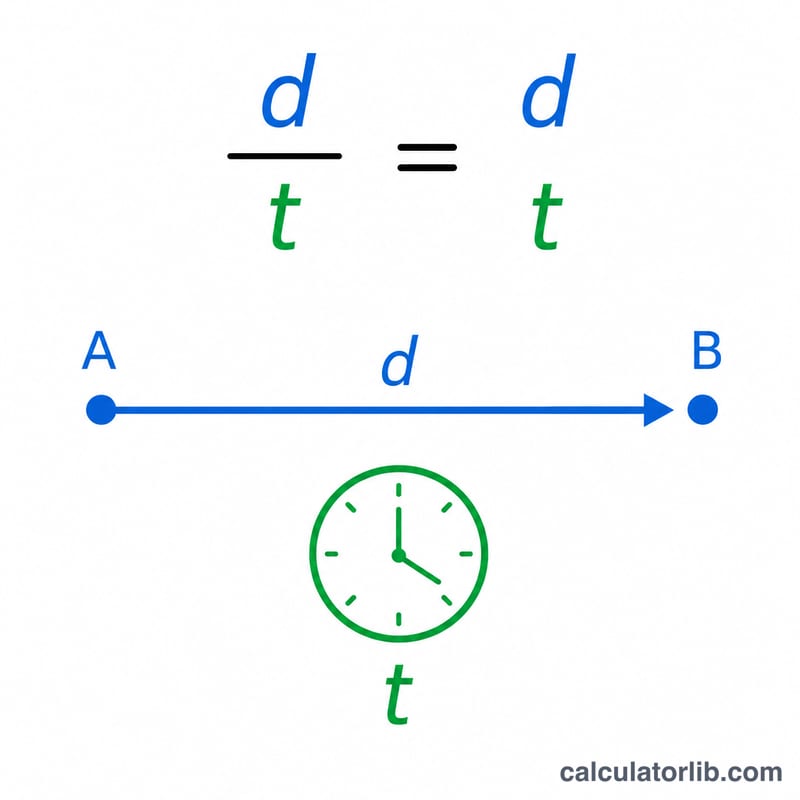
Worked example
Suppose you drive 150 km in 2 hours and 30 minutes. Total time = 2 + 30/60 = 2.5 hours. Average speed = 150 ÷ 2.5 = 60 km/h, which is about 37.28 mph and 16.67 m/s.
$$\text{Average speed} = \frac{150}{2.5} = 60 \text{ km/h}$$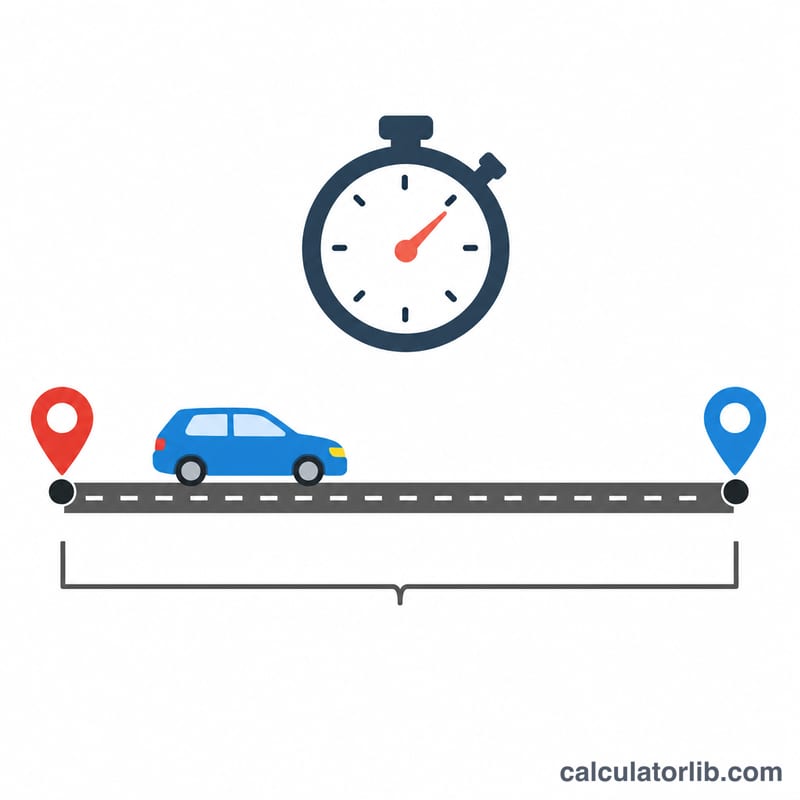
Speed Unit Conversions
The average speed calculator reports results in three common units: kilometers per hour (km/h), miles per hour (mph), and meters per second (m/s). The exact conversion factors below let you move between them, along with the distance-unit factors used internally to normalize your input.
| From | = km/h | = mph | = m/s |
|---|---|---|---|
| 1 km/h | 1 | 0.621371 | 0.277778 |
| 1 mph | 1.609344 | 1 | 0.44704 |
| 1 m/s | 3.6 | 2.236936 | 1 |
The key relationships are exact by definition: \(1\ \text{mph} = 1.609344\ \text{km/h}\) and \(1\ \text{m/s} = 3.6\ \text{km/h}\). To convert km/h to m/s, divide by 3.6 (since 1 km = 1000 m and 1 h = 3600 s, the factor is \(1000/3600 = 0.2778\)).
Distance unit factors
| Distance unit | Equivalent |
|---|---|
| 1 mile | 1.609344 km |
| 1 km | 1000 m = 0.621371 mi |
| 1000 m | 1 km |
| 1 m | 0.001 km |
For example, a measured 5-mile route equals \(5 \times 1.609344 = 8.04672\) km, which the calculator divides by your total time to produce a speed in all three units at once.
FAQ
Is average speed the same as instantaneous speed? No. Average speed covers the whole trip; instantaneous speed is what a speedometer reads at a single moment.
What if my time includes only minutes? Leave hours and seconds at 0 and just enter minutes — the calculator handles any combination.
Why are three units shown? So the same result is useful whether you think in metric (km/h, m/s) or imperial (mph) terms.