
What Is Average Speed?
Average speed is the total distance an object travels divided by the total time it takes — not simply the average of the individual speeds. It tells you how fast you went overall, accounting for slowdowns, stops, and changes in pace. This calculator works with any consistent units: if you enter distance in miles and time in hours, you get miles per hour; kilometers and hours give km/h.
How to Use This Calculator
Enter the total distance covered and the total time taken (in hours). The calculator divides distance by time to return your average speed. If your time is in minutes, divide by 60 first (e.g. 90 minutes = 1.5 hours).
The Formula Explained
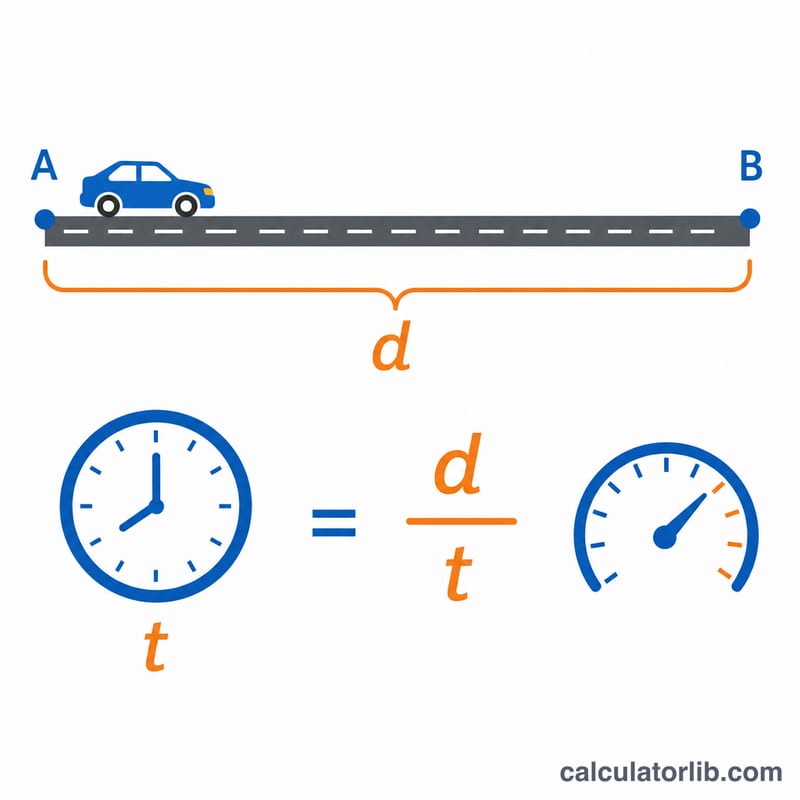
The core equation is $$\text{Average Speed} = \dfrac{\text{Total Distance}}{\text{Total Time}}$$ This is sometimes called a harmonic-style average when speeds vary across equal-distance segments, because spending more time at slower speeds pulls the overall average down. The key insight: always sum the actual distance and actual time, then divide — never just average the speed readings.
Worked Example
Suppose you drive 150 miles and it takes 2.5 hours including a short stop. Average speed:
$$\text{Average Speed} = \frac{150}{2.5} = \textbf{60 mph}$$Even if part of the trip was at 80 mph and part at 40 mph, the true average that reflects your journey is 60 mph.
Speed & Time Unit Conversions
The average speed formula, \(\text{Average Speed} = \frac{\text{Total Distance}}{\text{Total Time}}\), works in any consistent units. Because the form expects time in hours, you often need to convert minutes or seconds first. The tables below cover the most common conversions.
Speed conversions
| From | To km/h | To mph | To m/s |
|---|---|---|---|
| 1 mph | 1.609 km/h | 1 mph | 0.447 m/s |
| 1 km/h | 1 km/h | 0.621 mph | 0.278 m/s |
| 1 m/s | 3.600 km/h | 2.237 mph | 1 m/s |
| 1 knot | 1.852 km/h | 1.151 mph | 0.514 m/s |
Time-to-hours conversions
| Minutes | Hours | Seconds | Hours |
|---|---|---|---|
| 15 min | 0.25 h | 900 s | 0.25 h |
| 30 min | 0.5 h | 1,800 s | 0.5 h |
| 45 min | 0.75 h | 2,700 s | 0.75 h |
| 60 min | 1 h | 3,600 s | 1 h |
| 90 min | 1.5 h | 5,400 s | 1.5 h |
To convert: hours = minutes ÷ 60, or hours = seconds ÷ 3,600. For example, \(90 \div 60 = 1.5\) h.
More Worked Examples
Example 1 — Equal distance, two different speeds (harmonic mean)
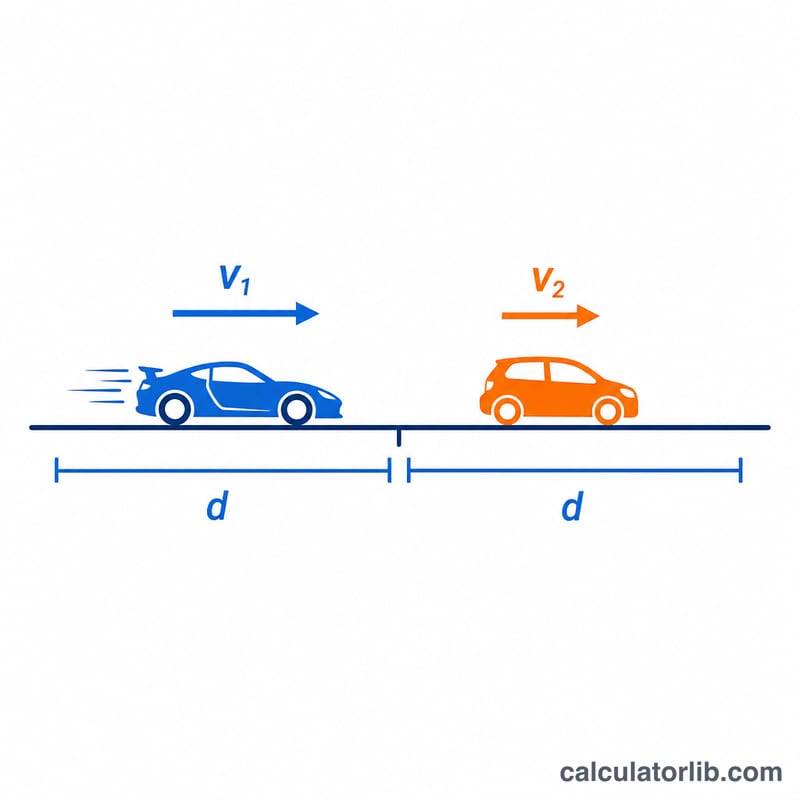
A driver covers 60 miles at 30 mph, then another 60 miles at 60 mph. A common mistake is to average the two speeds as \((30 + 60)/2 = 45\) mph — but average speed must use total distance over total time.
- Time for first leg: \(60 \div 30 = 2\) hours.
- Time for second leg: \(60 \div 60 = 1\) hour.
- Total distance: \(60 + 60 = 120\) miles.
- Total time: \(2 + 1 = 3\) hours.
- Average speed: \(\dfrac{120}{3} = \) 40 mph.
This 40 mph result is the harmonic mean of the two equal-distance leg speeds — always lower than the simple arithmetic mean because more time is spent at the slower speed.
Example 2 — Converting minutes to hours first
A cyclist rides 15 km in 45 minutes. Since the calculator needs time in hours, convert first: \(45 \div 60 = 0.75\) h.
- Total distance: 15 km.
- Total time: \(45 \div 60 = 0.75\) hours.
- Average speed: \(\dfrac{15}{0.75} = \) 20 km/h.
If you'd rather enter the time directly as hours, minutes and seconds, the Distance & Time to Speed Calculator handles the conversion for you using the same \(\text{distance} \div \text{time}\) relationship.
FAQ
Is average speed the same as average of speeds? No. If you drive one hour at 30 mph and one hour at 60 mph, the average speed is 45 mph — but only because the times are equal. For equal distances the result differs (it's the harmonic mean).
What units does it use? Any, as long as you're consistent. Distance unit per hour comes out of the calculation.
How do I handle minutes? Convert minutes to hours by dividing by 60 before entering the time.