
What is the Speed Converter?
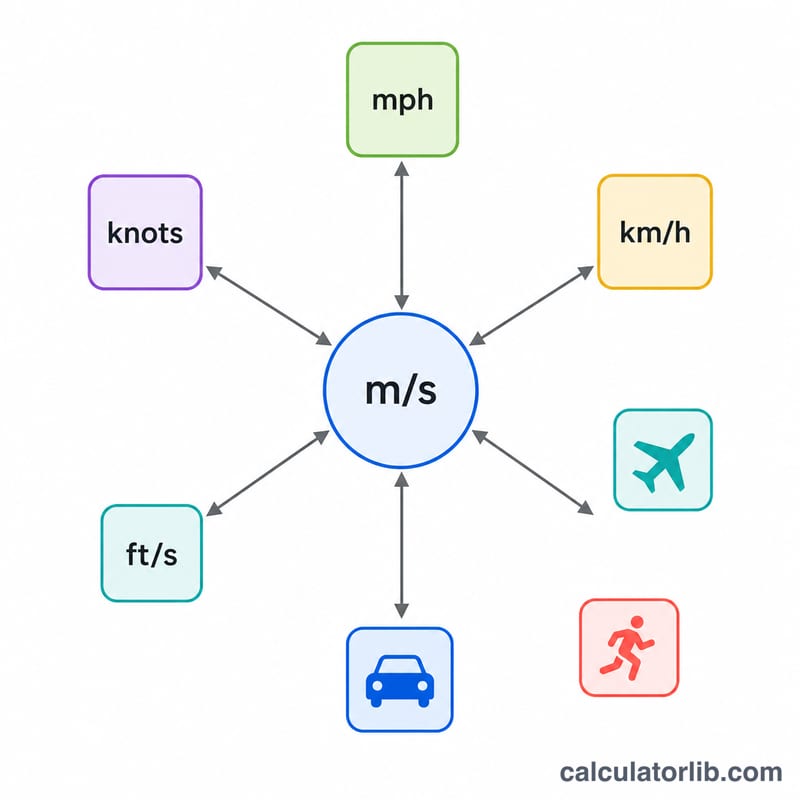
The Speed Converter Calculator translates a speed from one unit into all the common alternatives — miles per hour (mph), kilometers per hour (km/h), meters per second (m/s), knots, and feet per second (ft/s). It is a universal physics/units tool that works the same everywhere in the world.
How to use it
Enter the numeric speed value, choose the unit it is currently expressed in, and the calculator shows the equivalent value in every other unit at once. Meters per second is displayed as the headline figure because it is the SI base unit used internally for the conversion.
The formula explained
All conversions route through a single base unit: meters per second. First the input is divided by its own factor to obtain m/s, then multiplied by each target factor. The factors relative to m/s are: mph = 2.23694, km/h = 3.6, knots = 1.94384, and ft/s = 3.28084. Because every unit shares the same base, the conversions are consistent and reversible.
$$v_{m/s} = \frac{\text{Speed (mph)}}{2.23694}$$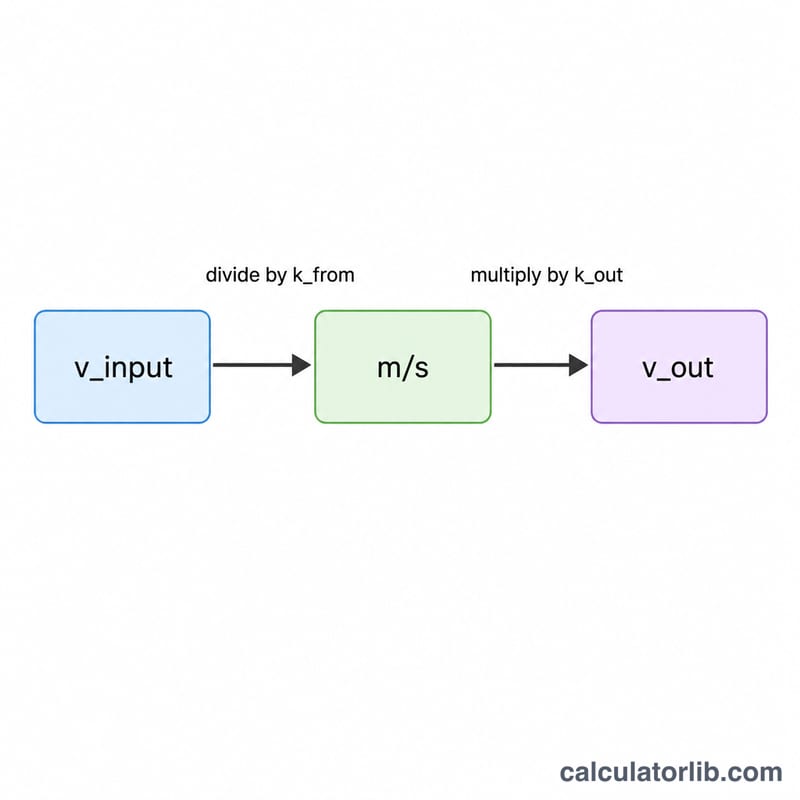
Worked example
Suppose you have a speed of 100 mph. Dividing by the mph factor gives \(100 \div 2.23694 \approx 44.704\) m/s. From there: \(44.704 \times 3.6 \approx 160.934\) km/h, \(44.704 \times 1.94384 \approx 86.898\) knots, and \(44.704 \times 3.28084 \approx 146.667\) ft/s. So 100 mph is roughly 160.9 km/h.
FAQ
What is a knot? A knot is one nautical mile per hour, used in maritime and aviation contexts. One knot equals about 1.852 km/h.
Why use m/s as the base? Meters per second is the SI (metric) base unit for speed, which makes the math clean and avoids compounding rounding errors between units.
Are these conversions exact? They use standard, high-precision factors. Results are accurate to well within everyday and scientific needs.