
What Is Ground Speed?
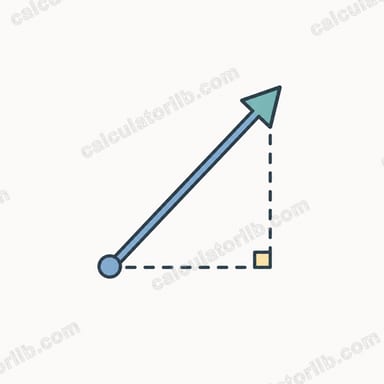
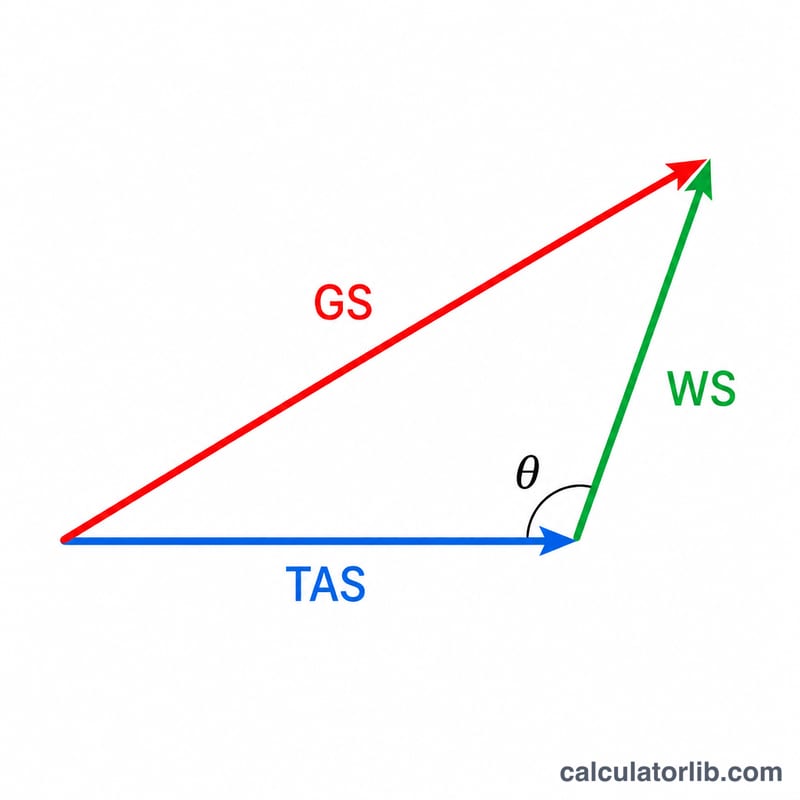
Ground speed (GS) is the actual speed of an aircraft relative to the ground, as opposed to true airspeed (TAS), which is the speed relative to the surrounding air mass. Because the air mass itself moves with the wind, a tailwind pushes you faster over the ground while a headwind slows you down. This Ground Speed Calculator combines your TAS, the wind speed (WS), and the wind angle (\(\theta\)) into a single resultant velocity using the velocity triangle.
How to Use the Calculator
Enter your true airspeed in knots, the wind speed in knots, and the wind angle \(\theta\) in degrees. The angle is measured between the aircraft's heading and the direction the wind is blowing toward. Use \(\theta = 0°\) for a pure tailwind, \(\theta = 180°\) for a pure headwind, and 90° for a direct crosswind. Click calculate to get your ground speed plus how much faster or slower you travel compared with your airspeed.
The Formula Explained
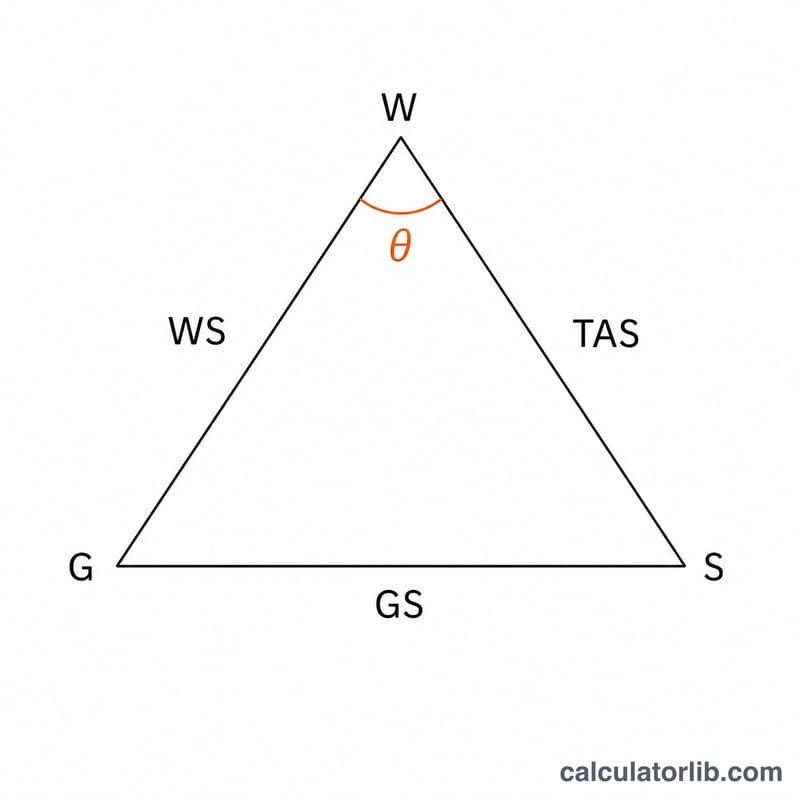
The wind triangle is solved with the law of cosines:
$$\text{GS} = \sqrt{\text{TAS}^{2} + \text{WS}^{2} - 2\,\text{TAS}\cdot\text{WS}\cdot\cos\!\left(\theta\right)}$$This treats the airspeed vector and wind vector as two sides of a triangle and finds the magnitude of their sum. When \(\theta = 0°\), \(\cos\theta = 1\) and the formula reduces to \(\text{GS} = |\text{TAS} - \text{WS}|\)... actually adding for tailwind; when \(\theta = 180°\), \(\cos\theta = -1\) giving \(\text{GS} = \text{TAS} + \text{WS}\). The cosine term smoothly handles every crosswind case in between.
Worked Example
Suppose TAS = 120 kt, wind = 20 kt, and \(\theta = 90°\) (direct crosswind). Then $$\text{GS} = \sqrt{120^{2} + 20^{2} - 2\cdot120\cdot20\cdot\cos 90°} = \sqrt{14400 + 400 - 0} = \sqrt{14800} \approx 121.66 \text{ kt}.$$ The crosswind barely changes your speed but pushes you sideways, requiring a wind correction angle.
FAQ
Is this the same as the E6B wind triangle? Yes — it solves the same velocity triangle the E6B flight computer uses to find ground speed magnitude.
What units should I use? Any consistent units work; results are returned in the same units you enter (typically knots).
Does this give wind correction angle? No, this tool returns ground speed magnitude only. The drift/correction angle requires a separate trigonometric step.