
What this calculator does
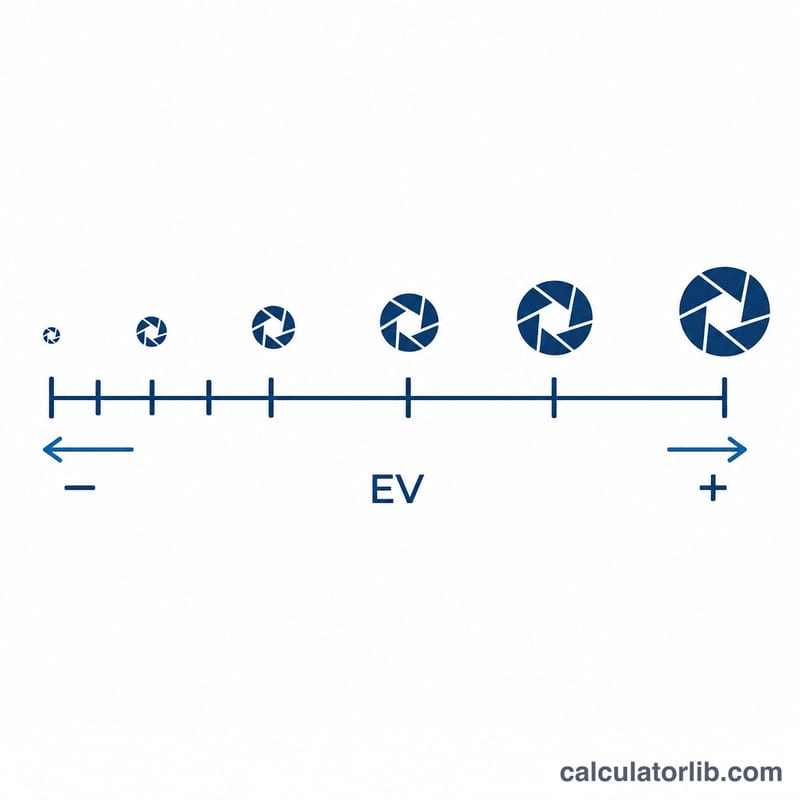
The Shutter Speed Calculator works out a new shutter speed when you change exposure value (EV), aperture, or ISO. It uses the photographic "stop" system, where every stop either doubles or halves the amount of light. This makes it easy to keep a consistent exposure when you switch settings, or to deliberately make an image brighter or darker.
How to use it
Enter your current shutter speed in seconds (for example, \(1/250 = 0.004\ \text{s}\)). Then enter how many stops you are changing: positive Exposure Change makes the final image brighter (a longer shutter), while opening the Aperture or raising ISO lets in more light, so the shutter must speed up to compensate. The tool returns the new shutter time in seconds plus its familiar 1/x fraction.
The formula explained
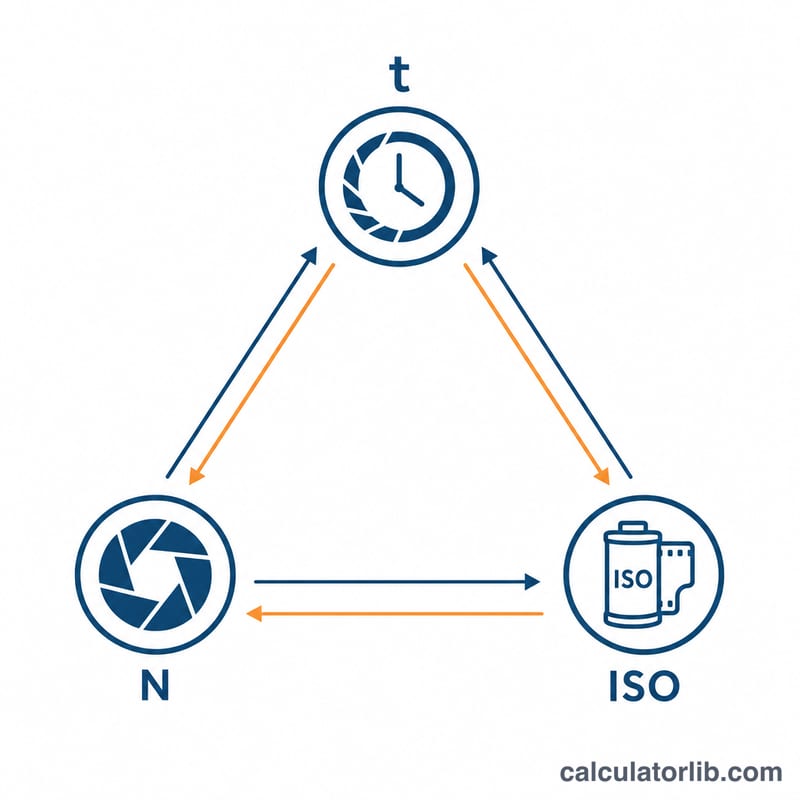
The core relationship is $$t_{\text{new}} = t_{\text{old}} \cdot 2^{\,(\Delta\text{EV} - \Delta\text{Aperture} - \Delta\text{ISO})}$$ Because each stop is a factor of two, adding one stop of brightness doubles the time, and removing one halves it. Aperture and ISO subtract because they add light independently, which means the shutter must shorten to hold the same total exposure.
Worked example
Start at \(1/250\ \text{s}\) (\(0.004\ \text{s}\)) and open the aperture by 2 stops with no other change. Net stops on the shutter = \(0 - 2 - 0 = -2\). So $$t_{\text{new}} = 0.004 \cdot 2^{-2} = 0.004 \cdot 0.25 = 0.001\ \text{s}$$ which is \(1/1000\ \text{s}\) — a much faster shutter to balance the brighter lens.
FAQ
Why does opening the aperture speed up the shutter? Both control light. If the lens lets in twice as much light, the sensor needs half the time to receive the same exposure.
What is a "stop"? A stop is a doubling or halving of light. One stop brighter = twice the exposure.
How do I enter \(1/100\ \text{s}\)? Type 0.01, since \(1 \div 100 = 0.01\) seconds.