
What is the Orbital Speed Calculator?
This tool computes the speed a satellite must travel to maintain a stable circular orbit around a central body, along with the time it takes to complete one full revolution (the orbital period). It applies anywhere in the universe — it is a pure physics tool based on Newton law of universal gravitation, valid for planets, moons, stars, and artificial satellites.
How to use it
Enter the mass \(M\) of the central body in kilograms (Earth = \(5.972\times10^{24}\,\text{kg}\)) and the orbital radius \(r\) in metres, measured from the centre of the central body to the satellite. The calculator returns the orbital speed in m/s and km/s plus the orbital period in seconds.
The formula explained
For a circular orbit, gravity supplies exactly the centripetal force, giving:
$$v = \sqrt{\frac{GM}{r}}$$where \(G = 6.674\times10^{-11}\,\text{m}^3\text{kg}^{-1}\text{s}^{-2}\) is the gravitational constant, \(M\) is the central mass, and \(r\) is the orbital radius. The period follows from the circumference divided by the speed:
$$T = \frac{2\pi r}{v} = 2\pi\sqrt{\frac{r^3}{GM}}$$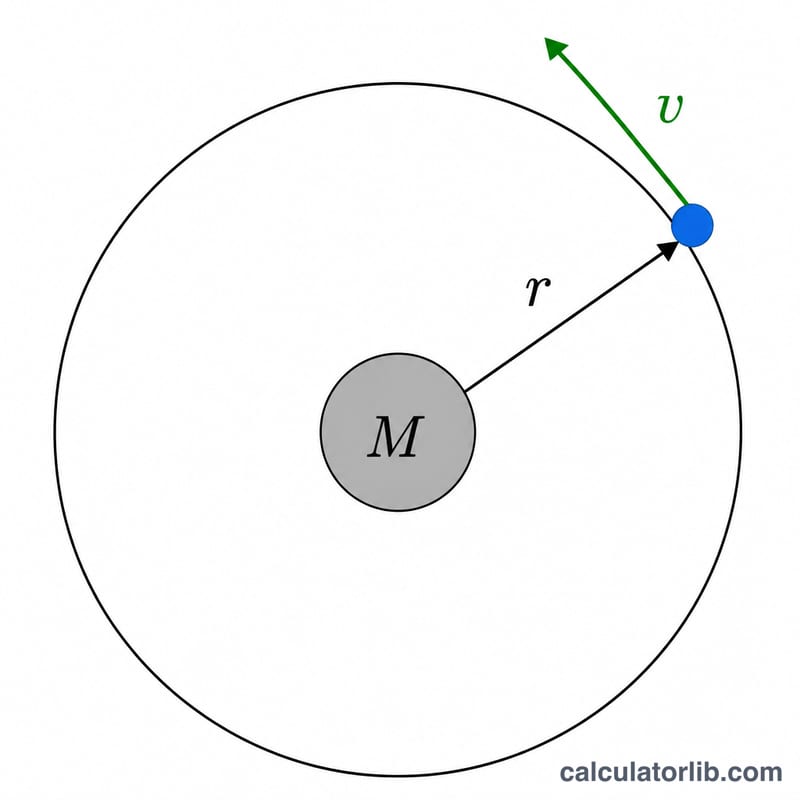
Worked example
For the International Space Station at \(r = 6.771\times10^{6}\,\text{m}\) around Earth:
$$v = \sqrt{\frac{(6.674\times10^{-11})(5.972\times10^{24})}{6.771\times10^{6}}} \approx 7672\,\text{m/s}$$$$T = \frac{2\pi (6.771\times10^{6})}{7672} \approx 5545\,\text{s} \approx 92\ \text{min}$$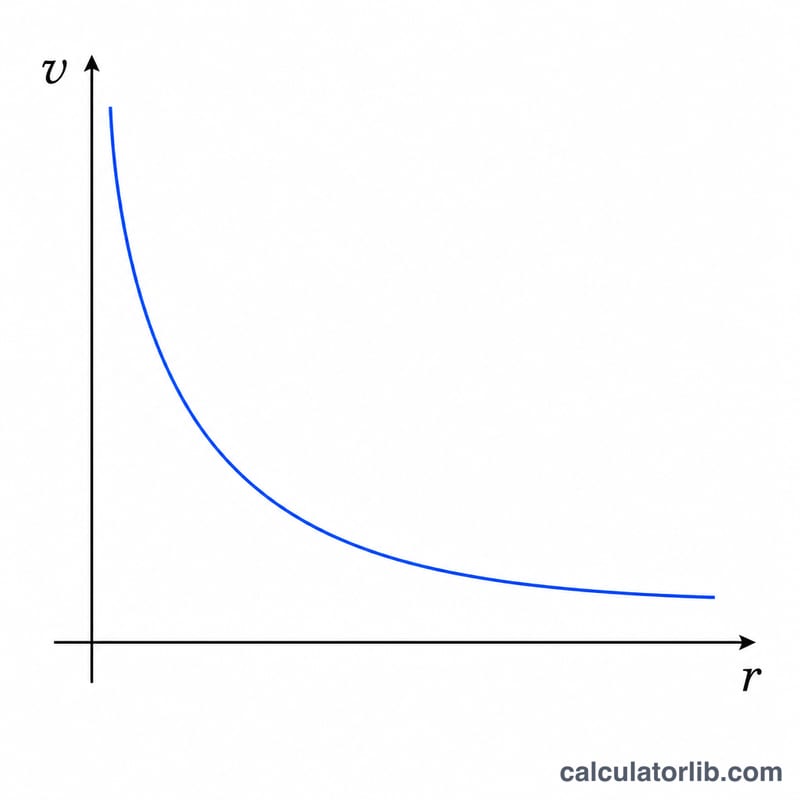
FAQ
Does altitude or radius go in? Use the radius from the centre of the planet, i.e. planet radius plus altitude.
Why is a lower orbit faster? Because \(v\) scales with \(1/\sqrt{r}\); closer orbits require higher speed to balance stronger gravity.
Is this valid for elliptical orbits? The result is exact for circular orbits and gives the average behaviour for near-circular ones; highly elliptical orbits need the vis-viva equation.