
What the Cake Portion Calculator Does
This tool estimates how many servings you can cut from a cake based on its shape, dimensions, number of layers, and serving style. It is handy for planning birthdays, parties, and weddings so you bake or order the right size without leftovers or shortages.
How to Use It
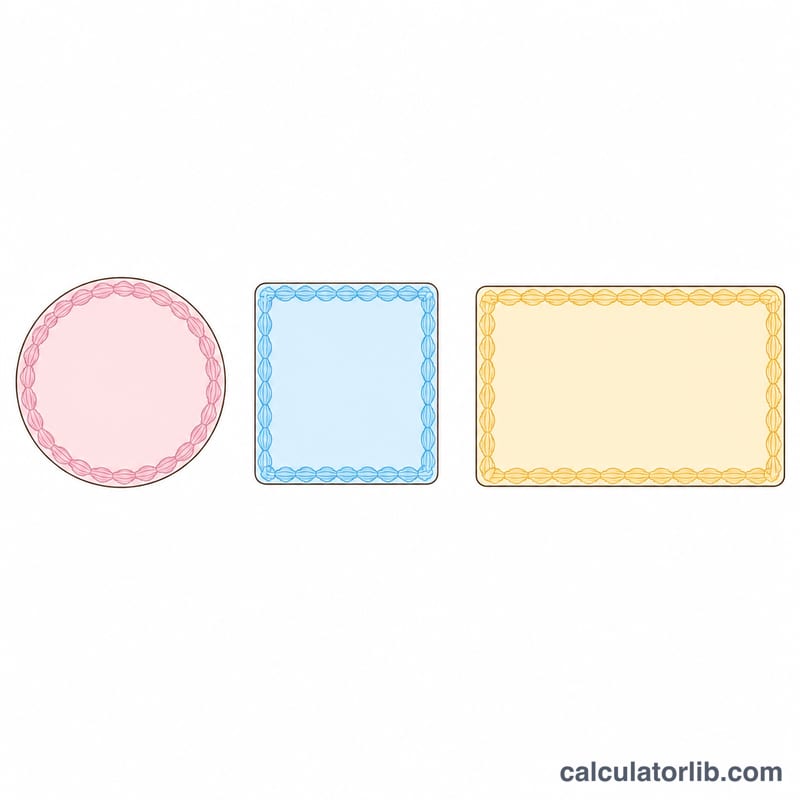
Choose your cake shape (round, square, or rectangle), enter the diameter or width in inches, add the length for rectangular cakes, pick a serving style, and enter how many layers tall the cake is. The calculator returns an estimated serving count plus the top surface area used.
The Formula
The estimate is based on the cake top area divided by the footprint of each slice, scaled by the number of stacked layers:
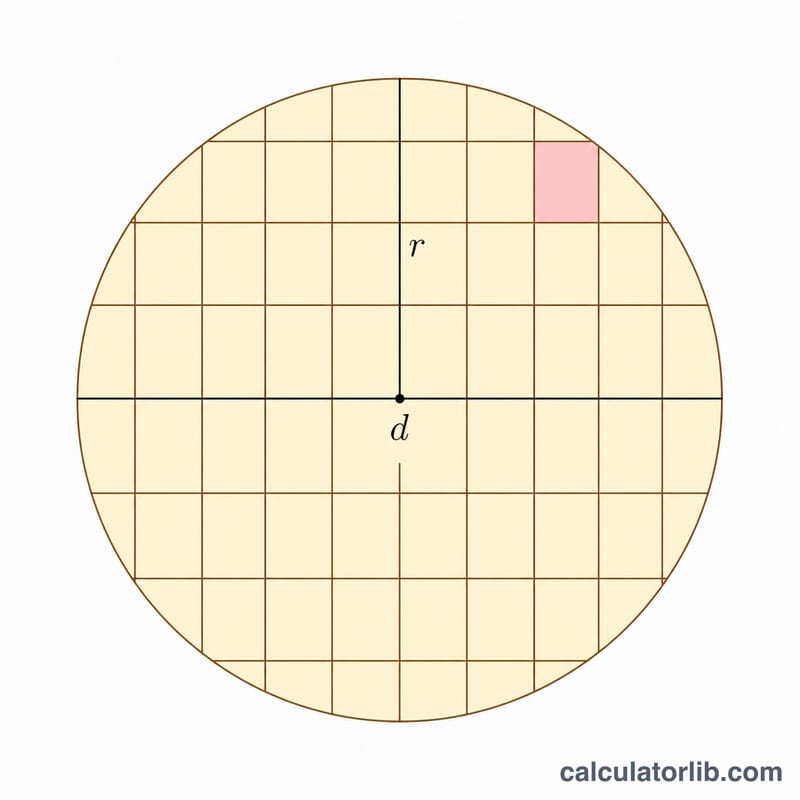
$$\text{Servings} = \frac{A}{a} \times L$$where \(A\) = top surface area (in²), \(a\) = area per serving (in²), and \(L\) = number of layers. For a round cake \(A = \pi (d/2)^2\). A party portion uses \(a = 4\,\text{in}^2\) (a 2×2 in slice) and a wedding portion uses \(a = 2\,\text{in}^2\) (a 1×2 in finger slice).
Worked Example
A 10-inch round, 2-layer cake served party style:
$$A = \pi \left(\tfrac{10}{2}\right)^{2} = 78.54\,\text{in}^2$$ $$\text{Servings} = \frac{78.54}{4} \times 2 = 39.27 \to 39$$So you can expect about 39 generous party portions.
FAQ
Why do wedding cakes serve more people? Wedding slices are cut much smaller (finger portions), so the same cake yields roughly double the servings of party cuts.
Does layer height matter? Yes — a taller, multi-layer cake gives more cake per slice footprint, so servings scale with the number of layers.
Are these exact counts? No. They are practical estimates; actual yield depends on how generously you cut and trim.