
What is the Tree Volume Calculator?
This tool estimates the merchantable stem volume of a standing tree from three easy measurements: its diameter at breast height (DBH), its total height, and a form factor that accounts for stem taper. It is used by foresters, arborists, woodlot owners and students to gauge timber yield, carbon stock and growth.
How to use it
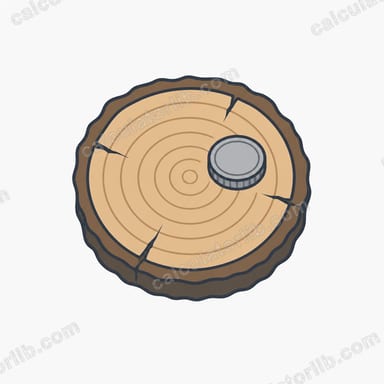
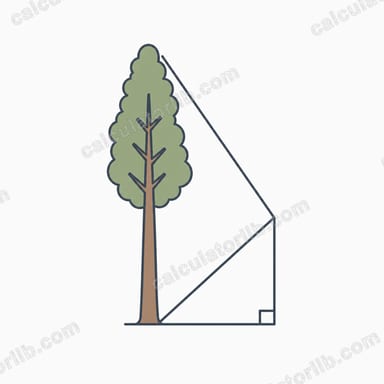
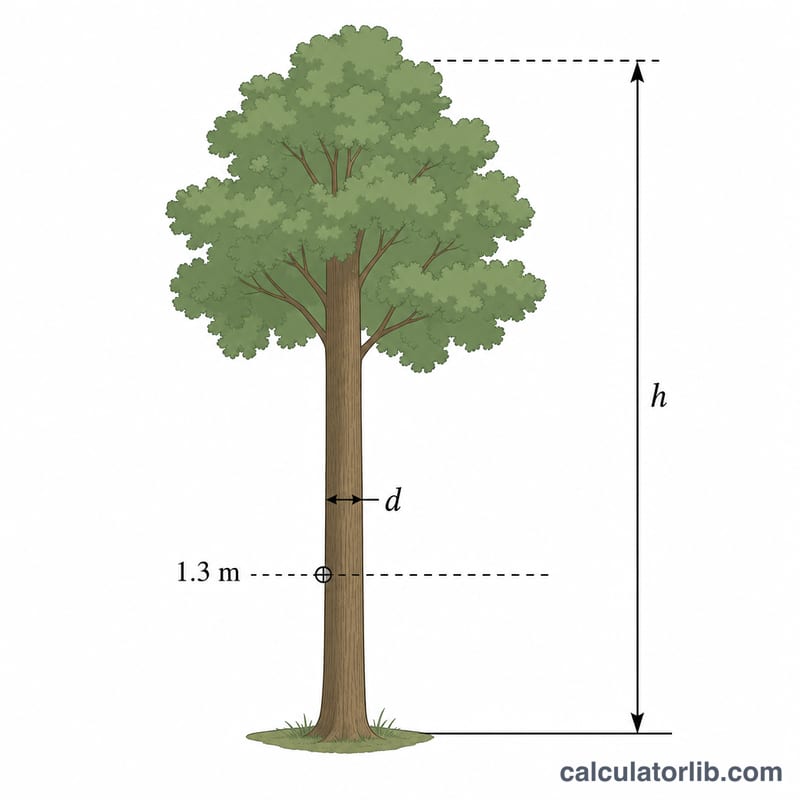
Measure DBH with a diameter tape at 1.3 m above ground and enter it in centimetres. Enter total tree height in metres (use a clinometer or hypsometer). Then enter a form factor: roughly \(0.5\) for many broadleaves, \(0.4\)–\(0.45\) for tapering conifers. The calculator converts DBH to metres, computes basal area and multiplies by height and the form factor.
The formula explained
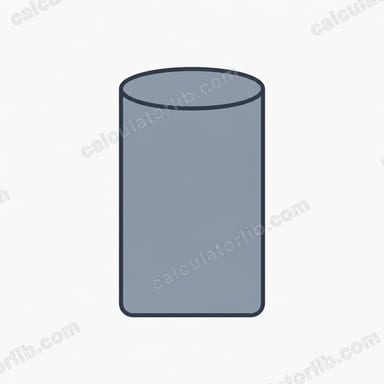
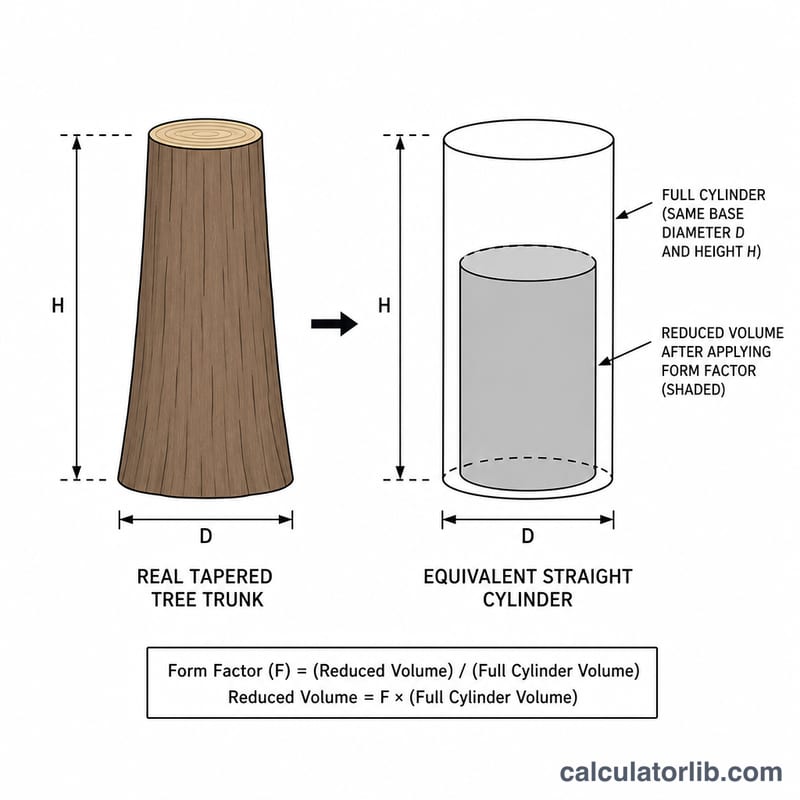
The stem is modelled as a tapering cylinder. The display volume is:
$$V = \frac{\pi D^2}{4} \times H \times f$$
where \(D\) = stem diameter in metres, \(H\) = height in metres, and \(f\) = form factor (dimensionless). The term \(\frac{\pi D^2}{4}\) is the basal area \(A\). A perfect cylinder has \(f = 1\); real stems taper, so \(f < 1\).
Worked example
For DBH = 40 cm, height = 20 m, form factor = 0.5:
$$D = 0.40\,\text{m},\quad A = \frac{\pi (0.40)^2}{4} = 0.1257\,\text{m}^2$$
$$V = 0.1257 \times 20 \times 0.5 = 1.257\,\text{m}^3$$
FAQ
What is a form factor? It is the ratio of actual stem volume to the volume of a cylinder with the same DBH and height, correcting for taper.
Does this include branches? No — it estimates main stem (bole) volume only, not crown or branch wood.
How accurate is it? It is a quick field estimate. For precise inventory use species-specific volume tables or taper equations.