
What is the Tree Value Calculator?
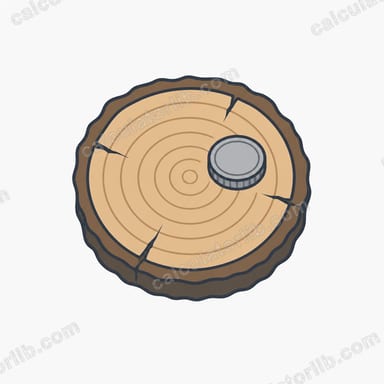
This calculator estimates how much usable lumber a tree or log contains and what that volume is worth. It uses the Doyle log rule, one of the most widely used scaling formulas in North American forestry for estimating board-foot volume from a log's small-end diameter and length. A board foot is a unit of lumber equal to 144 cubic inches (12 in \(\times\) 12 in \(\times\) 1 in).
How to use it
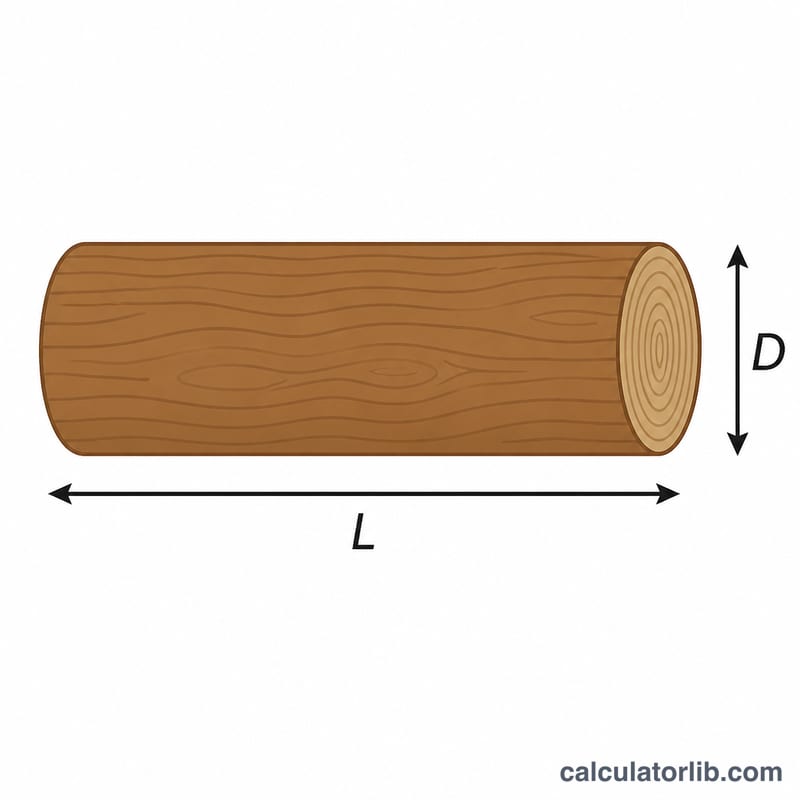
Enter three values: the diameter measured inside the bark at the small end of the log (in inches), the merchantable log length (in feet), and the current price you can get per board foot (in dollars). The calculator returns the estimated board-foot volume and the total dollar value.
The formula explained
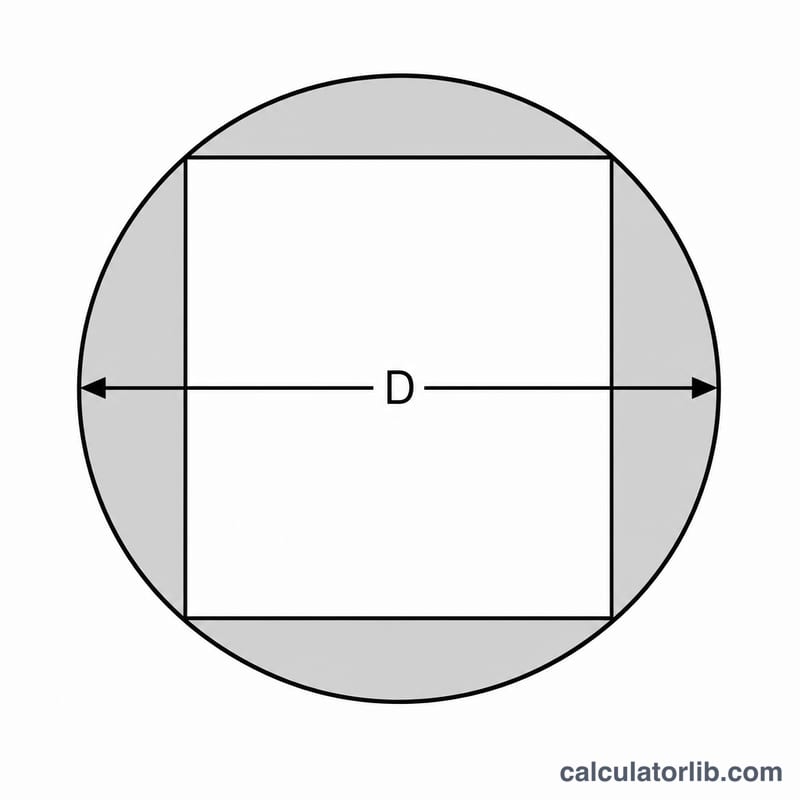
The Doyle rule is: $$\text{Board feet} = \left(\frac{D - 4}{4}\right)^{2} \times L$$ where \(D\) is the small-end diameter in inches and \(L\) is the log length in feet. The "− 4" accounts for slab and edging waste, and the squaring reflects how cross-sectional area scales with diameter. Multiply the resulting board feet by your price per board foot to get the value.
Worked example
For a log with a 16-inch small-end diameter and 16 feet of length: $$\left(\frac{16 - 4}{4}\right)^{2} = \left(\frac{12}{4}\right)^{2} = 3^{2} = 9$$ multiply by 16 = 144 board feet. At $0.50 per board foot, the value is $$144 \times \$0.50 = \$72.00$$
FAQ
Why does the Doyle rule undervalue small logs? The fixed 4-inch deduction is a large fraction of a small log's diameter, so it overstates waste on logs under about 16 inches. Other rules (Scribner, International 1/4") may estimate higher for small logs.
Which diameter should I measure? Always use the diameter inside the bark at the smaller end of the log.
Is this a precise appraisal? No. It is an estimate. Actual value depends on species, grade, defects, taper, and local mill pricing. Use it for planning, not for binding sales.