
What Is the Log Board Foot Calculator?
This tool estimates how many board feet of usable lumber can be sawn from a log. A board foot is a unit of lumber volume equal to \(144\) cubic inches — a piece \(12\,\text{in}\times12\,\text{in}\times1\,\text{in}\). Because a round log cannot be turned entirely into rectangular boards, foresters and sawyers use standardized log rules to predict yield. This calculator supports the three most common rules used in North America: Doyle, Scribner, and the International 1/4-inch rule.
How to Use It
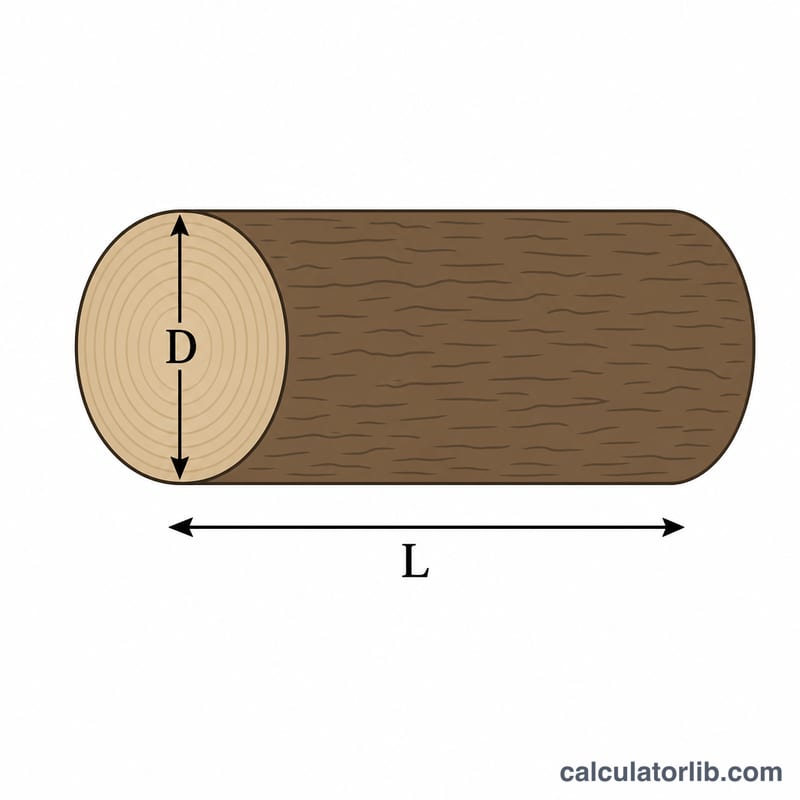
Measure the diameter inside the bark at the small end of the log in inches, and the log length in feet. Choose a log rule and read the estimated board-foot volume. Doyle tends to underestimate small logs; the International 1/4-inch rule is considered the most accurate; Scribner falls in between and is widely used commercially.
The Formula
The Doyle rule is the simplest and most popular:
$$\text{BF} = \frac{(D-4)^2 \times L}{16}$$where \(D\) = small-end diameter in inches and \(L\) = length in feet. The \(-4\) accounts for slab and edging waste.
Worked Example
For a log \(16\) inches in diameter and \(16\) feet long using Doyle:
$$\text{BF} = \frac{(16-4)^2 \times 16}{16} = \frac{144 \times 16}{16} = 144\,\text{BF}$$So this log yields roughly 144 board feet of lumber.
FAQ
Which rule should I use? Many state markets specify a rule; if none is given, the International 1/4-inch rule is the most scientifically accurate.
Why does Doyle give lower numbers for small logs? Its fixed \(-4\) waste term overpenalizes small-diameter logs, so it underestimates their yield.
Is actual sawn lumber the same? No — these are estimates. Real yield depends on sawyer skill, kerf, defects, and taper.