
What Is a Board-on-Board Fence Calculator?
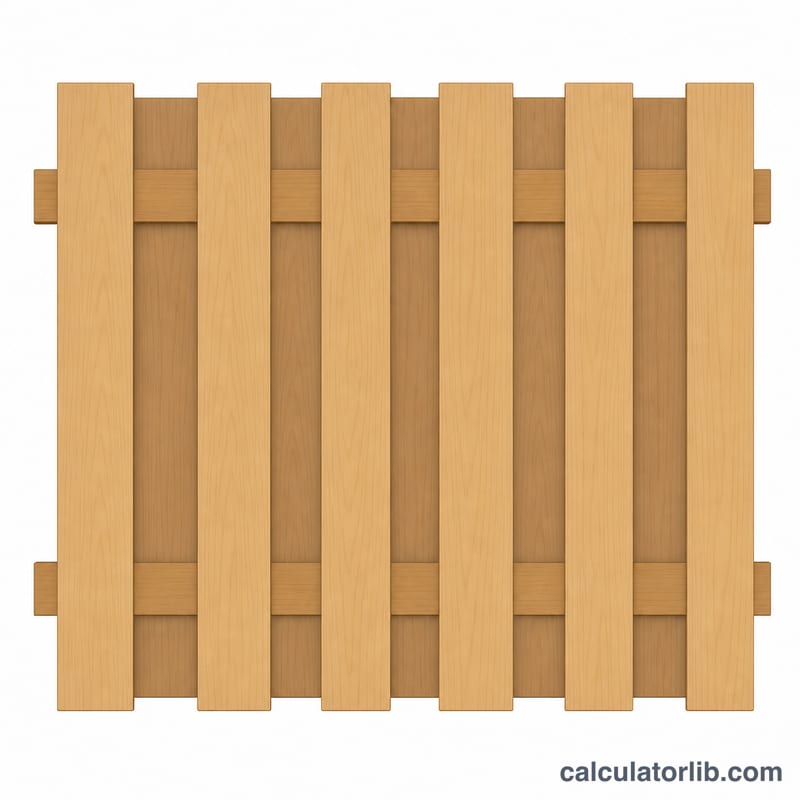
A board-on-board fence (also called a shadowbox or overlapping picket fence) uses pickets that overlap each other so there are no gaps when viewed straight on. Because each board partly covers its neighbor, you need more boards than a simple side-by-side fence. This calculator estimates how many pickets you will need based on your total fence length, the width of each board, and how much each board overlaps the next.
How to Use It
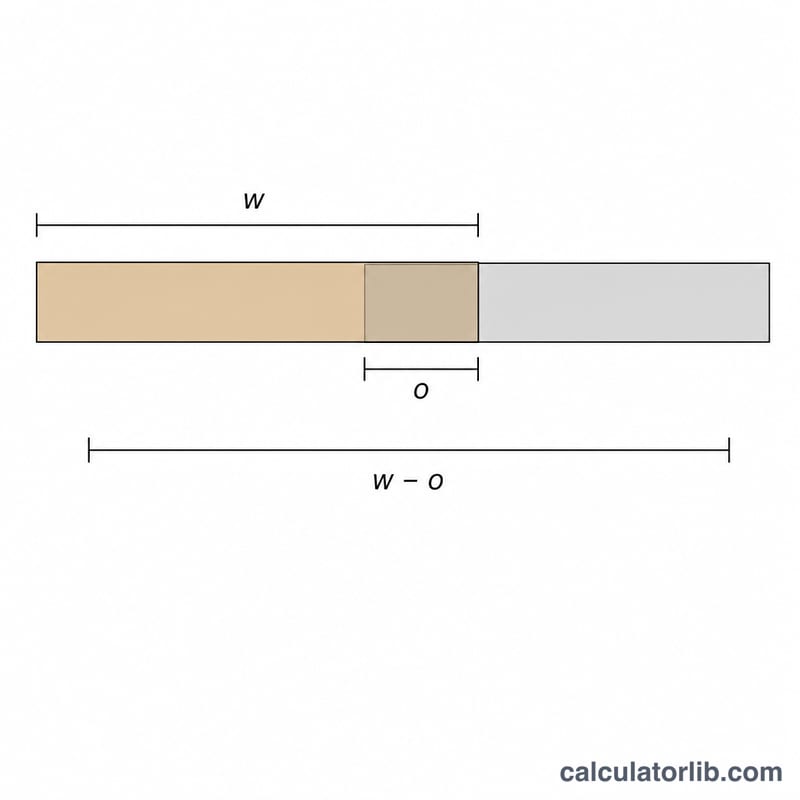
Enter the total length of your fence in feet, the width of a single picket in inches, and the overlap in inches between adjacent boards. The calculator converts the fence length to inches, subtracts the overlap from the board width to find each board's effective coverage, and divides to find the number of boards, rounding up so you never come up short.
The Formula Explained
The core equation is:
$$\text{boards} = \left\lceil \frac{\text{fence length}}{\text{board width} - \text{overlap}} \right\rceil$$The effective coverage per board is the visible width once you subtract the overlapped portion. Dividing the fence length by this effective width gives the raw count, and rounding up (ceil) ensures full coverage. All measurements are converted to consistent units (inches) internally.
Worked Example
Suppose you have a 100 ft fence (1,200 in), 5.5-inch boards, and a 1-inch overlap. Effective coverage is \(5.5 - 1 = 4.5\) inches.
$$\text{Boards} = \left\lceil \frac{1{,}200}{4.5} \right\rceil = \lceil 266.67 \rceil = \textbf{267 boards}$$Standard Picket Widths and Overlaps
Board-on-board (also called shadowbox or overlapping picket) fences use dimensional lumber whose actual dressed width is smaller than the nominal size used to order it. The picket-count formula relies on the actual width, not the nominal label, so always measure or confirm the dressed dimension before calculating.
| Nominal Size | Actual Width | Common Use |
|---|---|---|
| 1×4 | 3.5 in | Narrow, traditional pickets |
| 1×6 | 5.5 in | Most common privacy picket |
| 1×8 | 7.25 in | Wide modern pickets |
| 1×10 | 9.25 in | Extra-wide pickets / fewer boards |
| 1×12 | 11.25 in | Solid-look panels, backer boards |
The overlap is how much each front board covers the adjacent board (or each side overlaps the gap-spaced rear boards). Typical overlaps:
| Overlap | Effect |
|---|---|
| 1 in | Minimum overlap; uses fewer boards but offers less privacy as wood shrinks |
| 1.5 in | Balanced privacy and material use |
| 2 in | Maximum privacy; allows for shrinkage and warp, uses more boards |
The effective coverage per board equals the board width minus the overlap. For a 5.5 in board at 1 in overlap, each board covers \(5.5 - 1 = 4.5\) inches of fence run.
FAQ
Does overlap of zero work? Yes — with zero overlap the boards sit edge to edge, which is a standard side-by-side picket fence.
Should I add extra boards? It's wise to buy 5–10% extra to account for cuts, warped boards, and waste.
What if overlap is larger than board width? That isn't physically possible; the calculator only returns a result when board width exceeds overlap.