
What Is a Board Foot?
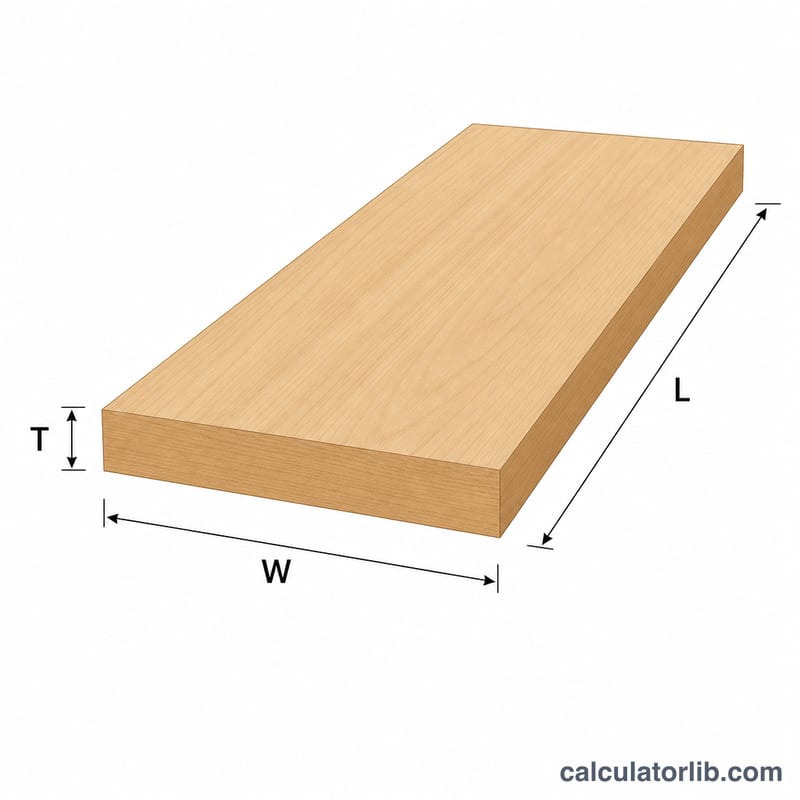
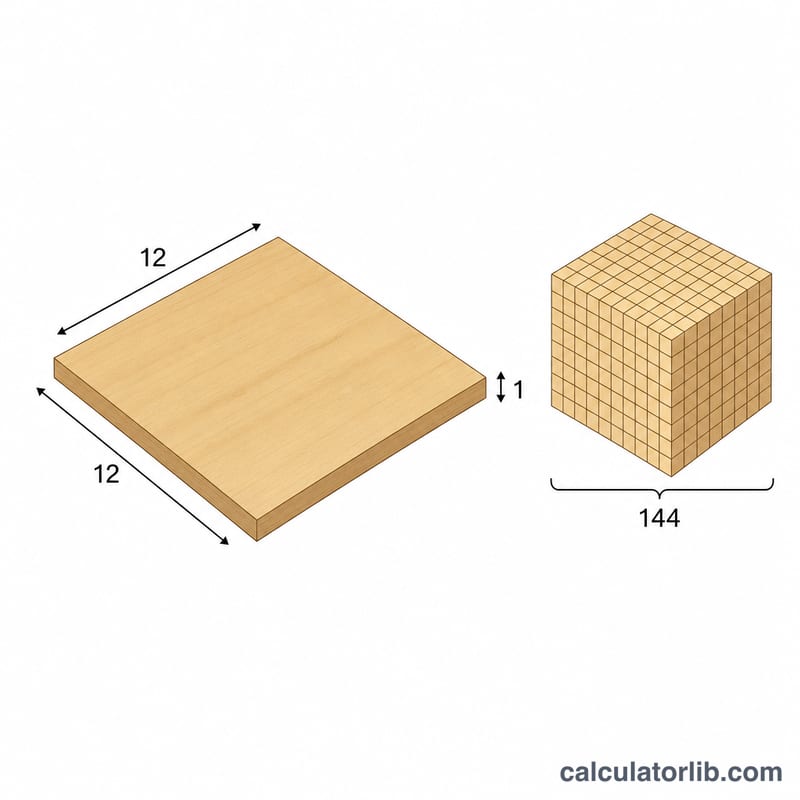
A board foot (BF) is the standard unit used to measure the volume of hardwood and rough lumber in the United States and Canada. One board foot equals a piece of wood measuring 12 inches × 12 inches × 1 inch — that is, 144 cubic inches of wood. Unlike a linear foot, a board foot accounts for thickness and width as well as length, making it the fairest way to price lumber that comes in many sizes.
How to Use This Calculator
Enter the thickness, width, and length of a single board — all in inches. If your length is in feet, multiply it by 12 first (an 8-foot board is 96 inches). Enter how many identical boards you have, and optionally a price per board foot to estimate total cost. The calculator returns the board feet per board, the total board feet, and the estimated price.
The Formula Explained
The core formula is $$\text{Board feet} = \frac{\text{Thickness} \times \text{Width} \times \text{Length}}{144}$$, with every dimension in inches. The 144 divisor converts cubic inches into board feet (\(12 \times 12 \times 1 = 144\)). To get the total, multiply by the number of boards. Cost is simply total board feet × price per board foot.
Worked Example
Suppose you buy 10 oak boards, each 1 inch thick, 6 inches wide, and 96 inches (8 ft) long. Per board: $$(1 \times 6 \times 96) \div 144 = 576 \div 144 = 4 \text{ board feet}.$$ For 10 boards: \(4 \times 10 = 40\) board feet. At $5.50 per board foot, the cost is \(40 \times \$5.50 = \$220\).
Standard Lumber Thickness Reference (Quarter System)
Hardwood lumber is commonly sold using the quarter system, where thickness is expressed in quarters of an inch. A board described as "4/4" ("four-quarter") is nominally 1 inch thick. This notation refers to the rough (unsurfaced) thickness; once a board is surfaced (planed smooth), its actual thickness is less.
| Quarter Notation | Spoken As | Nominal Thickness (in) | Typical Surfaced (S2S) Thickness (in) |
|---|---|---|---|
| 4/4 | Four-quarter | 1 | 13/16 (0.8125) |
| 5/4 | Five-quarter | 1.25 | 1‑1/16 (1.0625) |
| 6/4 | Six-quarter | 1.5 | 1‑5/16 (1.3125) |
| 8/4 | Eight-quarter | 2 | 1‑3/4 (1.75) |
| 10/4 | Ten-quarter | 2.5 | 2‑1/4 (2.25) |
| 12/4 | Twelve-quarter | 3 | 2‑3/4 (2.75) |
| 16/4 | Sixteen-quarter | 4 | 3‑3/4 (3.75) |
Important: Board feet are almost always billed on the nominal (rough) dimensions, not the surfaced ones. Surfaced thicknesses vary by mill and by whether the board is finished on one side (S1S), two sides (S2S), or four sides (S4S). Always confirm with your supplier which dimension they price by before calculating.
Board Feet Across Common Lumber Sizes
Board feet are calculated from nominal thickness, width, and length using:
$$\text{Board Feet} = \frac{\text{Thickness (in)} \times \text{Width (in)} \times \text{Length (in)}}{144}$$The table below shows board feet for a single board of each size, plus an example cost at a sample rate of $5.00 per board foot. As a worked example, a 2×10 board 144 in long contains \(\frac{2 \times 10 \times 144}{144} = \) 20 board feet, costing $100.00 at $5/BF.
| Nominal Size (T × W) | Length (in) | Board Feet per Board | Cost @ $5.00/BF |
|---|---|---|---|
| 1 × 6 | 96 | 4 | $20.00 |
| 2 × 4 | 96 | 5.33 | $26.67 |
| 1 × 8 | 120 | 6.67 | $33.33 |
| 1 × 12 | 96 | 8 | $40.00 |
| 2 × 6 | 120 | 10 | $50.00 |
| 2 × 10 | 144 | 20 | $100.00 |
| 2 × 12 | 144 | 24 | $120.00 |
Note: 2×4 and similar dimensional softwood are often sold by linear foot rather than board foot, but the board-foot value is still useful for comparing material volume and cost across sizes.
Practical Buying Tips
- Order 10–15% extra. Real lumber has knots, splits, checks, and wane. Cutting to length, ripping to width, and squaring boards all remove usable material. Adding 10–15% (more for highly figured or defect-prone stock) ensures you don't run short mid-project.
- Round up to whole boards. Suppliers sell physical boards, not fractional board feet. After you total your required board footage, round up to the next whole board in the lengths actually stocked.
- Confirm nominal vs. actual dimensions. Board feet are usually billed on rough/nominal size, but a surfaced board is thinner and narrower than its nominal label. Ask whether the quoted price and dimensions are rough or surfaced so your volume — and your bill — match expectations.
- Account for kerf loss. Every saw cut removes material equal to the blade's kerf (commonly about 1/8 in). Across many crosscuts and rip cuts this adds up; factor it into both length and width when planning yields from each board.
- Buy from one batch when appearance matters. Color and grain vary between lots and even between trees. For visible furniture or trim, source all your stock at once for a consistent look.
These are general guidelines for planning material purchases. Actual yields depend on your specific project, equipment, and the grade of lumber you buy.
FAQ
Do I use nominal or actual thickness? Lumber is usually sold by nominal "quarter" thickness (4/4 = 1 inch, 8/4 = 2 inches) for rough stock. Use the dimensions your supplier prices by.
What if my length is in feet? Convert to inches by multiplying by 12 before entering it, since this tool expects all three dimensions in inches.
Is a board foot the same as a square foot? No. A square foot measures area only, while a board foot measures volume, factoring in thickness as well.