
What Is the Aluminum Weight Calculator?
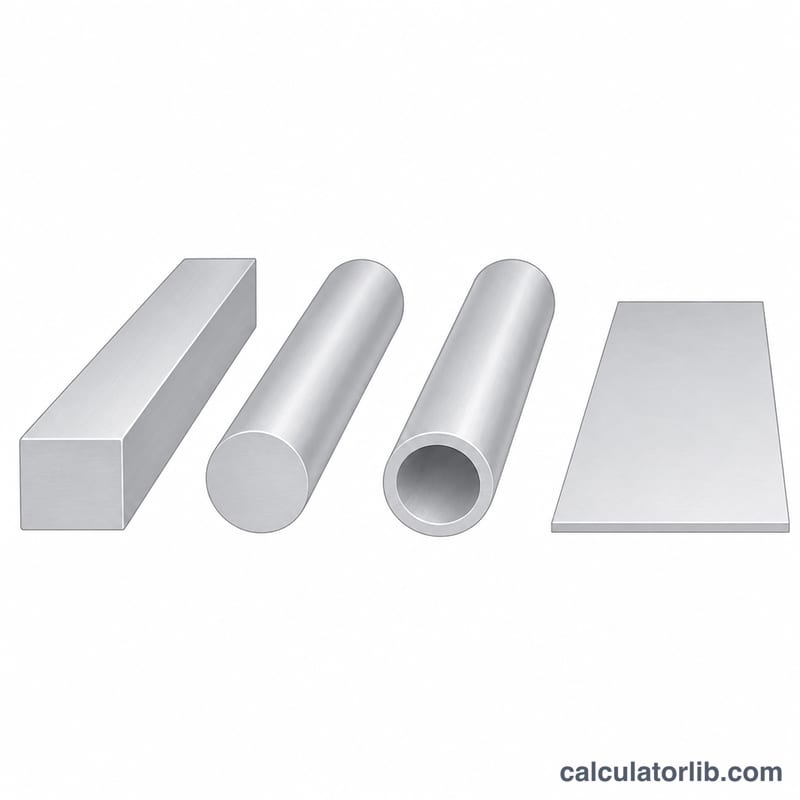
This tool estimates the weight of common aluminum stock — rectangular bars, round bars, tubes/pipes and sheets/plates — directly from their dimensions. It works by computing the volume of the part and multiplying by the density of aluminum, taken here as 2.70 g/cm³ (a typical value for pure and most structural aluminum alloys, which range roughly 2.66–2.81 g/cm³).
How to Use It
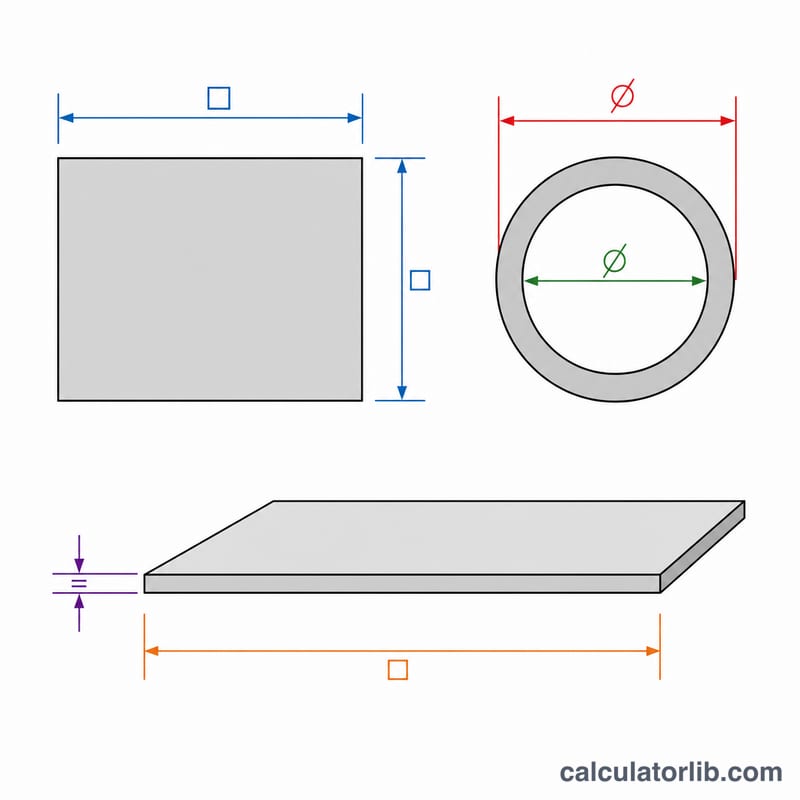
Pick the shape, enter all dimensions in millimetres, and set a quantity if you have more than one piece. For a rectangular bar or sheet, enter length, width and height/thickness. For a round bar, enter length and outer diameter. For a tube, also enter the inner diameter so the hollow centre is subtracted. The result shows total weight in kilograms and grams plus the total volume.
The Formula Explained
Weight equals volume times density:
$$\text{Weight} = \text{Volume} \times 2.70\ \text{g/cm}^3$$First the volume is found in cubic millimetres: a bar is \(L \times W \times H\), a cylinder is \(\pi \cdot r^2 \cdot L\), and a tube is \(\pi \cdot (r_o^2 - r_i^2) \cdot L\). That volume is converted to cubic centimetres by dividing by 1000, then multiplied by 2.70 g/cm³ to get grams, and divided by 1000 for kilograms.
Worked Example
A solid round aluminum bar 1000 mm long with a 50 mm diameter: radius = 25 mm, volume:
$$V = \pi \times 25^2 \times 1000 = 1{,}963{,}495\ \text{mm}^3 = 1963.5\ \text{cm}^3$$Weight:
$$W = 1963.5 \times 2.70 = 5301.4\ \text{g} \approx 5.30\ \text{kg}$$Ordering and Practical Tips
Calculated weight is a clean theoretical figure based on nominal dimensions and a single density. Real stock and real cutting introduce variation, so build in some allowance before you place an order or commit to a quote.
- Add margin for cut-offs and waste. Saw kerf, facing allowance, end trim and the occasional scrapped piece all consume material. For machined parts cut from bar or plate, adding roughly 5–10% to the calculated stock weight is a sensible starting point; for jobs with many short pieces from long stock, account for the drop (off-cut) you cannot use.
- Confirm the exact alloy density. The calculator uses \(2.70\ \mathrm{g/cm^3}\). If you are buying 7075 (\(2.81\)) or 5083 (\(2.66\)), the true weight differs by up to about 4%. When ordering by weight rather than by length, that difference is money — use the alloy's published density or scale the result by the density ratio shown in the reference table above.
- Account for mill tolerance on stock dimensions. Extruded and rolled aluminum is supplied to dimensional tolerances, not exact nominals. Bar diameters, sheet thickness and tube wall can each run over or under the stated size, and weight scales with these dimensions (with thickness and diameter having the largest effect). Use the nominal size for budgeting but expect the delivered weight to vary by a few percent, and weigh critical lots on receipt.
- Match the shape to the real cross-section. Use the tube mode (not solid bar) for hollow profiles, and remember that extrusions with fillets, chamfers or hollows weigh slightly less than the simple rectangular or round approximation. For complex profiles, the manufacturer's published weight-per-meter is more accurate than a bounding-box estimate.
- Round up, not down, for shipping and handling. When sizing packaging, freight or crane capacity, use the upper end of your weight estimate so you are never under-rated.
This is general guidance for estimating and ordering; for structural, certified or safety-critical applications, follow the material certificate, the relevant standard and your supplier's published data.
FAQ
What density does it use? 2.70 g/cm³, a standard average for aluminum. Specific alloys vary slightly.
Can I use inches? No — enter all dimensions in millimetres for accurate results.
Does it handle multiple pieces? Yes, set the quantity field and the total weight is multiplied accordingly.