
What is the Brick Calculator?
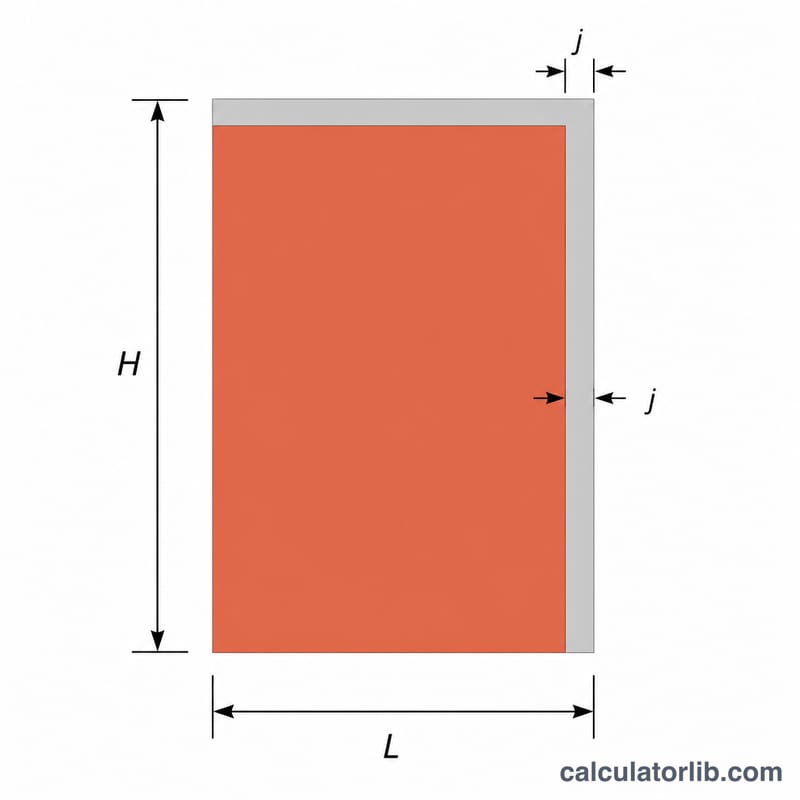
The Brick Calculator estimates how many bricks you need to build a wall. It works for any country and brick standard because you enter your own brick dimensions and mortar joint thickness. The key idea is that every brick effectively occupies a slightly larger area than its physical size, because a mortar joint is added on top and to one side of each brick.
How to use it
Enter the wall length and height in metres to get the wall area. Then enter your brick's face length and height in millimetres — a common UK brick is 215 × 65 mm, while a standard modular brick is about 194 × 57 mm. Add the mortar joint (usually 10 mm) and a wastage percentage (typically 5–10%) to cover cuts and breakages. The calculator returns the total bricks needed, rounded up.
The formula explained
Each brick plus its mortar joint covers an area of \((L+j) \times (H+j)\). Converting from millimetres to metres and dividing the wall area by this value gives the base brick count. Multiplying by \(\left(1 + \text{wastage}/100\right)\) adds a safety margin so you don't run short mid-job.
$$ N = \left\lceil \frac{A}{a} \cdot \left(1 + \dfrac{\text{Wastage (\%)}}{100}\right) \right\rceil $$ $$ \text{where}\quad \left\{ \begin{aligned} A &= \text{Wall Length (m)} \times \text{Wall Height (m)} \\ a &= \frac{\text{Brick L (mm)} + \text{Mortar (mm)}}{1000} \times \frac{\text{Brick H (mm)} + \text{Mortar (mm)}}{1000} \end{aligned} \right. $$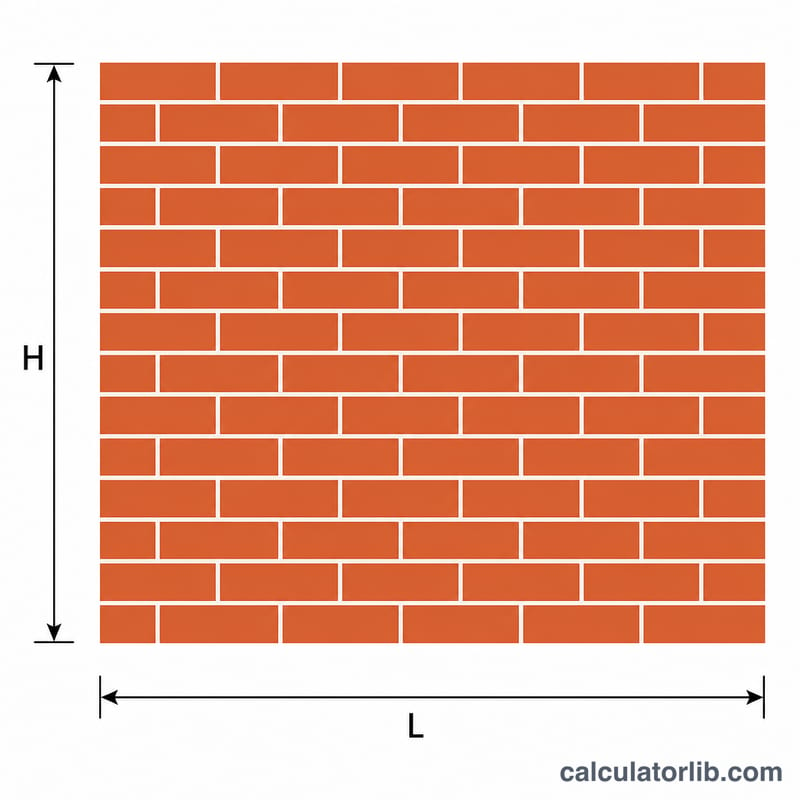
Worked example
For a 5 m × 2.5 m wall (12.5 m²) using 215 × 65 mm bricks with a 10 mm joint: the brick face becomes \(0.225\,\text{m} \times 0.075\,\text{m} = 0.016875\,\text{m}^2\). That is 59.26 bricks per m². \(12.5 \div 0.016875 \approx 740.74\) bricks, and with 5% wastage \(\approx 777.78\), rounded up to 778 bricks.
Standard Brick Sizes by Country
Brick dimensions are usually quoted as Length \(\times\) Height \(\times\) Width in millimetres, where the face that shows in the wall is the Length \(\times\) Height. When you calculate bricks per square metre, you add the mortar joint to both the length and the height, because each brick carries half a joint on every side. The values below are the nominal work sizes most commonly specified in each region.
| Standard | Length (mm) | Height (mm) | Width (mm) | Typical mortar joint (mm) |
|---|---|---|---|---|
| UK standard (BS EN 771) | 215 | 65 | 102.5 | 10 |
| US modular | 194 | 57 | 92 | 10 (3/8") |
| US standard | 203 | 57 | 102 | 10 (3/8") |
| Australian standard | 230 | 76 | 110 | 10 |
| Indian (modular) | 190 | 90 | 90 | 10 |
With a 10 mm joint, a UK brick occupies a face area of \((215+10)\times(65+10) = 225 \times 75 = 16{,}875\,\text{mm}^2\), or \(0.016875\,\text{m}^2\) — giving the familiar figure of roughly 60 bricks per square metre for a single-leaf wall.
Practical Recommendations
- Always add wastage. Order about 5% extra for a simple, straight wall and up to 10% where there are many cuts, returns, arches or decorative bonds. Breakage, off-cuts and rejected bricks add up quickly.
- Buy in full packs. Bricks are sold in banded packs (commonly 400–500 per pack in the UK). Round your order up to whole packs rather than loose units, and keep a few spares for future repairs or matching — colour and texture can change between production batches.
- Check the delivery on arrival. Inspect packs for breakage and shortfall before signing, and note any damage on the delivery ticket. The wastage allowance covers normal handling losses, not a heavily damaged pallet.
- Double the count for double-leaf walls. A cavity or solid double-leaf wall has two skins of brickwork, so multiply the single-leaf result by two (plus any extra for wall ties and closers). Make sure you are counting the visible face dimensions, not the brick width.
- Estimate the mortar too. Brickwork needs roughly 0.02–0.03 m³ of mortar per square metre of single-leaf wall for a 10 mm joint. Use a dedicated mortar or cement estimator to convert your wall area into bags of cement and volumes of sand once you know the brick count.
This is general guidance for estimating purposes. Confirm quantities, bonding and structural requirements with your supplier or a qualified builder before ordering.
FAQ
Does this include both wall faces? No — it assumes a single-leaf (half-brick) wall. For a double-leaf wall, double the result.
Why round up? You can only buy whole bricks, and rounding up ensures you have enough to finish.
What wastage should I use? 5% for simple walls, up to 10% where many cuts or arches are involved.