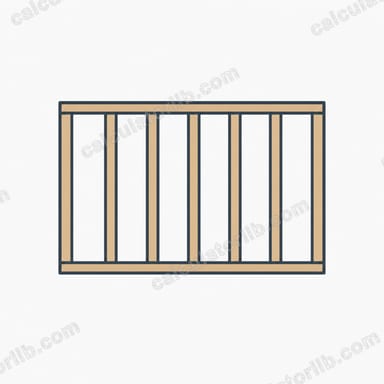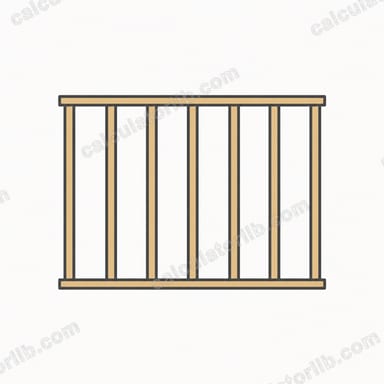

What Is the Wall Framing Stud Calculator?
This calculator estimates how many vertical wall studs you need to frame a stud wall. Enter the wall length, choose the stud spacing (most commonly 16 inches on center), and add any door or window openings. The tool returns the total number of studs so you can order materials with confidence and minimize waste.
How to Use It
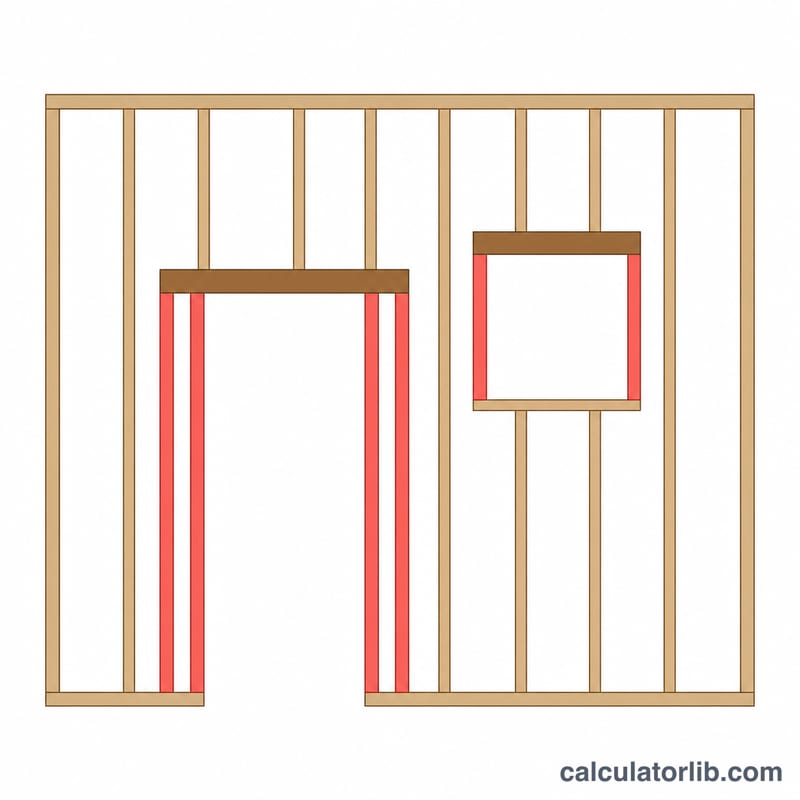
Measure the total length of the wall in feet. Pick your spacing — 16" on center is standard for residential framing, 24" is common for non-load-bearing or some energy-code walls, and 12" is used for extra strength. Enter the number of doors and windows so the calculator can add allowance studs (kings, jacks, and cripples) around each opening.
The Formula Explained
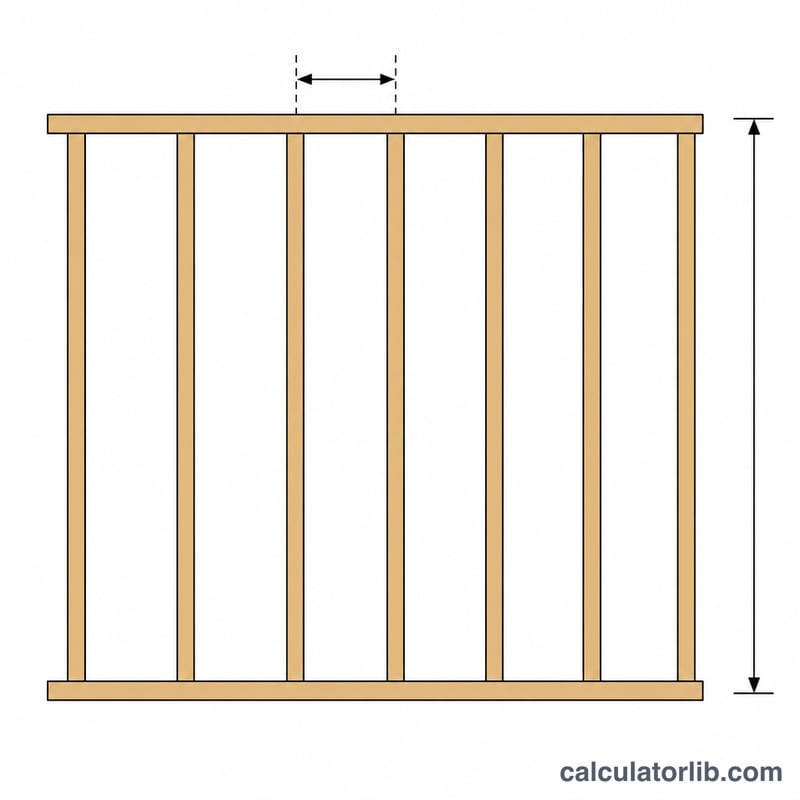
The core relationship is $$\text{Studs} = \left\lceil \frac{\text{Wall Length (ft)}}{\text{Spacing (in)}/12} \right\rceil + 1$$. Spacing is converted from inches to feet (spacing \(\div\) 12), then divided into the wall length. Rounding up guarantees a stud at every layout mark, and the +1 accounts for the stud that closes the far end of the wall. Each opening then adds roughly 3 extra studs.
Worked Example
For a 20-foot wall at 16" on center: \(16 \div 12 = 1.333\) ft spacing. \(20 \div 1.333 = 15\), rounded up = 15, plus 1 = 16 base studs. Add one door (3 extra studs) and the total becomes 19 studs.
FAQ
Does this include top and bottom plates? No — this counts vertical studs only. Plates are horizontal members estimated by wall length separately.
Why round up? You always need a stud at the start, at every spacing mark, and at the end, so partial spacings round up to a full stud.
How accurate is the openings estimate? Three studs per opening is a practical average; large or specialized openings may need more headers and cripples.