
What is the Brick Wall Calculator?
This tool estimates how many bricks you need to build a wall of a given size. It accounts for the brick dimensions, the mortar joint thickness around each brick, and an optional waste allowance for cuts and breakages. It uses standard UK brick sizing by default but works with any brick size.
How to use it
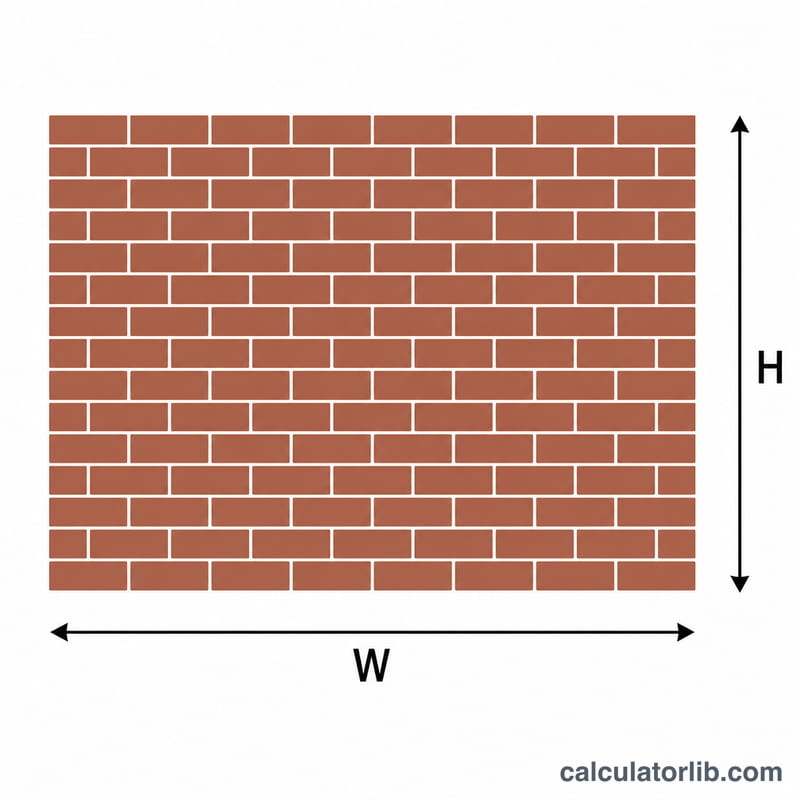
Enter the wall length and height in metres, the brick length and height in millimetres, the mortar joint in millimetres, and a waste percentage. The calculator returns the wall area, bricks per square metre, the raw number of bricks, and the total including waste (rounded up).
The formula
Each brick occupies a footprint that includes half a mortar joint on each side, so the effective unit is the brick size plus one full joint. With \(L\) = brick length, \(H\) = brick height and \(m\) = mortar joint (all in metres):
$$n = \frac{1}{(L+m)\times(H+m)}$$Then the total is the wall area \(A\) times \(n\) times the waste factor, where \(w\) is the waste fraction:
$$N = A \times n \times (1 + w)$$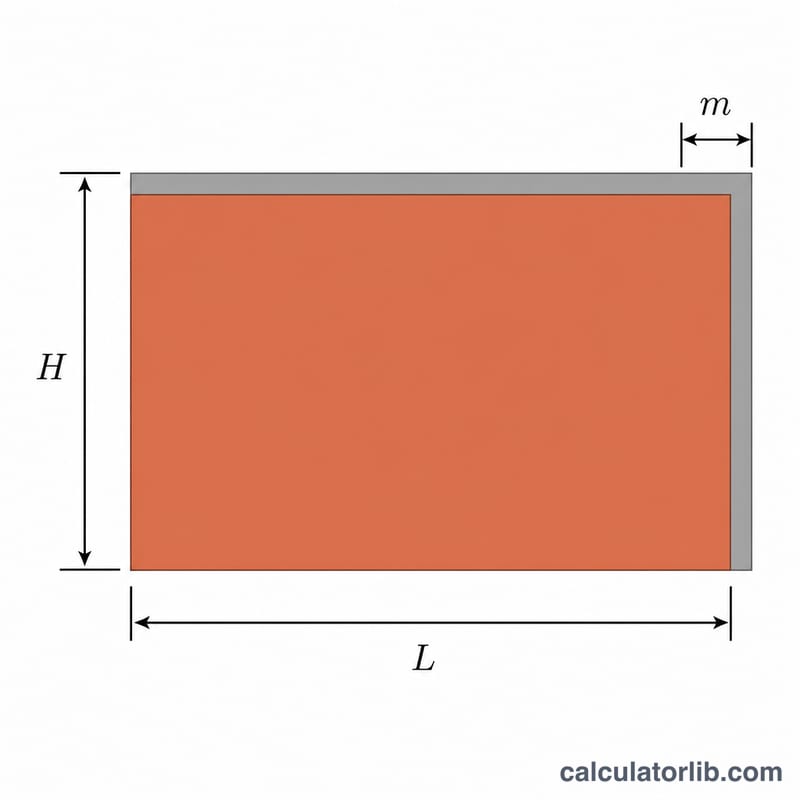
Worked example
For a 5 m by 2.5 m wall using a standard UK brick (215 mm by 65 mm) with a 10 mm joint and 10% waste:
$$A = 5 \times 2.5 = 12.5\,\text{m}^2$$ $$n = \frac{1}{0.225 \times 0.075} = 59.26\,\text{bricks/m}^2$$ $$N = 12.5 \times 59.26 \times 1.1 \approx 815\,\text{bricks}$$Standard Brick Sizes and Bricks per Square Metre
The number of bricks needed per square metre depends on the face size of the brick (its length × height as seen on the wall) plus the mortar joint. With a standard 10 mm joint, each brick effectively occupies a slightly larger area. The bricks-per-m² figure is calculated as:
$$ \text{Bricks/m}^2 = \frac{1\,000\,000}{(\text{Brick L} + \text{Joint})(\text{Brick H} + \text{Joint})} $$For a UK standard brick (215 × 65 mm) with a 10 mm joint, the effective face area is \((215+10)(65+10) = 225 \times 75 = 16\,875\ \text{mm}^2\), giving \(1\,000\,000 / 16\,875 \approx\) 60 bricks per square metre (single skin, no waste).
| Brick type | Face L × H (mm) | Joint (mm) | Bricks/m² (single skin) |
|---|---|---|---|
| UK standard | 215 × 65 | 10 | ≈ 59.3 (≈ 60) |
| US modular | 194 × 57 | 10 | ≈ 72.6 (≈ 73) |
| US standard (queen) | 203 × 57 | 10 | ≈ 69.9 (≈ 70) |
| Metric (Australia) | 230 × 76 | 10 | ≈ 48.5 (≈ 49) |
| Metric (Europe) | 290 × 90 | 10 | ≈ 33.3 (≈ 34) |
| Roman / thin | 290 × 52 | 10 | ≈ 55.6 (≈ 56) |
Figures are for a single-skin (half-brick) wall laid in stretcher bond. Double-skin walls require roughly twice these quantities.
Ordering and Material Tips
- Round up to whole bricks and full packs. Bricks are sold in packs (commonly 400–500 per pack in the UK). Always round your total up to the next full pack rather than ordering a part-pack.
- Add 5–10% for waste. Allow about 5% for a simple straight wall and up to 10–15% for walls with many cuts, corners, curves, decorative bonds or arches, where more bricks are trimmed or broken.
- Buy from one batch. Brick colour and texture vary between production batches. Order all your bricks at once from the same batch so the finished wall matches, and keep a few spares for future repairs.
- Double-skin (cavity) walls. A standard cavity or solid double-skin wall uses two leaves of brick, so double the single-skin count. Add extra for piers, returns and any decorative header courses.
- Don't forget the mortar. A single-skin brick wall typically needs roughly 0.02–0.03 m³ of mortar per square metre. Estimate cement and sand separately with a dedicated mortar calculator before you order materials.
- Account for openings. Subtract the area of doors, windows and any voids before calculating, but keep the full waste allowance to cover cuts around those openings.
This is general estimating guidance. For structural walls, foundations and building-code compliance, consult a qualified builder or structural engineer.
FAQ
Why add a mortar joint? Bricks are laid with mortar between them, so the effective size of each brick in the wall is larger than the brick alone.
How much waste should I allow? 5-10% is typical to cover cuts, breakages and offcuts; use more for complex walls.
Does this include a double layer? No, the result is for a single-skin wall. For a double-skin wall, double the result.