
What This Calculator Does
The CNC Machining Cost Calculator gives a quick, defensible estimate of what it costs to machine a batch of parts on a CNC mill or lathe. It combines the one-time setup labor, the recurring machining time, raw material cost and an optional profit margin into a single job total and a per-part price you can quote to a customer.
How To Use It
Enter the machine time per part (cycle time in hours), your shop machine rate in dollars per hour, the one-time setup time and labor rate, the material cost per part, the quantity of parts, and an optional profit margin. The result shows the total job cost, the cost per part, and a breakdown of each component.
The Formula
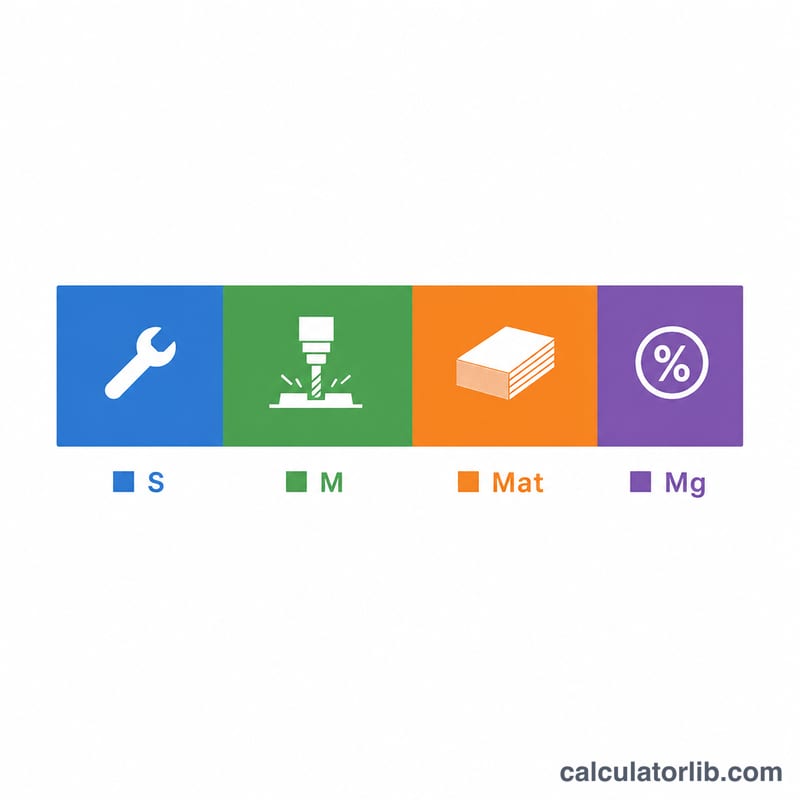
The calculator adds setup, machining and material costs, then applies the margin. With \(t_s\) = setup hours, \(R_l\) = labor rate, \(t_m\) = machine hours per part, \(R_m\) = machine rate, \(C_{mat}\) = material cost per part, \(Q\) = quantity and \(m\) = margin percent:
$$\text{Total} = \left(t_s R_l + t_m R_m Q + C_{mat} Q\right)\left(1 + \frac{m}{100}\right)$$The per-part cost is simply \(\text{Total} / Q\).
Worked Example
Suppose setup is 1 hour at $40/hr, machine time is 0.5 hr/part at $75/hr, material is $8/part, quantity is 10, and margin is 20%.
$$\text{Subtotal} = (1 \times 40) + (0.5 \times 75 \times 10) + (8 \times 10) = 40 + 375 + 80 = 495$$ $$\text{Total} = 495 \times 1.20 = 594$$ $$\text{Per Part} = \frac{594}{10} = 59.40$$So the job costs $594, or $59.40 per part.
Typical Shop Machine Rates by Machine Type
The machine rate is the fully-burdened hourly cost of running a machine — it bundles depreciation (the capital cost of the machine spread over its life), electrical power, compressed air, perishable tooling, fixturing, maintenance and a share of shop overhead (rent, insurance, supervision). It is normally separate from the operator's labor rate, since one operator may tend several machines. The figures below are representative North American shop-rate ranges; your own number depends on machine cost, utilization and region, so treat these as sanity-check brackets rather than fixed prices.
| Machine type | Typical rate ($/hr) | Notes |
|---|---|---|
| 3-axis CNC mill (VMC) | $60 – $130 | Workhorse for prismatic parts; lower capital cost |
| 5-axis CNC mill | $120 – $250 | Complex geometry, fewer setups, high capital cost |
| CNC lathe / turning center | $50 – $120 | Round parts; live tooling raises the rate |
| Swiss-type lathe | $80 – $180 | High-volume small precision parts, near-lights-out |
| EDM (wire / sinker) | $80 – $200 | Slow cycles, hard materials, tight tolerance/finish |
All rates above are intended to cover machine depreciation, power and consumables, perishable tooling and allocated shop overhead. Add labor, raw material and margin on top — this calculator keeps the labor (setup) and machine portions on separate inputs so you can mix a high machine rate with a lower labor rate when one operator runs multiple spindles.
Practical Quoting Tips
The calculator gives a solid baseline, but a competitive, profitable quote needs a few real-world adjustments:
- Add explicit line items for tooling, consumables, finishing and freight. Special end mills, custom fixtures, deburring, anodizing/plating, heat treat and outbound shipping are easy to forget and can quietly erase your margin. List them separately so the customer sees the value and you don't absorb the cost.
- Pad cycle time for chip-to-chip handling. Spindle-cutting time is not the whole story — load/unload, part flipping, tool changes, in-process inspection and chip clearing all add up. A common rule is to add 15–30% to raw cut time, more for small or fiddly parts.
- Set a minimum lot charge for small runs. One- and two-off jobs cost real money to program and set up. A flat minimum (e.g. $150–$350) protects you from quotes where the math says a few dollars but the door-to-door effort says otherwise.
- Round quotes sensibly. Round the final figure up to a clean number rather than quoting $483.78 — it reads as professional and gives a small buffer for surprises. Round in your favor, not the customer's.
- Build in a sane margin and convert it correctly. If you want a true gross margin (profit as a % of price) rather than a markup (profit as a % of cost), be deliberate — a 30% margin equals a 42.9% markup. A 30% margin converts to a 42.86% markup on cost.
- Revisit your machine and labor rates at least annually. Power prices, wages, insurance and new equipment financing all drift. Recompute your fully-burdened machine rate every year (and after any major capital purchase) so your quotes don't slowly fall behind your actual costs.
This is general shop-quoting guidance, not financial advice. Validate every rate against your own bookkeeping and adjust for your market and lead-time situation.
FAQ
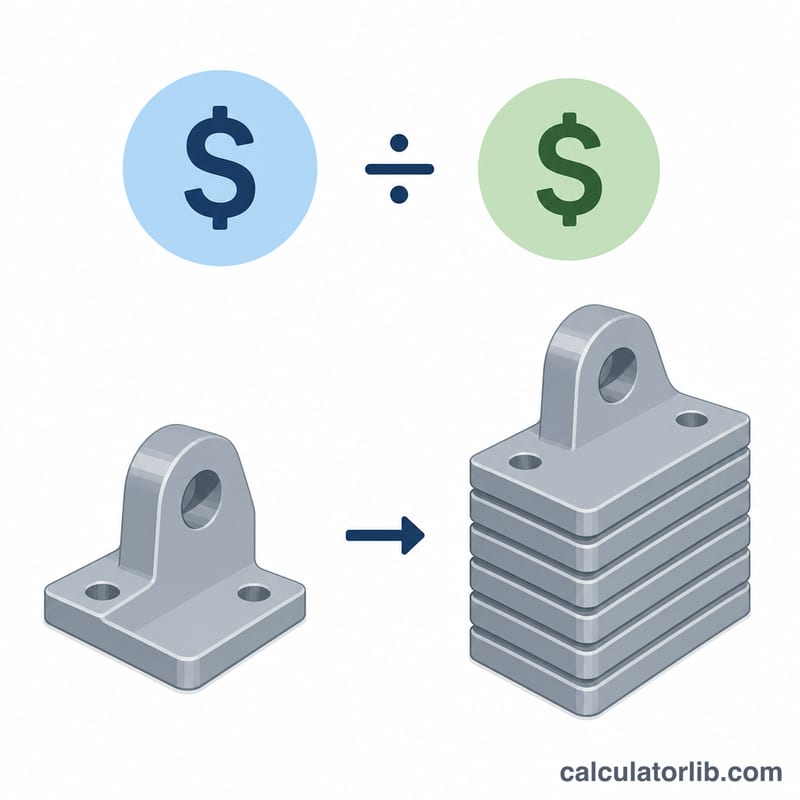
Is setup charged per part? No. Setup is a one-time cost spread across the whole batch, which is why larger quantities lower the per-part price.
What should I use as the machine rate? Use your fully-burdened shop rate covering machine depreciation, power, tooling and overhead — commonly $50–$150/hr depending on the machine.
Does this include tooling or shipping? No. Add consumables, special tooling, finishing and freight to the material cost or as a separate line if needed.