
What Is the 3D Printing Cost Calculator?
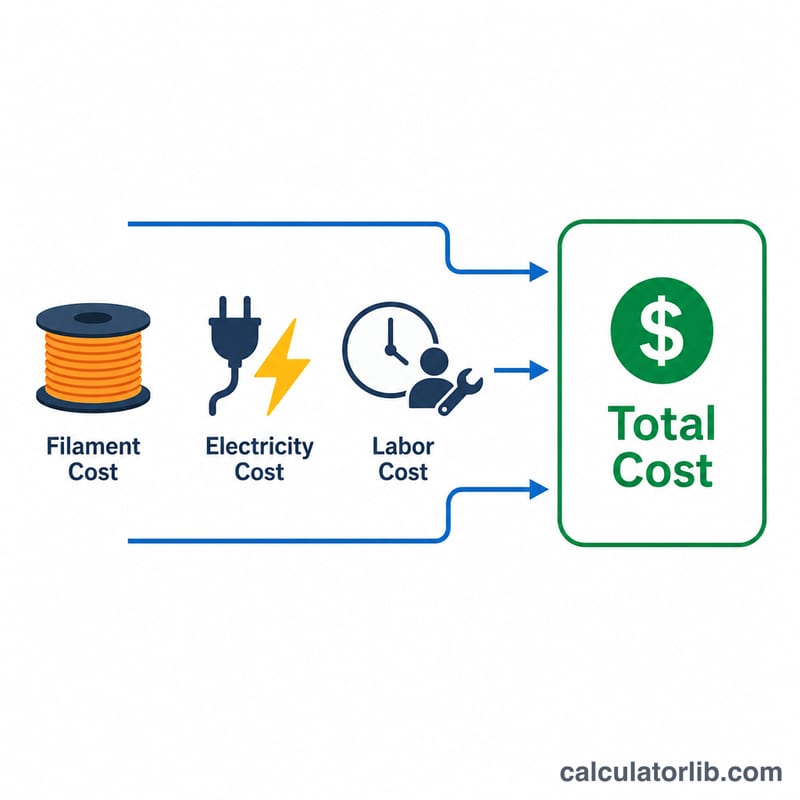
The 3D Printing Cost Calculator estimates how much a single printed part really costs to produce. It combines three main expense drivers: the filament (material) you consume, the electricity your printer draws during the job, and any labor you want to bill for setup and post-processing. Whether you sell prints, run a maker space, or just want to understand your hobby spending, this tool turns grams and hours into real currency.
How to Use It
Enter the filament weight of your part in grams (your slicer usually reports this), the price you paid per kilogram of filament, and the total print time in hours. Then add your printer's average power draw in kilowatts (a typical desktop FDM printer is about 0.1–0.15 kW), your local electricity rate per kWh, and an optional hourly labor rate. The calculator returns the material, electricity, and labor cost separately, plus the grand total.
The Formula Explained
The total cost is the sum of three terms:
$$\text{Cost} = \frac{g}{1000}\,p + h\,P\,r + h\,L$$Material = \(\frac{g}{1000}\times p\) (grams ÷ 1000) × price per kg. Electricity = print hours × printer power (kW) × electricity rate per kWh. Labor = print hours × labor rate. Adding them gives your true cost per print, which you can mark up for a selling price.
Worked Example
Suppose a print uses 50 g of filament costing $25/kg, takes 5 hours, and your printer draws 0.15 kW with electricity at $0.15/kWh and a $10/hour labor rate. Material = \((50/1000)\times 25 = \$1.25\). Electricity = \(5\times 0.15\times 0.15 = \$0.1125\). Labor = \(5\times 10 = \$50\). Total = $51.36.
Typical Filament Prices & Power Draw by Type
The two biggest recurring costs in 3D printing are filament (or resin) and electricity. Material cost depends on the price per kilogram and how many grams a print consumes; electricity cost depends on the printer's average power draw in kilowatts and how long the job runs. The ranges below are typical retail figures for consumer-grade spools and average sustained power draw — actual values vary by brand, color, and printer model.
| Filament / Material | Typical Price (per kg) | Notes |
|---|---|---|
| PLA | $18 – $25 | Easiest to print, most economical |
| PETG | $20 – $30 | Tougher, slightly higher cost |
| ABS | $20 – $28 | Heat resistant, needs enclosure |
| TPU (flexible) | $28 – $45 | Specialty, prints slowly |
| Nylon | $35 – $70 | Engineering-grade, hygroscopic |
| ASA | $25 – $40 | UV-stable ABS alternative |
| Standard resin (SLA/MSLA) | $25 – $50 per kg/L | Sold by liter; add wash/cure cost |
| Printer Type | Typical Power Draw | In kW (for the calculator) |
|---|---|---|
| Small FDM (e.g. single hotend, heated bed) | 80 – 150 W | 0.08 – 0.15 kW |
| Large FDM / high-temp enclosed | 150 – 350 W | 0.15 – 0.35 kW |
| Resin (MSLA, with curing) | 40 – 120 W | 0.04 – 0.12 kW |
Power draw is rarely constant — heated beds cycle on and off — so these figures represent a reasonable average over a full print. As an example, a small FDM printer averaging 120 W (0.12 kW) running for 10 hours at a rate of $0.16/kWh costs $0.19 in electricity.
Pricing & Markup Recommendations
Knowing your true cost is only the first step — turning it into a sustainable price means accounting for risk, overhead, and the value of your time. The tips below are general business guidance, not professional financial advice.
- Add a failure/waste buffer of ~10–20%. Prints fail, supports waste filament, and nozzles and beds wear out. Multiply your calculated material + electricity cost by 1.10–1.20 to absorb these losses over many jobs.
- Don't forget labor, even your own. Slicing, monitoring, removal, sanding, and packing all take time. A labor rate of $5–$25/hour keeps your effort from silently subsidizing the customer.
- Factor in shipping, packaging, and fees. Boxes, tape, postage, and marketplace/payment fees (often 3–15%) come straight out of your margin. Add them as a flat amount or a percentage on top of true cost.
- Set a markup multiplier over true cost. A common approach is to take true cost \(C\) (material + electricity + labor + buffer) and apply a multiplier: hobby/break-even \(1.2\times C\), side income \(2\times C\), and retail/Etsy-style \(2.5\text{–}3\times C\). For a medium print with a true cost of $43.19, a \(2\times\) markup gives a $86.38 list price.
- Convert markup to margin so you know your profit share. A 2× price means a 100% markup, which equals a 50% gross margin. If your true cost is $43.19 and you sell at $86.38, your gross margin is 50%.
- Round up to a clean, sellable price. After applying your multiplier, round to a tidy figure (e.g. $86.38 → $89 or $90). Rounding up protects margin and looks intentional.
Re-run the cost calculator whenever filament prices or your electricity rate change, and review your markup periodically so pricing keeps pace with real costs.
FAQ
Does this include printer wear or failed prints? No. To account for maintenance and failures, increase your labor rate or add a margin on top of the total.
What power draw should I use? Measure with a plug meter if possible; otherwise 0.10–0.15 kW is a reasonable estimate for most consumer FDM printers.
How do I find filament grams? Your slicer (Cura, PrusaSlicer, Bambu Studio) displays the estimated filament weight after slicing the model.