
What Is the Drone Flight Time Calculator?
This tool estimates how long a drone (or any battery-powered aircraft) can stay airborne on a single charge. It works from four physical inputs: battery capacity in amp-hours, pack voltage, the average power the motors and electronics draw in watts, and a discharge efficiency factor. The result is a realistic flight-time estimate rather than the optimistic figure printed on a spec sheet.
How to Use It
Enter your battery capacity in amp-hours (a 5200 mAh pack is 5.2 Ah). Enter the nominal voltage — a 6S LiPo is about 22.2 V. Enter the average power draw during typical flight; hovering pulls less than aggressive forward flight. Finally set a discharge efficiency: 80% is a sensible default because you should rarely drain a LiPo below ~20% to protect its lifespan and keep a safety margin.
The Formula Explained
Capacity (Ah) multiplied by voltage (V) gives the pack's total energy in watt-hours (Wh). Multiplying by the efficiency fraction gives the usable energy. Dividing usable watt-hours by the average power draw (W) yields flight time in hours, and multiplying by 60 converts to minutes:
$$T = \frac{\text{Capacity (Ah)} \times \text{Voltage (V)} \times \frac{\text{Efficiency (\%)}}{100} \times 60}{\text{Power (W)}}$$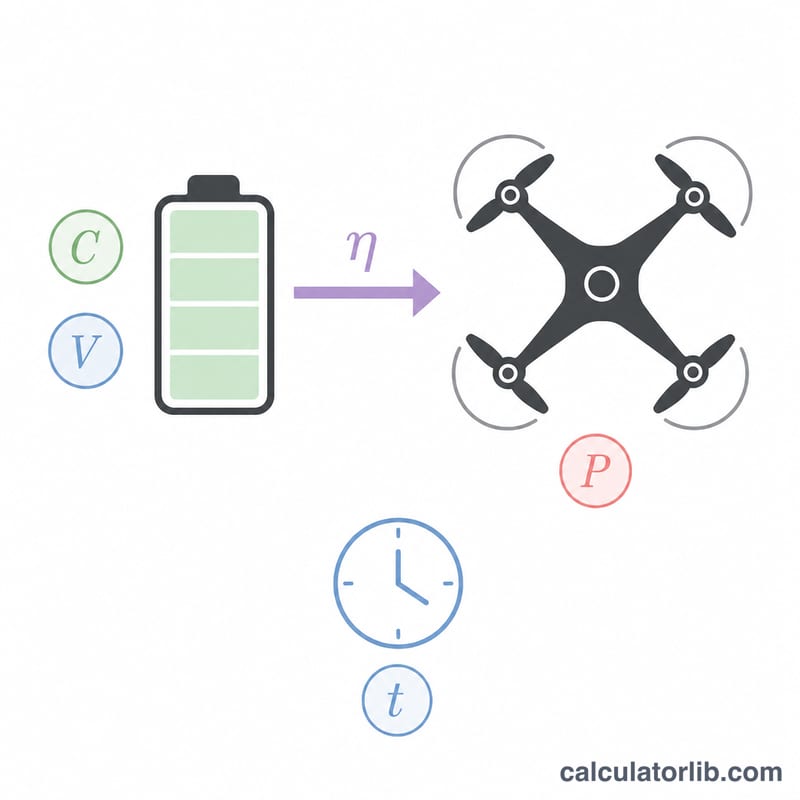
Worked Example
Take a 5.2 Ah, 22.2 V battery drawing 300 W on average at 80% efficiency. Total energy = \(5.2 \times 22.2 = 115.44\) Wh. Usable = \(115.44 \times 0.80 = 92.352\) Wh. Flight time:
$$\frac{92.352 \times 60}{300} = \mathbf{18.47 \text{ minutes}}$$FAQ
Why not just use rated capacity? Because you should never fully discharge a lithium battery — the efficiency factor models the usable portion and accounts for sag and conversion losses.
What efficiency should I pick? 75–85% is typical for LiPo packs flown to a safe cut-off. Heavier or higher-current draws favour the lower end.
Does this account for wind or payload? Indirectly — both change your average power draw, so estimate power for your actual flight conditions for a better result.