
What Is Reverberation Time?
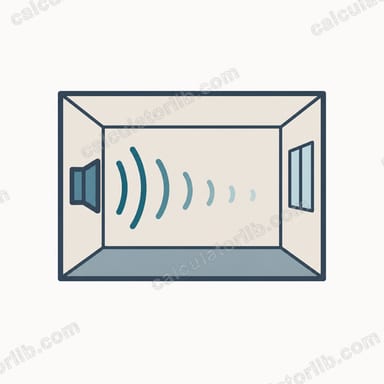
Reverberation time, commonly written as RT60, is the time it takes for sound to decay by 60 decibels after the source stops. It is one of the most important metrics in room acoustics, determining whether a space sounds "live" (long RT60) or "dead" (short RT60). Concert halls aim for longer reverberation, while studios, classrooms, and offices need shorter times for clarity.
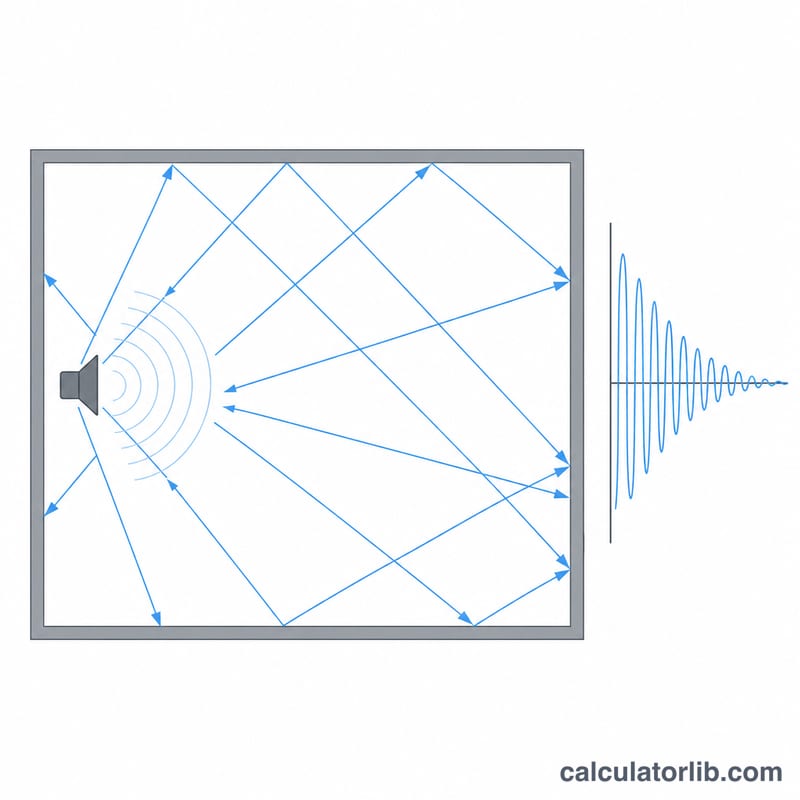
How to Use This Calculator
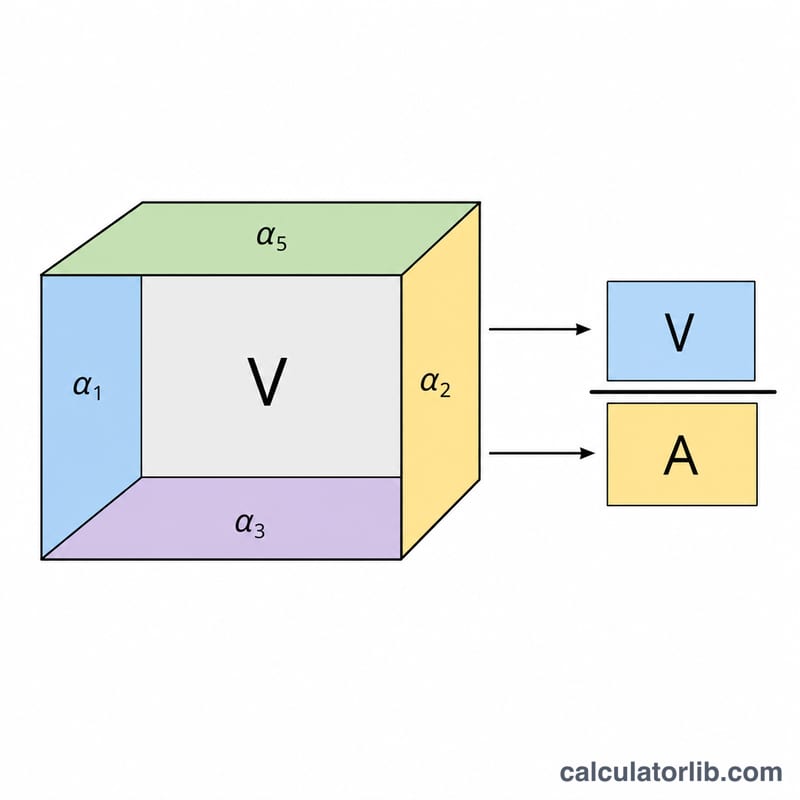
Enter the room volume in cubic metres, the total interior surface area in square metres, and the average sound absorption coefficient (\(\alpha\)) of those surfaces. The calculator applies the Sabine equation and returns RT60 in seconds, along with the total absorption A in sabins.
The Sabine Formula Explained
The Sabine equation is $$RT_{60} = \frac{0.161 \times \text{Volume (m}^3\text{)}}{\text{Surface Area (m}^2\text{)} \times \text{Absorption } \alpha}$$ where V is room volume and A is the total absorption. Absorption is found by summing each surface area multiplied by its absorption coefficient (\(A = \Sigma S \cdot \alpha\)). A coefficient of 0 reflects all sound; 1 absorbs all of it. The constant 0.161 applies when V is in m³ and A in metric sabins.
Worked Example
Consider a room of 200 m³ with 240 m² of surface and an average \(\alpha\) of 0.2. Total absorption $$A = 240 \times 0.2 = 48 \text{ sabins}$$ $$RT_{60} = \frac{0.161 \times 200}{48} \approx 0.67 \text{ seconds}$$ — a fairly controlled space suitable for speech.
FAQ
What is a good RT60? Speech-focused rooms target 0.4–0.7 s; music rooms 1.0–2.0 s; large concert halls up to 2.5 s.
Where do I find absorption coefficients? Manufacturers publish \(\alpha\) values per material and frequency band. Use a weighted average across all surfaces.
Is the Sabine formula always accurate? It works best for live rooms with low average absorption. For very absorbent rooms the Eyring formula is more precise.