
What this calculator does
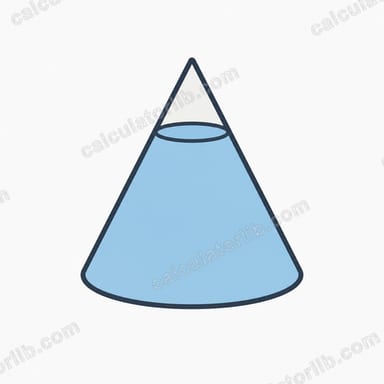
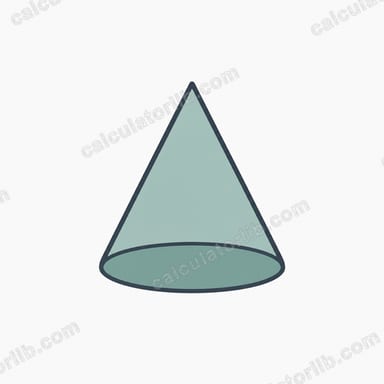
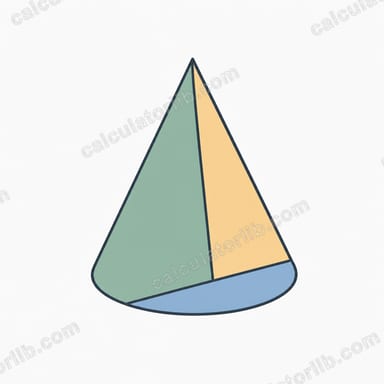
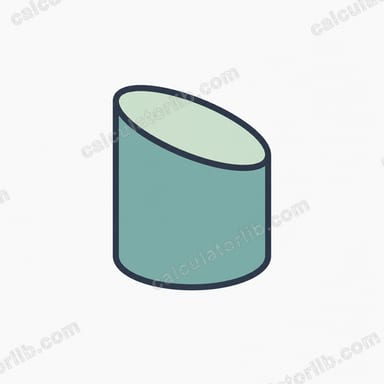
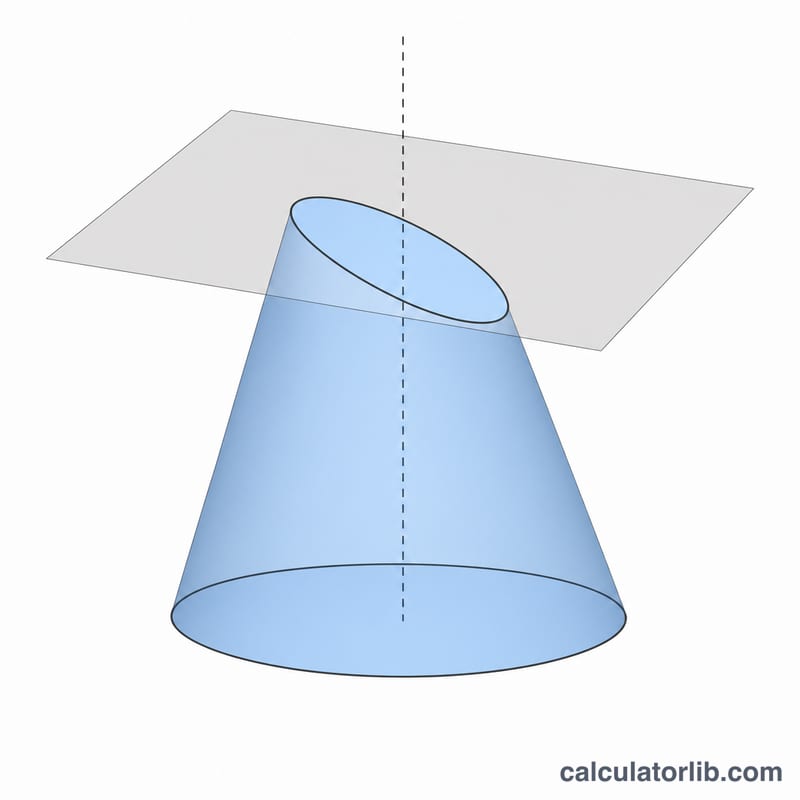
This tool computes the geometry of a right circular cone that has been sliced by an inclined plane. The plane pivots about a point on the cone's central axis, so it cuts the cone obliquely: one side rises while the opposite side descends. The solid we keep is the lower part, bounded below by the circular base and above by a slanted elliptical cut face. It returns three quantities: the retained volume \(V\), the slanted cut-section area \(S_u\), and the base area \(S_B\). Everything is pure solid geometry, so it applies identically anywhere and uses any single consistent length unit.
How to use it
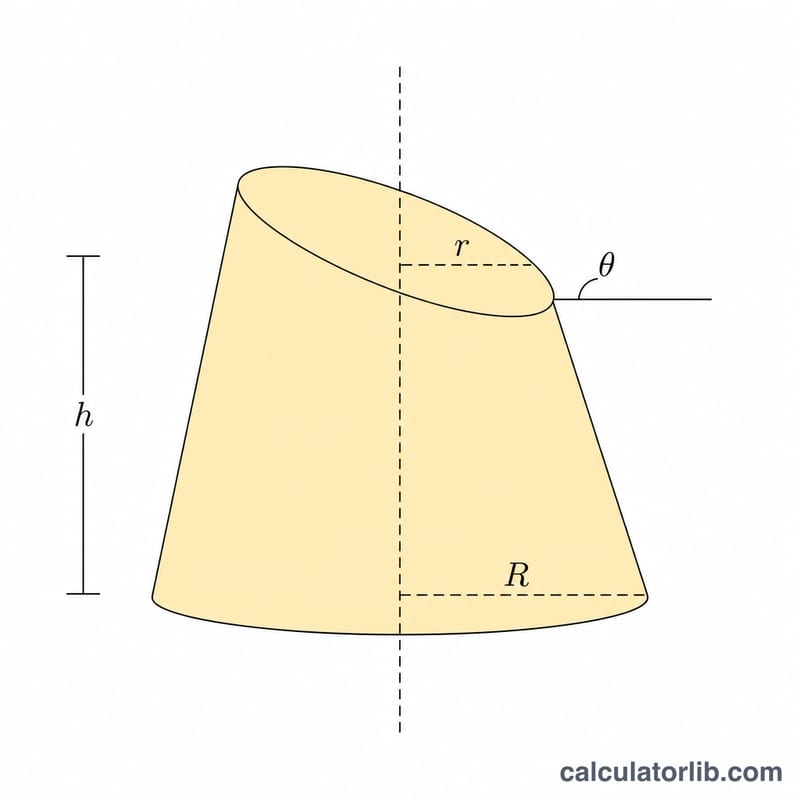
Enter the cone height \(H\), the base radius \(R\), the radius \(r\) of the horizontal cross-section at the level where the cutting plane crosses the axis, and the cut angle \(\theta\) in degrees. Use one consistent unit for all three lengths; volume comes out in that unit cubed and areas in that unit squared. The cut angle must satisfy \(0 \le \theta < 90\) degrees, \(R\) must be positive, and \(r\) should lie between 0 and \(R\).
The formula explained
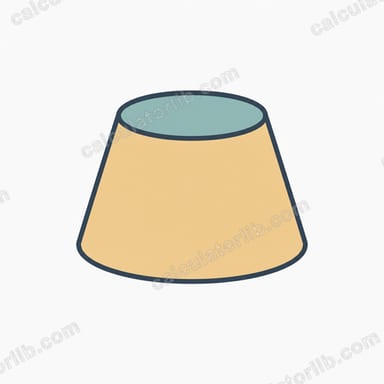
The base area is simply \(S_B = \pi R^2\). The slanted cut is an ellipse whose horizontal projection is the circle of radius \(r\); tilting by \(\theta\) stretches the area by \(1/\cos\theta\), so \(S_u = \pi r^2 / \cos\theta\). The volume is built as a frustum (from base radius \(R\) up to the pivot radius \(r\) over vertical rise \(h_p = H(R-r)/R\)) plus an oblique wedge term \(\tfrac{2}{3}r^3\tan\theta\) that accounts for the slant:
$$V = \frac{\pi h_p}{3}\left(R^2 + R\,r + r^2\right) + \frac{2}{3}\,r^3 \tan\theta$$
Worked example
With \(H=5\), \(R=8\), \(r=3\), \(\theta=15^\circ\): \(\cos 15^\circ=0.9659258\), \(\tan 15^\circ=0.2679492\). Base area \(= \pi \cdot 64 = 201.062\). Cut area \(= \pi \cdot 9 / 0.9659258 = 29.2738\). \(h_p = 5 \cdot (8-3)/8 = 3.125\), frustum \(= (\pi \cdot 3.125/3) \cdot (64+24+9) = 317.432\), wedge \(= 0.6667 \cdot 27 \cdot 0.2679492 = 4.823\). Volume $$V \approx 322.255.$$
FAQ
What happens at \(\theta = 0\)? The cut becomes horizontal: \(S_u = \pi r^2\) and the wedge term vanishes, leaving just the frustum volume.
Why does \(\theta\) have to stay below 90 degrees? As \(\theta\) approaches \(90^\circ\), \(\cos\theta\) approaches 0 and the slanted cut area diverges to infinity, so the configuration is invalid.
What unit is the answer in? Whatever unit you use for the lengths. If \(H\), \(R\) and \(r\) are in centimeters, the volume is in cubic centimeters and the areas in square centimeters.