
What this calculator does
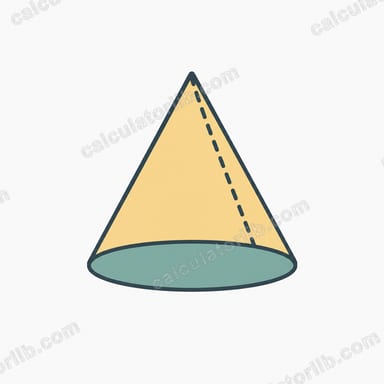
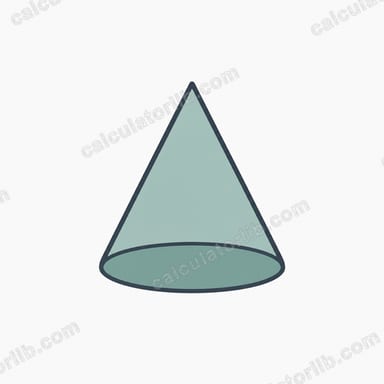
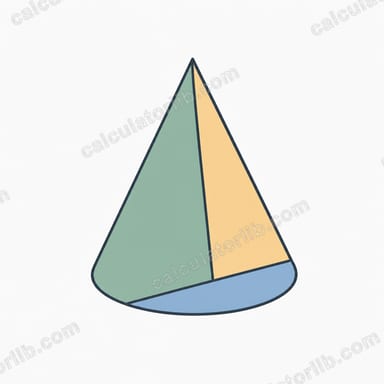
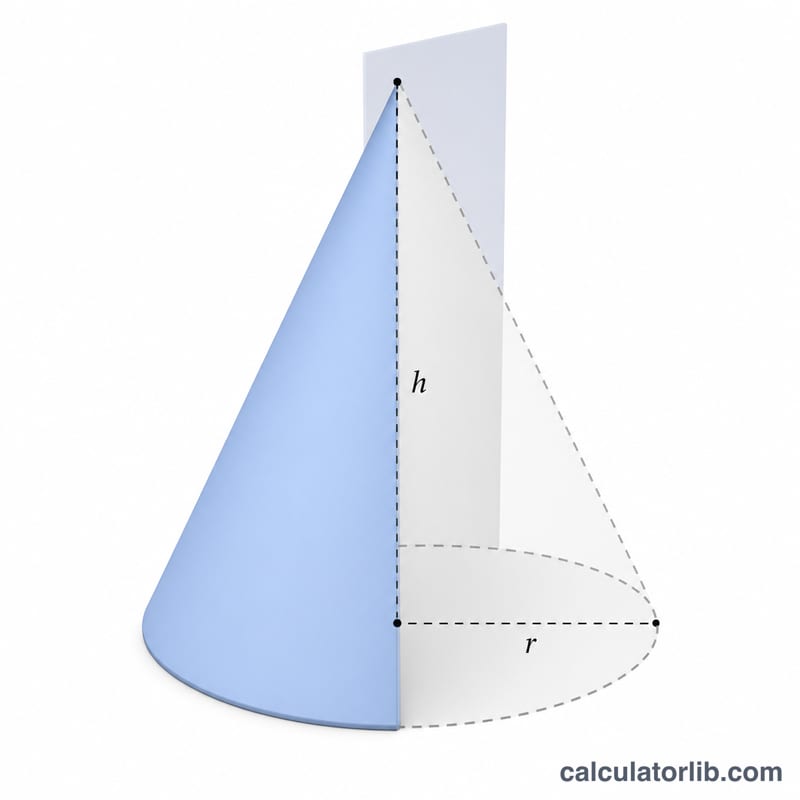
This tool analyzes a right circular cone (base radius r, height h) that is sliced by a single vertical cutting plane parallel to the cone's axis. It computes the geometric properties of the smaller piece that is cut off: its volume, the area of its base (a circular segment of the base circle), its curved lateral surface area, the flat area of the vertical cut, and the defining segment quantities — central angle, arc length and chord.
How to use it
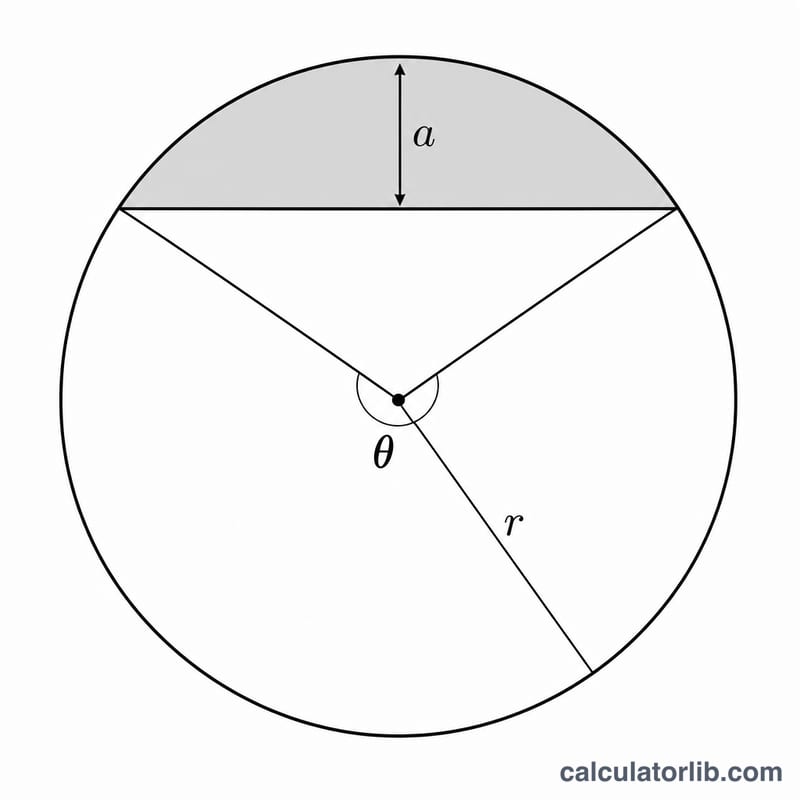
Enter all three lengths in the same unit (there is no unit dropdown). The base radius r and height h define the cone. The segment height a (the sagitta) is the depth of the slice, measured from the cutting chord to the far edge of the base circle, and must satisfy \(0 < a \le r\). When \(a = r\) the plane passes through the center and you get exactly half the cone; when a is small the slice is a thin sliver.
The formula explained
First compute the dimensionless parameter \(k = 1 - a/r\), which is the cosine of the half-angle subtended by the chord. The central angle is \(\theta = 2\cdot\arccos(k)\) radians. The base region is a circular segment of area \(S_B = \frac{r^{2}}{2}(\theta - \sin\theta)\). Because a cone is a scaled stack of its base, the volume above any planar base region is one third of that area times the height, so $$V = \frac{1}{3}\cdot S_B \cdot h.$$ The lateral surface above the arc is the fraction \(\theta/(2\pi)\) of the full cone lateral surface \(\pi r\sqrt{r^{2}+h^{2}}\), giving \(S_L = \frac{\theta}{2}\cdot r\sqrt{r^{2}+h^{2}}\). The vertical cut itself is a triangle with base equal to the chord c and height equal to the cone height h, so \(S_h = \tfrac12 ch\).
Worked example
For \(r = 5\), \(h = 7\), \(a = 3\): \(k = 0.4\), \(\theta = 2\cdot\arccos(0.4) = 2.3186\) rad, chord \(c = 9.1652\), arc \(L = 11.5928\). The base segment \(S_B = 12.5\cdot(2.3186 - 0.7332) = 19.8168\), so $$V = \frac{1}{3}\cdot 19.8168 \cdot 7 \approx 46.2393.$$ The slant height is \(\sqrt{74} = 8.6023\), giving \(S_L \approx 49.8657\) and the section area \(S_h = \tfrac12\cdot 9.1652\cdot 7 \approx 32.0780\).
FAQ
Is this a slanted cut? No. The plane is vertical (parallel to the axis), so the cut is a flat triangle and the base is a circular segment, not an ellipse.
What if a equals r? Then \(k = 0\), \(\theta = \pi\), and you get exactly half the full cone volume, \(\pi r^{2}h/6\).
What units do the outputs use? Lengths share whatever unit you input; areas come out in unit² and volume in unit³. Angles are in radians.