
What Is Optical Density?
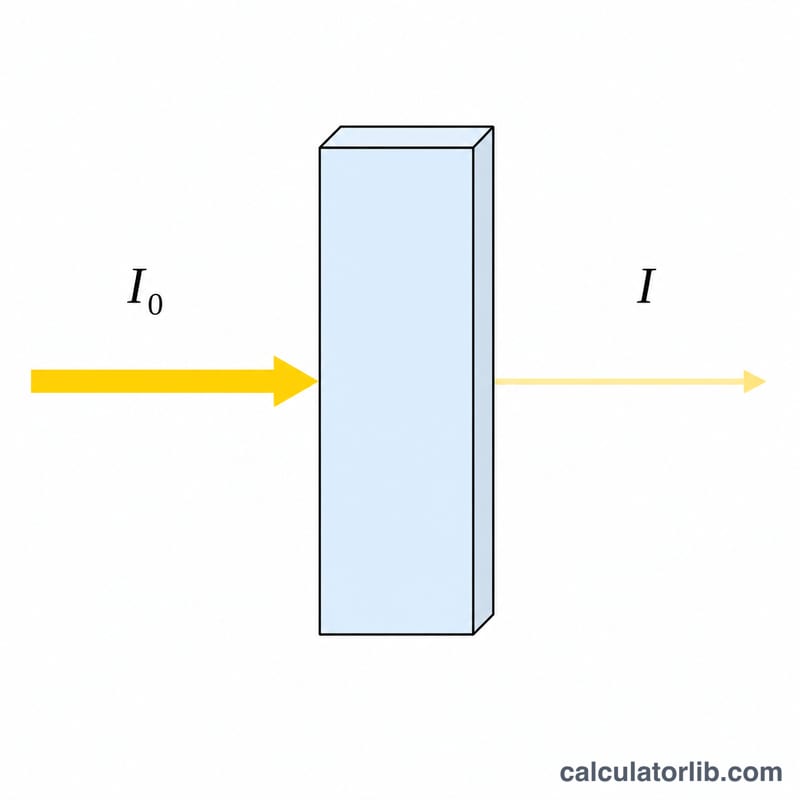
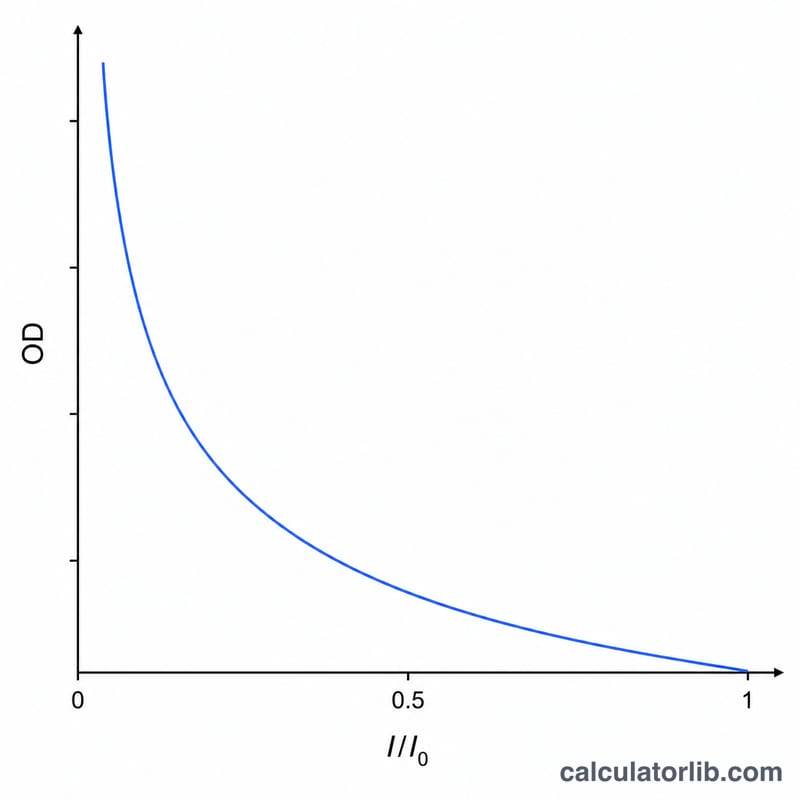
Optical density (OD), also called absorbance, measures how much light a sample blocks or attenuates as it passes through. It is defined logarithmically from the ratio of transmitted intensity (I) to incident intensity (I₀). A higher OD means more light is absorbed or scattered, leaving less to pass through. Because the scale is logarithmic, an OD of 1 transmits 10% of the light, OD 2 transmits 1%, and OD 3 transmits 0.1%.
How to Use This Calculator
Enter the incident intensity (I₀) — the light entering the sample — and the transmitted intensity (I) — the light measured after it exits. The calculator returns the optical density along with the transmittance as both a fraction and a percentage. Use any consistent intensity units (e.g. counts, watts, or detector readings); only the ratio matters.
The Formula Explained
The core equation is $$\text{OD} = -\log_{10}\left(\frac{\text{Transmitted Intensity }(I)}{\text{Incident Intensity }(I_0)}\right)$$ The ratio \(I/I_0\) is the transmittance T, a value between 0 and 1. Taking the negative base-10 logarithm converts this fraction into the additive, dimensionless OD scale used in spectrophotometry. Transmittance can be recovered with \(T = 10^{-\text{OD}}\), and the percentage transmittance is simply \(T \times 100\).
Worked Example
Suppose a beam of incident intensity \(I_0 = 100\) reaches a detector reading \(I = 10\) after passing through a sample. The transmittance is \(10/100 = 0.1\), or 10%. The optical density is $$\text{OD} = -\log_{10}(0.1) = -(-1) = 1.0$$ So the sample has an optical density of 1.0, transmitting one-tenth of the incident light.
FAQ
Is optical density the same as absorbance? In most laboratory contexts, yes — OD and absorbance are used interchangeably and share the same formula and units.
What does a negative OD mean? A negative OD occurs when the transmitted intensity exceeds the incident intensity (\(I > I_0\)), often due to scattering, fluorescence, or a blank/reference error.
What units does OD have? Optical density is dimensionless because it is the logarithm of a ratio of like quantities.