

What is arcsn(x, k)?
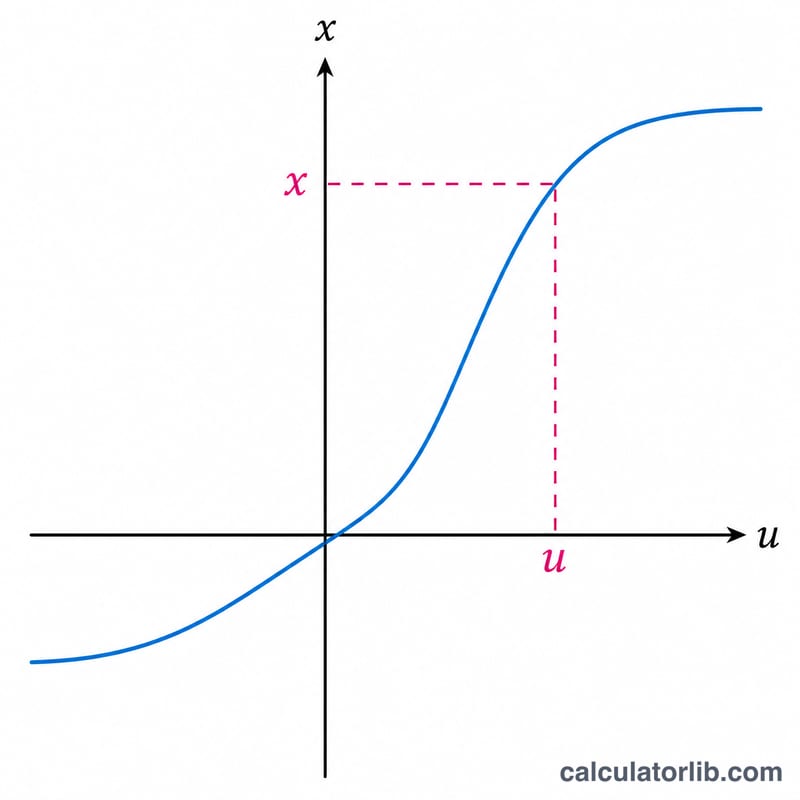
The inverse Jacobi elliptic sine function, written arcsn(x, k), answers the question: given a value x and an elliptic modulus k, what argument u produces sn(u, k) = x? Here sn is the Jacobi elliptic sine, a doubly-periodic generalization of the ordinary sine that appears throughout the theory of pendulum motion, nonlinear oscillators, conformal mapping, and the solution of certain differential equations. This tool is pure mathematics and applies universally.
The formula
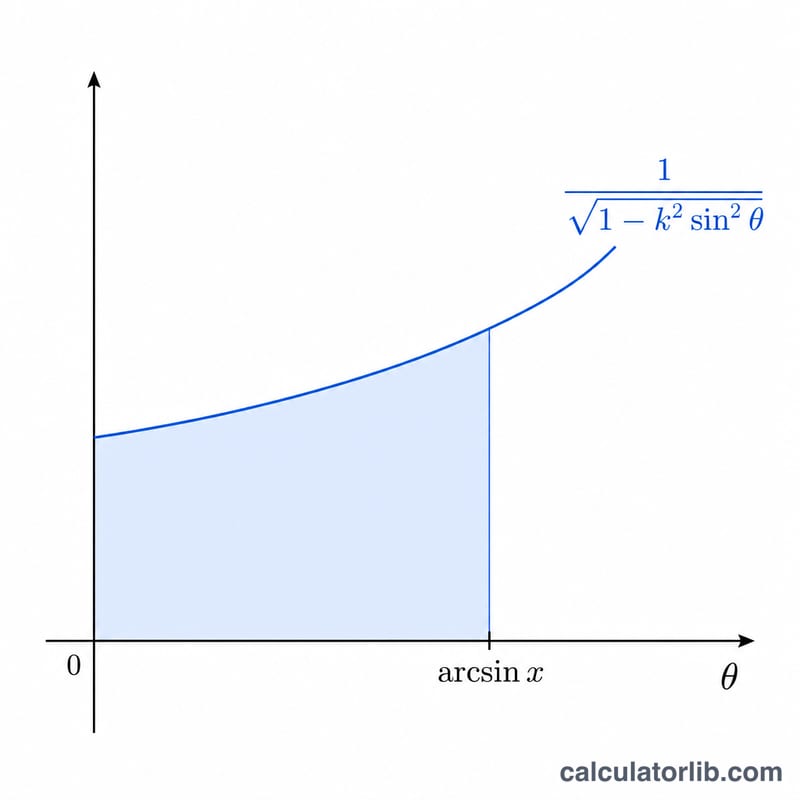
arcsn(x, k) is precisely the incomplete elliptic integral of the first kind evaluated at amplitude phi = arcsin(x):
$$\operatorname{arcsn}(x, k) = F(\arcsin x, k) = \int_{0}^{\arcsin x} \frac{d\theta}{\sqrt{1 - k^{2}\sin^{2}\theta}} = \int_{0}^{x} \frac{dt}{\sqrt{(1 - t^{2})(1 - k^{2} t^{2})}}$$ This calculator uses the modulus convention \(k\) (so the parameter is \(m = k^{2}\)). It is computed with Carlson's symmetric form $$\operatorname{arcsn}(x, k) = x \cdot R_F\!\left(1 - x^{2},\; 1 - k^{2}x^{2},\; 1\right),$$ where \(R_F\) is evaluated by the rapidly converging duplication algorithm. This gives full double precision and is exact in closed form.
How to use it
Enter x in the range -1 to 1 and the modulus k in the range 0 to 1, then read off u. The precision selector controls only how many digits are displayed; the underlying computation runs in double precision (about 15 significant figures).
Worked example
For x = 0.7 and k = 0.8: $$\operatorname{arcsn} = 0.7 \cdot R_F(0.51,\, 0.6864,\, 1) \approx 0.7 \cdot 1.18218 \approx 0.82753.$$ As a sanity check, with k = 0 the result would be \(\arcsin(0.7) = 0.77540\); because k = 0.8 makes the integrand denominator smaller than 1, the integral grows, so \(u > 0.7754\), consistent with 0.8275.
FAQ
What happens when k = 0? The integrand reduces to 1, so \(\operatorname{arcsn}(x, 0) = \arcsin(x)\).
What happens when k = 1? \(\operatorname{arcsn}(x, 1) = \operatorname{artanh}(x) = \tfrac{1}{2}\ln\!\left(\frac{1+x}{1-x}\right)\), which diverges as x approaches \(\pm 1\).
What is arcsn(±1, k) for k < 1? It equals \(\pm K(k)\), the complete elliptic integral of the first kind, a finite value. Only the combination k = 1 with x = ±1 diverges.