
What Is Telescope Magnification?
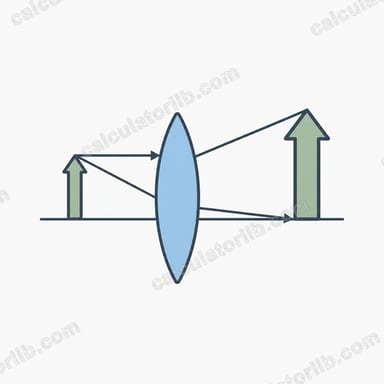
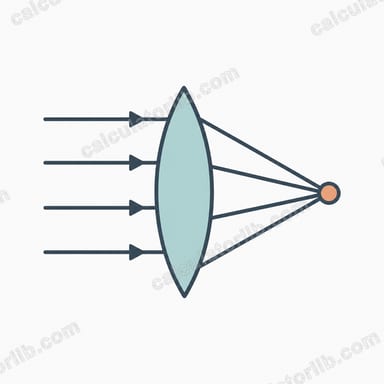
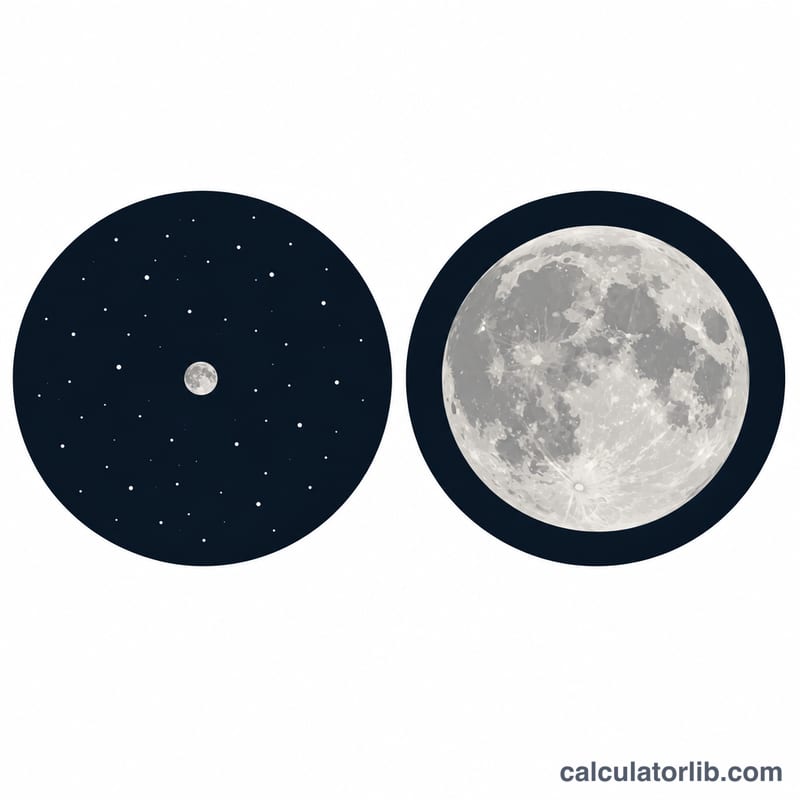
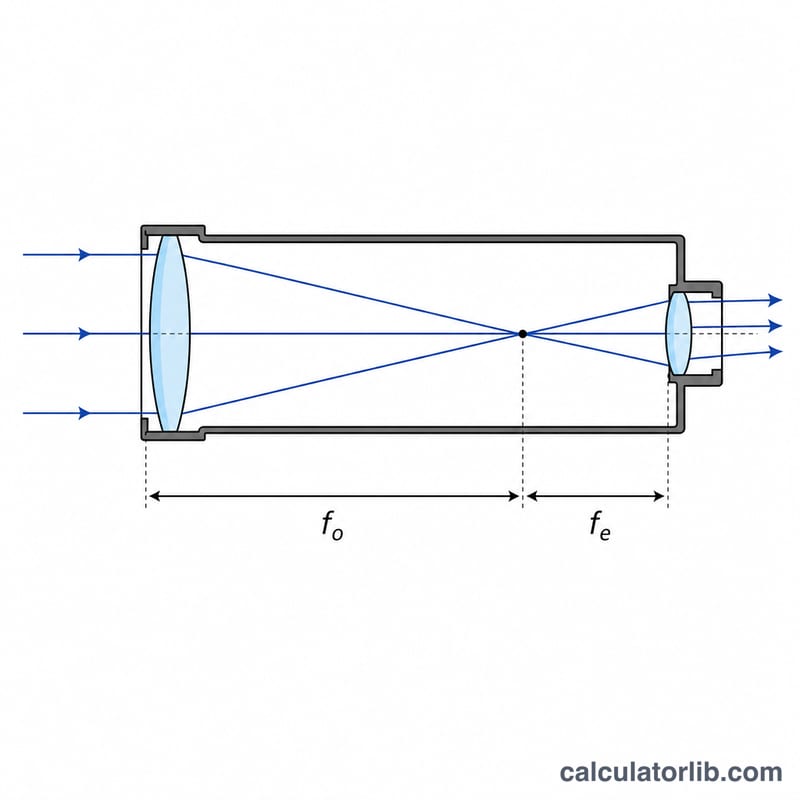
Telescope magnification (or "power") tells you how much larger an object appears through the telescope compared to the naked eye. It depends on two numbers: the focal length of your telescope (the objective) and the focal length of the eyepiece you insert. Because magnification is set by the eyepiece, swapping eyepieces is how you change power.
How to Use This Calculator
Enter your telescope's focal length in millimeters (usually printed on the tube or in the manual), then enter the focal length of your eyepiece (printed on the eyepiece, e.g. 25 mm). Optionally add your aperture in millimeters to also compute the exit pupil. Click calculate to see the magnification and exit pupil instantly.
The Formula Explained
The core formula is \( M = \frac{f_{\text{objective}}}{f_{\text{eyepiece}}} \). A shorter eyepiece focal length yields higher magnification. The exit pupil, the diameter of the beam of light leaving the eyepiece, is \( P = \frac{\text{aperture}}{M} \) — useful for matching your telescope to your eye and observing conditions.
Worked Example
Suppose your telescope has a focal length of 1000 mm and you use a 25 mm eyepiece. Then $$ M = \frac{1000}{25} = 40\times $$ With a 100 mm aperture, the exit pupil is $$ \frac{100}{40} = 2.5 \text{ mm} $$ a comfortable value for most viewing.
FAQ
What is the maximum useful magnification? A common rule of thumb is about \( 2\times \) the aperture in millimeters (or \( 50\times \) per inch). Beyond that the image grows dim and blurry.
Why does a smaller eyepiece give more power? Because magnification is inversely proportional to the eyepiece focal length — dividing by a smaller number gives a larger result.
What exit pupil should I aim for? Around 0.5–2 mm for planets and the Moon, and 4–7 mm for faint deep-sky objects under dark skies.