
What is beat frequency?
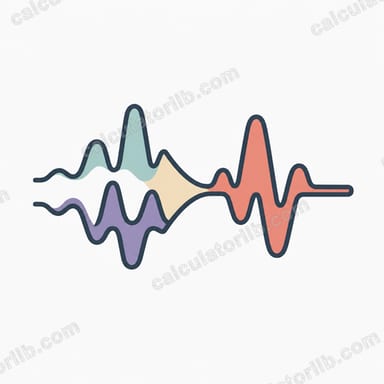
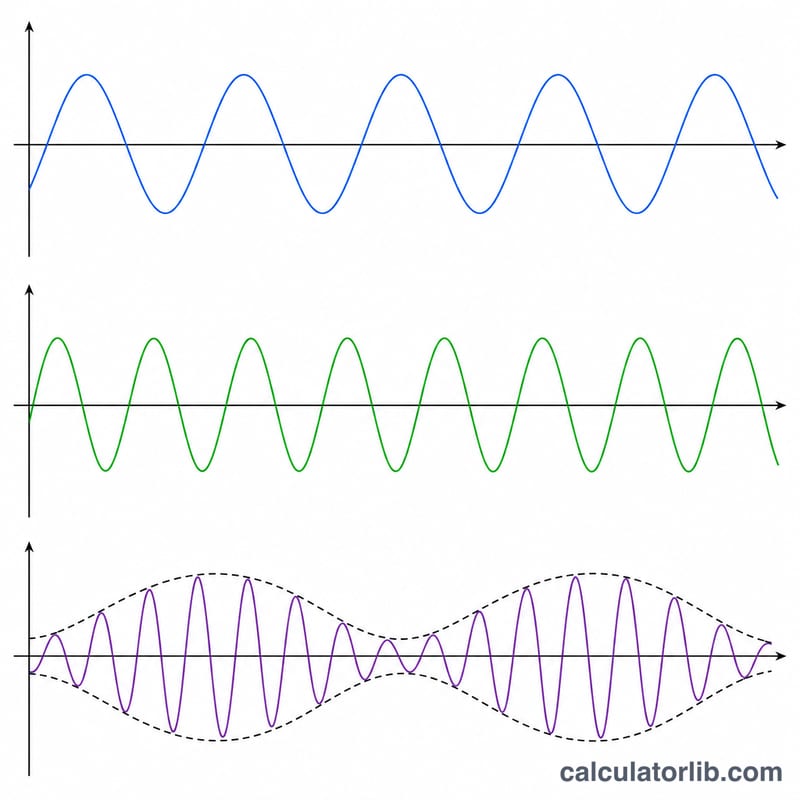
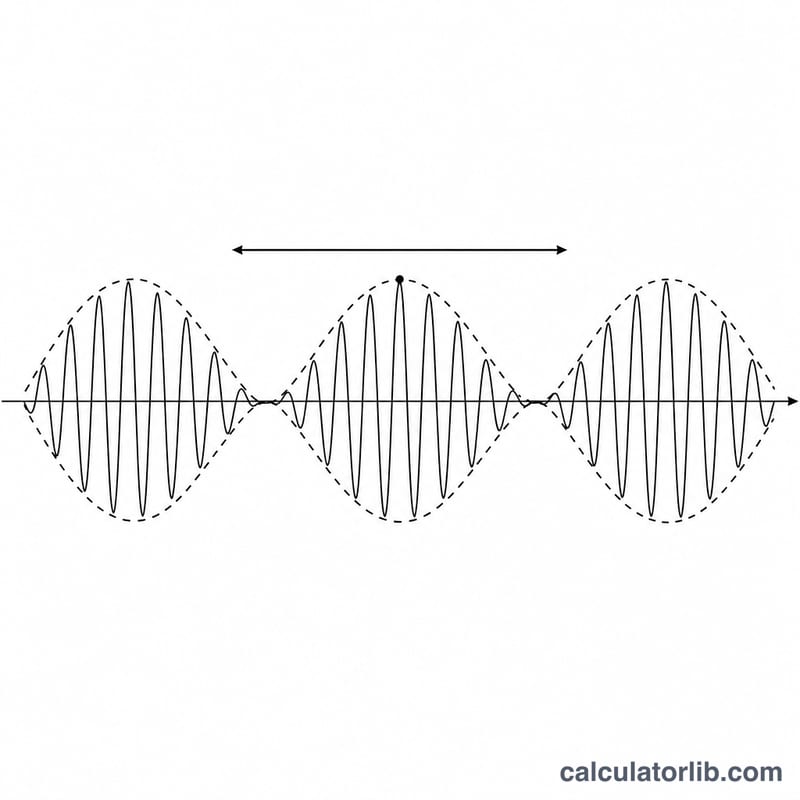
When two waves of slightly different frequencies overlap, their amplitudes alternately reinforce and cancel, producing a slow pulsing in loudness called beats. The rate of this pulsing — how many loud-soft cycles occur per second — is the beat frequency. This calculator works for any waves (sound, light, radio, vibrations) since the math is universal.
How to use this calculator
Enter the two source frequencies, \(f_1\) and \(f_2\), in hertz (Hz). The tool returns the beat frequency in Hz, the corresponding beat period in seconds, and the mean frequency (the pitch you actually perceive when the two tones are close together).
The formula explained
The beat frequency is simply the absolute value of the difference between the two frequencies:
$$f_{\text{beat}} = \left| f_1 - f_2 \right|$$
The absolute value ensures the result is always positive — it does not matter which frequency is larger. The beat period is the reciprocal, \(T = 1 / f_{\text{beat}}\), and the mean frequency is \((f_1 + f_2) / 2\).
Worked example
Two tuning forks vibrate at 256 Hz and 260 Hz. The beat frequency is $$|256 - 260| = 4 \text{ Hz},$$ meaning you hear 4 loudness pulses per second. The beat period is \(1 / 4 = 0.25 \text{ s}\), and the perceived pitch is \((256 + 260) / 2 = 258 \text{ Hz}\).
Interpreting Your Beat Frequency
The beat frequency \(f_{\text{beat}} = |f_1 - f_2|\) tells you how many amplitude pulses per second you hear when two tones of nearly equal frequency sound together. The result is always expressed in hertz (Hz), and the beat period is simply its reciprocal, \(T_{\text{beat}} = 1/f_{\text{beat}}\). The way this rate is perceived depends strongly on its magnitude.
How the beat rate is perceived
| Beat rate \(f_{\text{beat}}\) | Perception |
|---|---|
| Below ~7 Hz | Heard as distinct, countable pulses — a slow "wah-wah" swelling and fading of loudness. Easy to use for tuning. |
| ~7–20 Hz | The pulses blur together into a sensation of roughness or fluttering rather than separable beats. |
| Above ~20 Hz | The fluctuation is no longer heard as beats at all; the frequency difference itself begins to be perceived as a distinct, separate tone. |
What a lower beat rate means
A lower beat frequency means the two frequencies are closer together — the tones are more nearly in unison. As \(f_1\) and \(f_2\) converge, the beats slow down and the beat period lengthens; when the two frequencies are identical the beat rate falls to 0 Hz and the pulsing disappears entirely. This is the physical basis for tuning by ear: a musician or technician adjusts one source until the audible beats slow to a crawl and then vanish, signalling a match.
Worked example
Suppose one string sounds the A above middle C at the modern concert-pitch standard \(f_1 = 440\ \text{Hz}\) (ISO 16) and a second string sounds \(f_2 = 444\ \text{Hz}\). The beat frequency is
$$f_{\text{beat}} = |440 - 444| = \,$$ 4 Hz.
At 4 Hz the beats fall below the ~7 Hz threshold, so they are heard as four clear, countable swells of loudness each second — slow enough to count and use for tuning. The mean perceived pitch sits at the average, \((440+444)/2 = 442\ \text{Hz}\), and the beat period is \(1/4 = 0.25\ \text{s}\) between successive pulses.
Tying the result to standards
Because beat frequency is an absolute difference, it carries no information about which source is higher — only how far apart they are. To resolve the direction you must change one frequency slightly and observe whether the beats speed up or slow down. When comparing against a reference such as the A4 = 440 Hz pitch standard, a falling beat rate indicates you are approaching the target frequency. These figures describe the acoustics and the typical limits of human hearing; they are general physical information, not a prescription for any specific instrument, measurement procedure, or hearing assessment.
FAQ
Why do I hear beats? Because the two waves drift in and out of phase, their combined amplitude rises and falls at the difference frequency.
What if both frequencies are equal? The beat frequency is 0 Hz — no beating occurs, and the beat period is undefined (infinite).
Are beats used in tuning instruments? Yes. Musicians tune by minimizing the beat rate between a reference tone and the instrument until the beats slow to zero.