
What Is the Alfvén Velocity?
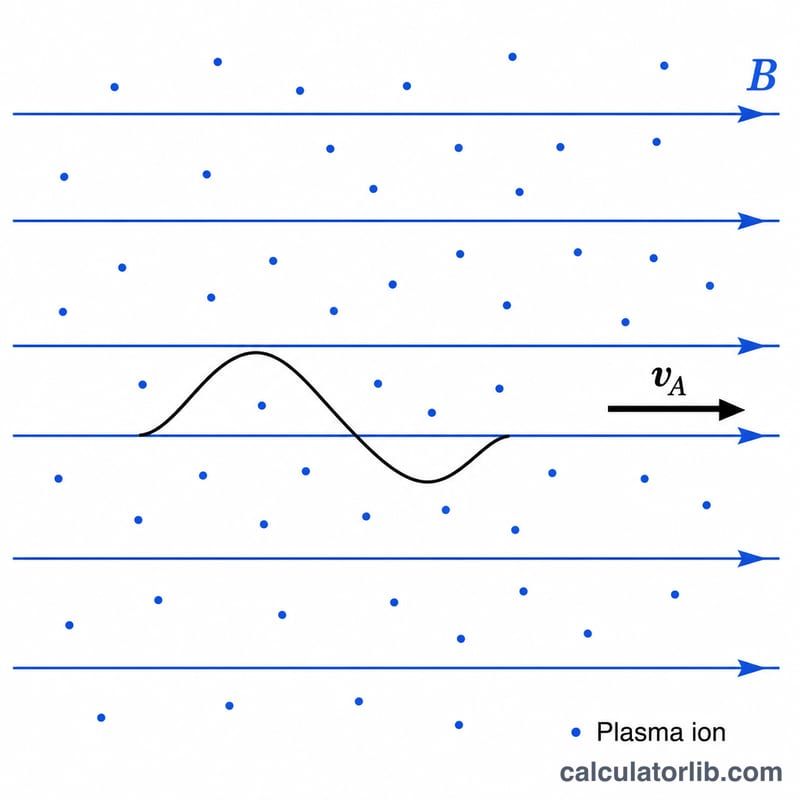
The Alfvén velocity is the characteristic propagation speed of Alfvén waves — transverse magnetohydrodynamic (MHD) waves that travel along magnetic field lines in an electrically conducting fluid such as a plasma. It is a fundamental quantity in space physics, solar physics, astrophysics, and fusion research, describing how quickly magnetic disturbances move through ionized matter.
How to Use This Calculator
Enter the magnetic field strength B in tesla and the plasma mass density ρ in kilograms per cubic metre. The calculator returns the Alfvén velocity in metres per second. Mass density is the number density of particles multiplied by the average particle mass (e.g. for a hydrogen plasma, \(\rho \approx n \times 1.6726 \times 10^{-27}\ \text{kg}\)).
The Formula Explained
The Alfvén speed is given by:
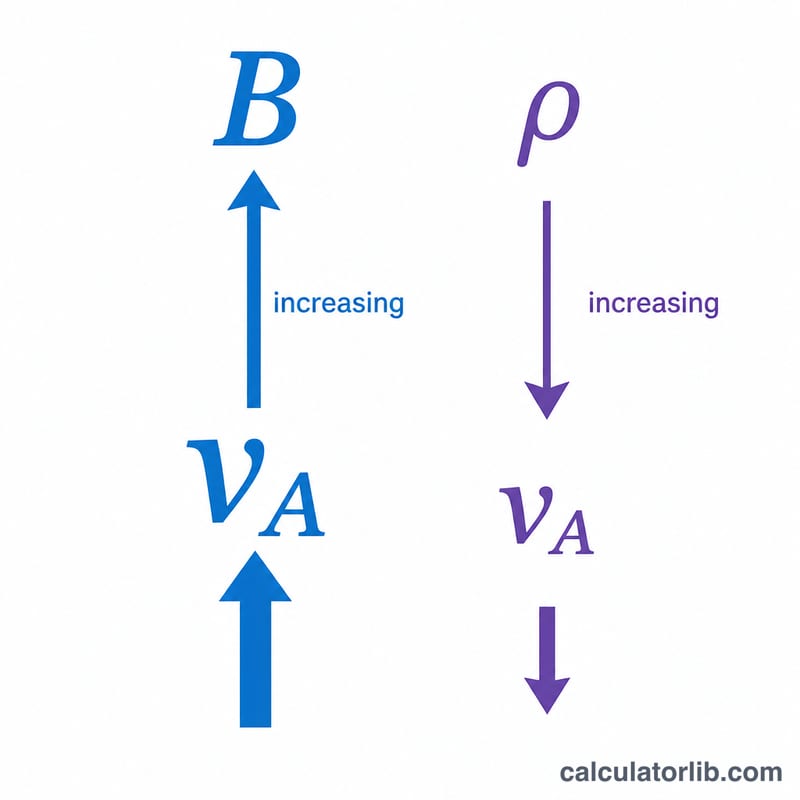
$$v_A = \dfrac{B}{\sqrt{\mu_0 \, \rho}}$$Here \(\mu_0 = 4\pi \times 10^{-7}\ \text{H/m}\) is the vacuum permeability (magnetic constant). A stronger magnetic field increases the wave speed, while a denser plasma (more inertia) slows it down. In SI units the result comes out directly in m/s.
Worked Example
Suppose \(B = 0.01\ \text{T}\) and \(\rho = 1 \times 10^{-12}\ \text{kg/m}^3\). Then $$\mu_0 \cdot \rho = 1.2566 \times 10^{-6} \times 10^{-12} = 1.2566 \times 10^{-18}.$$ Its square root is \(\approx 1.1210 \times 10^{-9}\). Dividing: $$v_A = \frac{0.01}{1.1210 \times 10^{-9}} \approx 8.92 \times 10^{6}\ \text{m/s}$$ — close to 3% of the speed of light.
Constants Used in the Calculation
The Alfvén velocity formula requires the vacuum permeability \(\mu_0\). The other constants below are useful for converting a measured particle number density into a mass density \(\rho\) (for a hydrogen plasma, \(\rho \approx n\,m_p\)) and for checking whether the result is non-relativistic (\(v_A \ll c\)).
| Constant | Symbol | Value | Units |
|---|---|---|---|
| Vacuum permeability | \(\mu_0\) | \(4\pi\times10^{-7} \approx 1.25664\times10^{-6}\) | H/m (T·m/A) |
| Proton mass | \(m_p\) | \(1.6726\times10^{-27}\) | kg |
| Electron mass | \(m_e\) | \(9.109\times10^{-31}\) | kg |
| Speed of light | \(c\) | \(2.998\times10^{8}\) | m/s |
Note that the electron mass is about 1836 times smaller than the proton mass, so in a quasi-neutral hydrogen plasma the mass density is dominated almost entirely by the ions. The factor \(\mu_0\) is exact in the older SI definition (\(4\pi\times10^{-7}\)); since the 2019 SI redefinition it is an experimentally determined quantity that remains equal to this value to within measurement uncertainty.
FAQ
Can the Alfvén speed exceed the speed of light? The classical formula can yield super-luminal values in extremely low-density, strongly magnetized regions; a relativistic correction is then required for accurate results.
What units should I use? SI units throughout: tesla for B and kg/m³ for ρ give the velocity in m/s.
How do I get mass density from particle density? Multiply the number density (particles/m³) by the mean particle mass in kilograms.