
What Is Terminal Velocity?
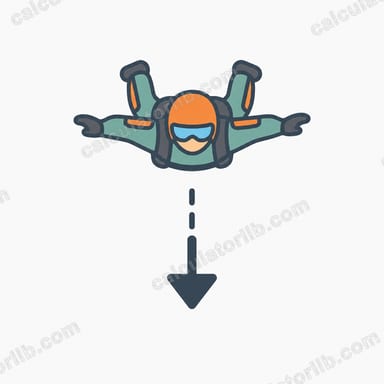
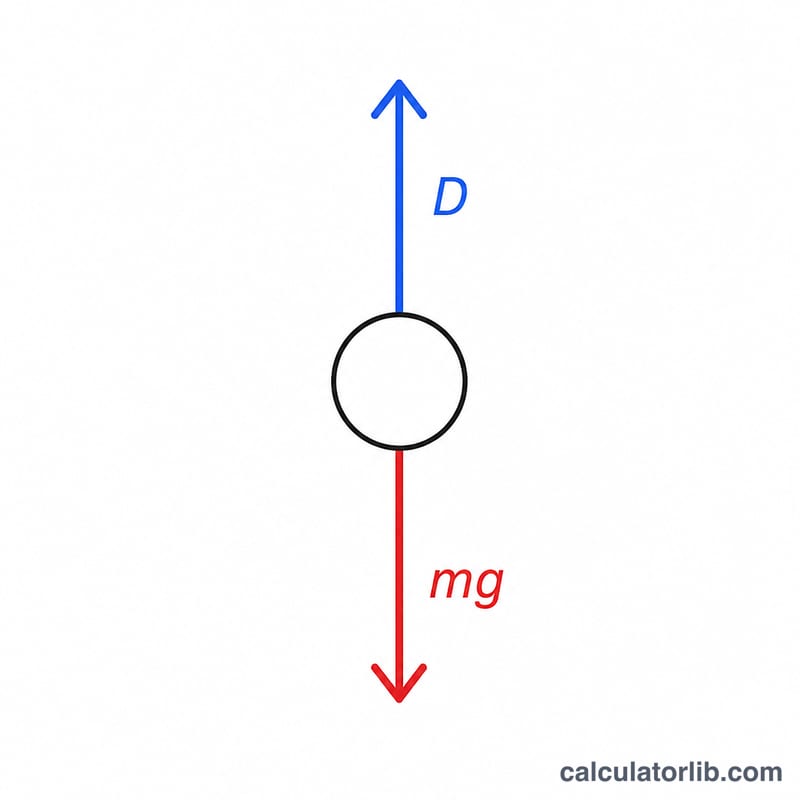
Terminal velocity is the constant maximum speed an object reaches when falling through a fluid (such as air or water). At this speed the upward drag force exactly balances the downward force of gravity, so the net force is zero and the object stops accelerating. This calculator works for any falling object, any fluid, and any gravity value — making it universal for physics homework, skydiving estimates, and engineering studies.
How to Use the Calculator
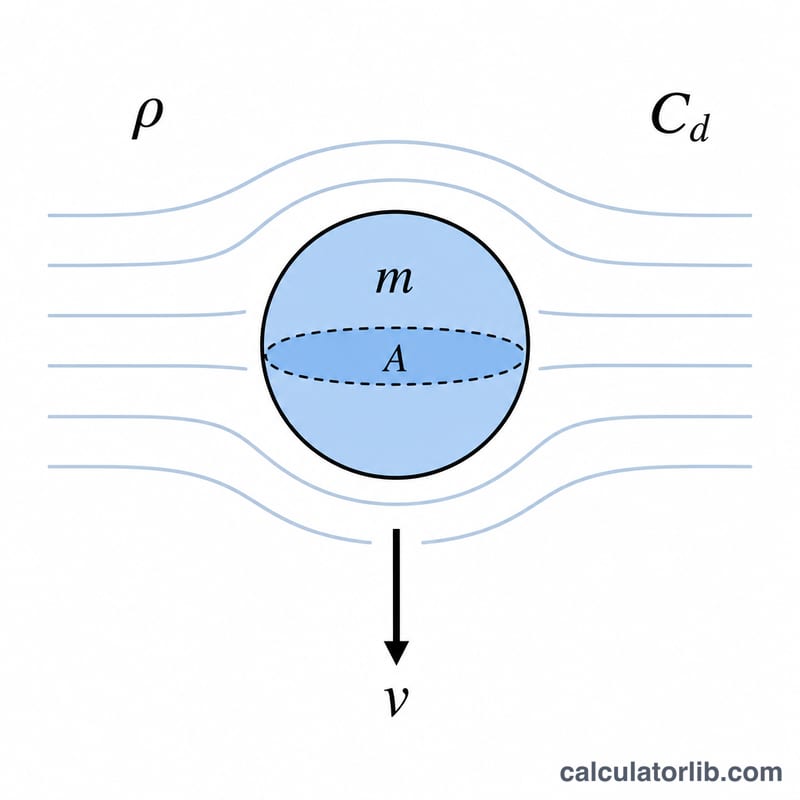
Enter the object's mass in kilograms, the gravitational acceleration (9.81 m/s² on Earth), the density of the surrounding fluid (about 1.225 kg/m³ for air at sea level), the cross-sectional area facing the flow in square metres, and the dimensionless drag coefficient (around 1.0 for a person, 0.47 for a sphere). The tool returns terminal velocity in m/s, km/h and mph.
The Formula Explained
The equation is $$v = \sqrt{\dfrac{2 \cdot m \cdot g}{\rho \cdot A \cdot Cd}}$$. It comes from setting the drag force \(\tfrac{1}{2} \cdot \rho \cdot v^2 \cdot A \cdot Cd\) equal to the weight \(m \cdot g\) and solving for \(v\). A heavier or denser object falls faster, while a larger area, denser fluid, or higher drag coefficient slows it down.
Worked Example
For a 75 kg skydiver with \(g = 9.81\), \(\rho = 1.225\) kg/m³, \(A = 0.7\) m² and \(Cd = 1.0\): numerator = \(2 \times 75 \times 9.81 = 1471.5\); denominator = \(1.225 \times 0.7 \times 1.0 = 0.8575\). So $$v = \sqrt{\dfrac{1471.5}{0.8575}} = \sqrt{1716.04} \approx 41.4 \text{ m/s}$$ or about 149 km/h — close to the real belly-down skydiving speed.
FAQ
Does mass affect terminal velocity? Yes — a heavier object has a higher terminal velocity, because more weight must be balanced by drag.
What is a typical drag coefficient? About 1.0–1.3 for a flat-faced human, 0.47 for a smooth sphere, and as low as 0.04 for a streamlined teardrop.
Why use fluid density? Falling through water (\(\rho \approx 1000\)) gives a far lower terminal velocity than falling through air (\(\rho \approx 1.225\)) for the same object.