
What Is Orbital Velocity?
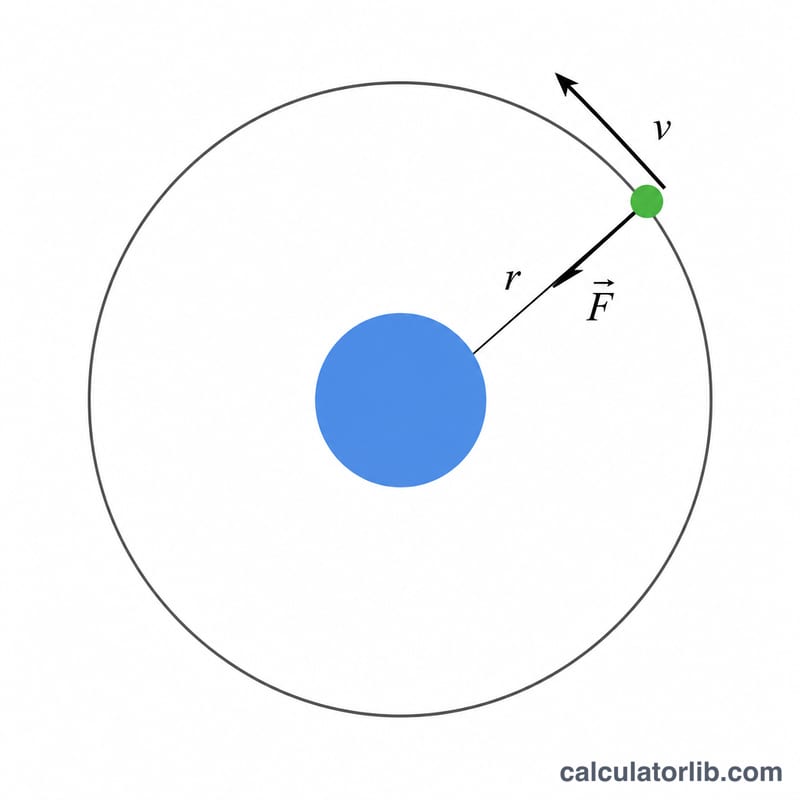
Orbital velocity is the speed an object must travel to stay in a stable circular orbit around a more massive body, such as a satellite around Earth or a planet around the Sun. At this speed, the gravitational pull of the central body exactly supplies the centripetal force needed to keep the object curving around it. Too slow and it falls inward; too fast and it escapes.
The Formula
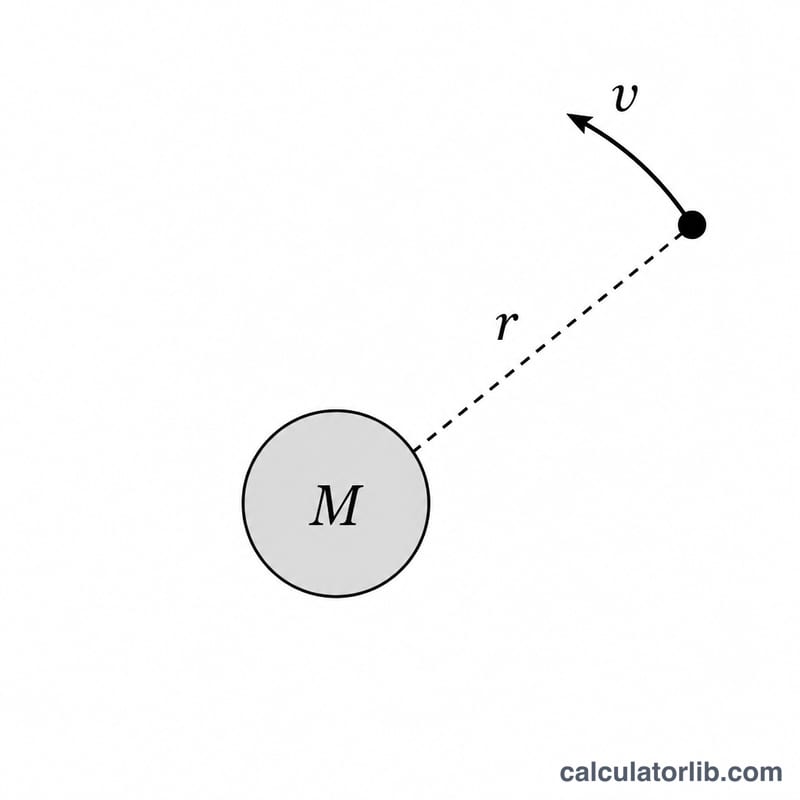
For a circular orbit, orbital velocity is given by $$v = \sqrt{\dfrac{G \cdot M}{r}}$$ where G is the gravitational constant (\(6.674 \times 10^{-11}\ \text{N}\cdot\text{m}^2/\text{kg}^2\)), M is the mass of the central body in kilograms, and r is the orbital radius in meters (measured from the center of the central body, not its surface). The result is in meters per second. The orbital period — the time for one complete loop — follows from \(T = 2\pi r / v\).
How to Use It
Enter the mass of the central body (for Earth, about \(5.972 \times 10^{24}\) kg) and the orbital radius. You can type scientific notation like 5.972e24. The calculator returns the velocity in m/s and km/s, plus the orbital period in seconds.
Worked Example
Consider a satellite orbiting at Earth's surface radius, \(r = 6.371 \times 10^{6}\) m, with \(M = 5.972 \times 10^{24}\) kg. Then $$v = \sqrt{\frac{6.674 \times 10^{-11} \times 5.972 \times 10^{24}}{6.371 \times 10^{6}}} \approx \sqrt{6.256 \times 10^{7}} \approx 7{,}910\ \text{m/s}$$ or about 7.91 km/s. This is close to the well-known low-Earth-orbit speed of roughly 7.9 km/s.
FAQ
Is the radius measured from the surface? No — it is measured from the center of the central body. For a low orbit, add the body's radius to the altitude.
Does this assume a circular orbit? Yes. This formula gives the speed for a perfectly circular orbit. Elliptical orbits have varying speed described by the vis-viva equation.
What about escape velocity? Escape velocity is \(\sqrt{2}\) times the circular orbital velocity at the same radius.