
What Is Specific Impulse?
Specific impulse (Isp) is the key performance measure of a rocket engine or jet propulsion system. It tells you how efficiently a propellant is converted into thrust — essentially how many seconds one unit weight of propellant can produce one unit of thrust. A higher Isp means more efficient use of propellant, which directly affects how much payload a rocket can carry and how far it can travel.
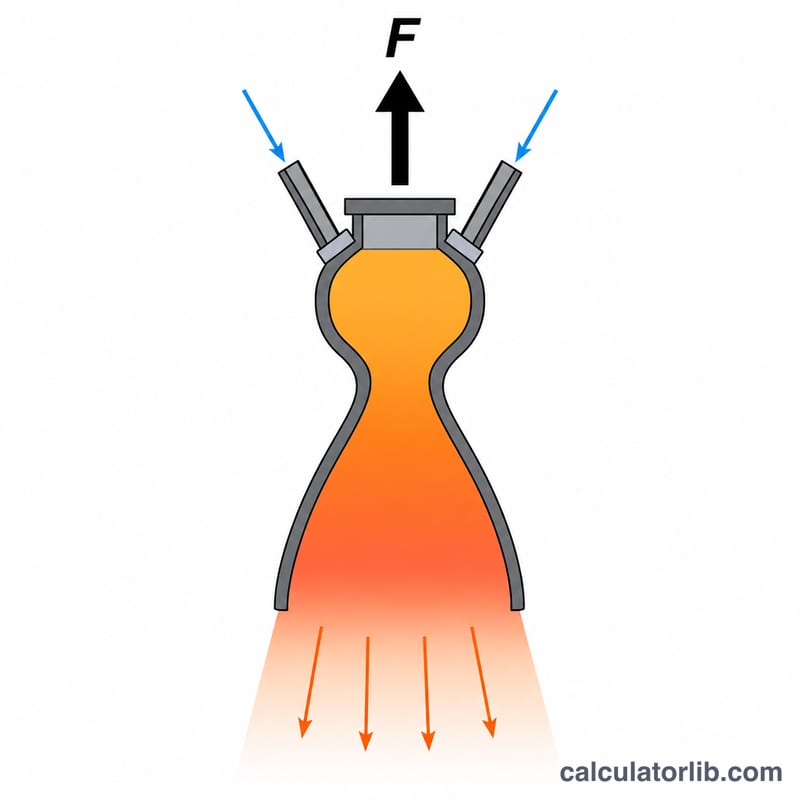
How to Use This Calculator
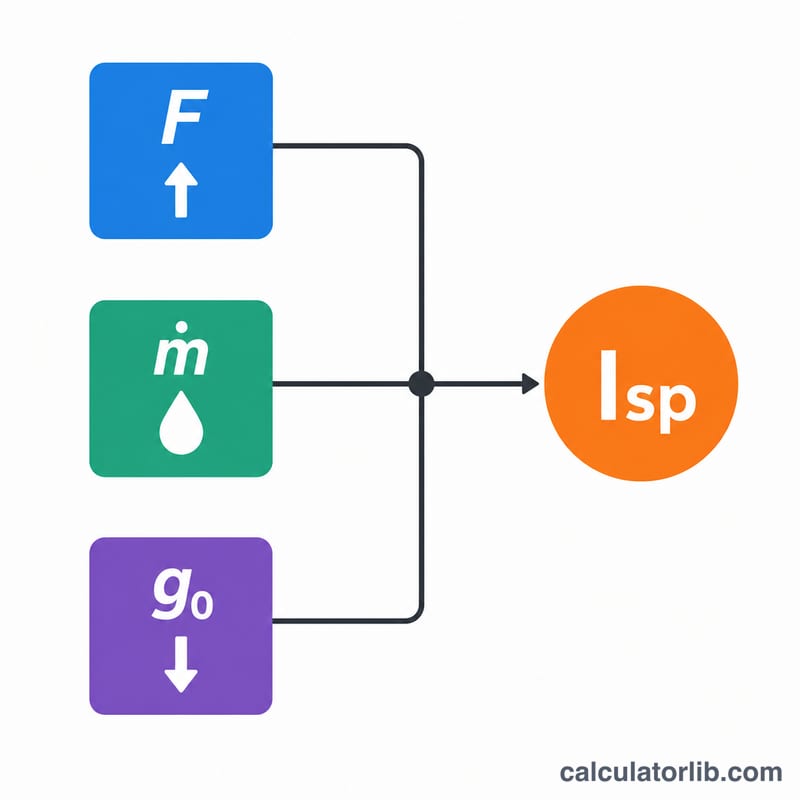
Enter three values: the thrust F in newtons, the propellant mass flow rate ṁ in kilograms per second, and the standard gravity g₀ (default 9.80665 m/s²). The calculator returns the specific impulse in seconds and the effective exhaust velocity in metres per second.
The Formula Explained
The governing equation is $$I_{sp} = \frac{F}{\dot{m} \cdot g_0}$$ Thrust divided by mass flow rate gives the effective exhaust velocity (ve) in m/s. Dividing that by standard gravity converts it into the more commonly quoted Isp expressed in seconds. Engineers use seconds because it is independent of the unit system, making engine comparisons easy worldwide.
Worked Example
Suppose an engine produces 1,000 N of thrust while consuming propellant at 0.5 kg/s, with g₀ = 9.80665 m/s². Then $$v_e = \frac{1000}{0.5} = 2000 \text{ m/s}$$ and $$I_{sp} = \frac{2000}{9.80665} \approx 203.94 \text{ seconds}$$ This is typical of a modest chemical thruster.
FAQ
Why is Isp measured in seconds? Dividing exhaust velocity by g₀ removes unit dependence, so the same number works in metric or imperial systems.
What is a good Isp? Solid rockets are ~250 s, liquid kerosene engines ~300–340 s, hydrogen engines ~450 s, and ion thrusters can exceed 3,000 s.
Does Isp depend on altitude? Yes — engines usually have higher Isp in vacuum than at sea level because back pressure reduces effective thrust.