
What Is Impulse and Momentum?
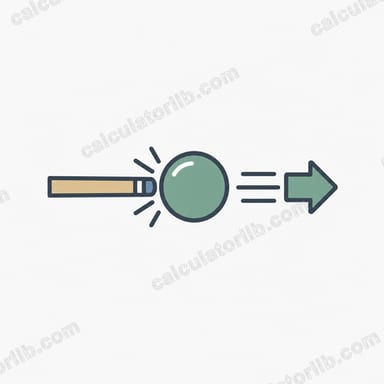
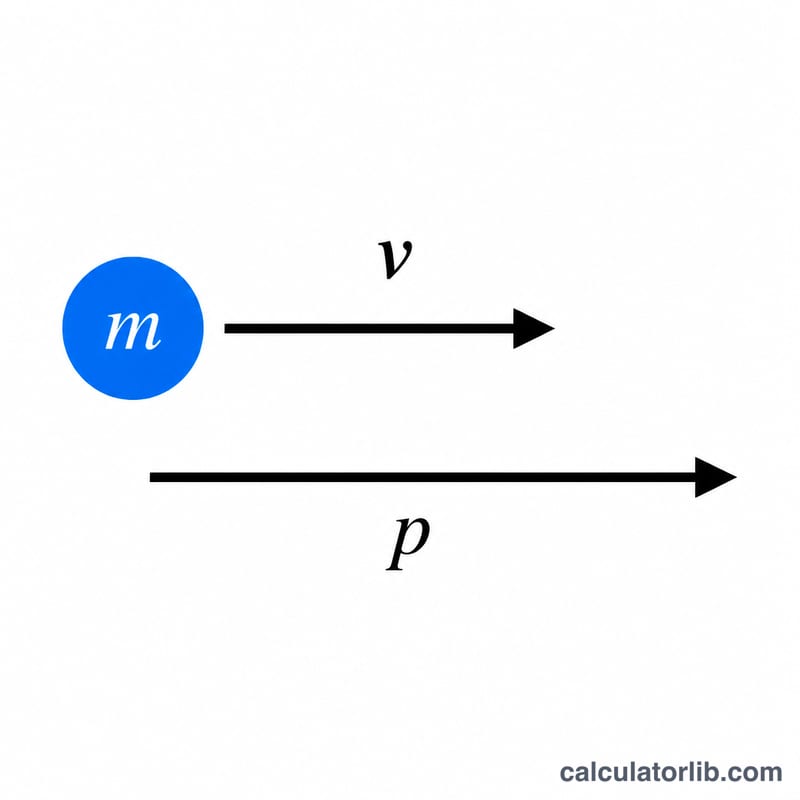
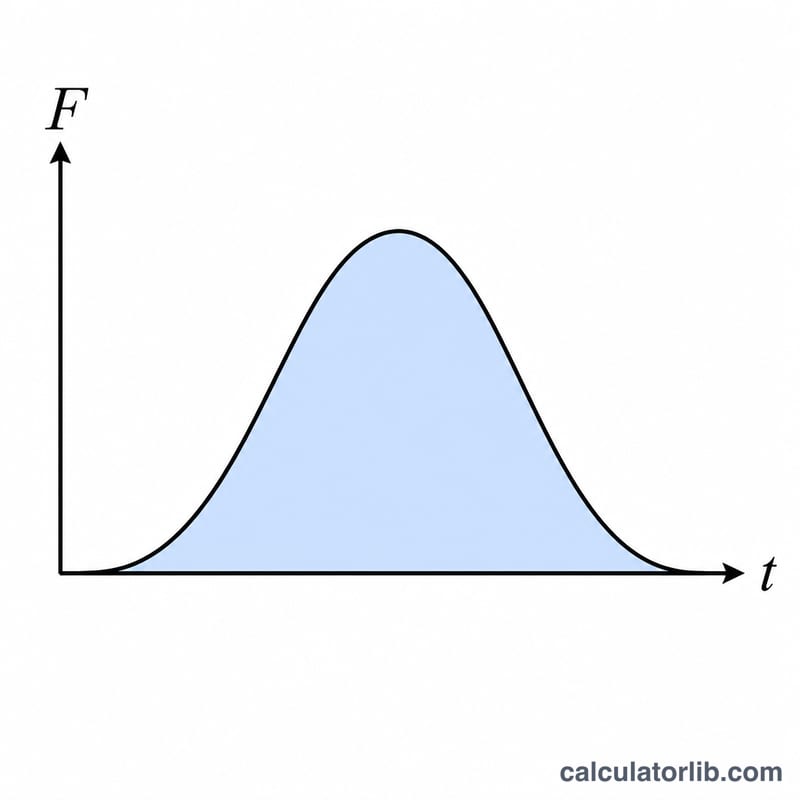
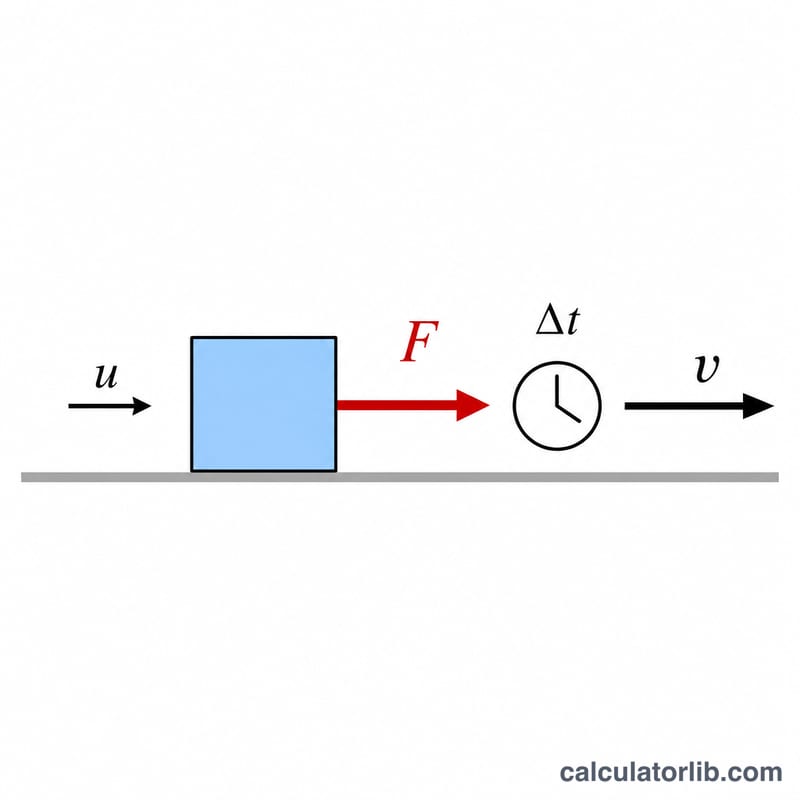
Momentum (p) is the product of an object's mass and velocity, \(p = m\cdot v\), measured in kilogram-metres per second (kg·m/s). Impulse (J) is the effect of a force acting over a time interval, \(J = F\cdot\Delta t\), measured in newton-seconds (N·s). The impulse–momentum theorem links them: the impulse applied to an object equals its change in momentum. This calculator uses that relationship to find impulse, initial and final momentum, and the average force.
How to Use the Calculator
Enter the object's mass in kilograms, its initial velocity (u) and final velocity (v) in metres per second, and the time interval (Δt) in seconds over which the change occurs. The tool returns the impulse (equal to the change in momentum), the initial and final momentum, and the average force. Velocities can be negative to indicate the opposite direction.
The Formula Explained
The core equation is $$J = F\cdot\Delta t = \Delta p = m\left(v - u\right).$$ The change in momentum \(\Delta p\) is final momentum minus initial momentum, \(m\cdot v - m\cdot u\). Because impulse equals this change, dividing impulse by the time interval gives the average force: \(F = J / \Delta t\). Note that 1 N·s is exactly equal to 1 kg·m/s, so impulse and momentum share units.
Worked Example
A 2 kg ball starts at rest (\(u = 0\) m/s) and reaches 10 m/s in 2 s. The impulse is $$J = 2 \times (10 - 0) = 20\ \text{N}\cdot\text{s}.$$ The initial momentum is \(2 \times 0 = 0\) kg·m/s, and the final momentum is \(2 \times 10 = 20\) kg·m/s. The average force is \(F = 20 / 2 = 10\) N.
FAQ
Are impulse and momentum the same thing? They have the same units and impulse equals the change in momentum, but momentum is a property of a moving object while impulse describes the force–time effect that changes it.
Can velocity be negative? Yes. Velocity is a vector, so use a negative sign for motion in the opposite direction (e.g. a ball bouncing back).
What if Δt is zero? Average force is undefined for a zero time interval, so the calculator reports a force of 0 in that case while still showing the impulse and momentum.