
What is the Momentum Calculator?
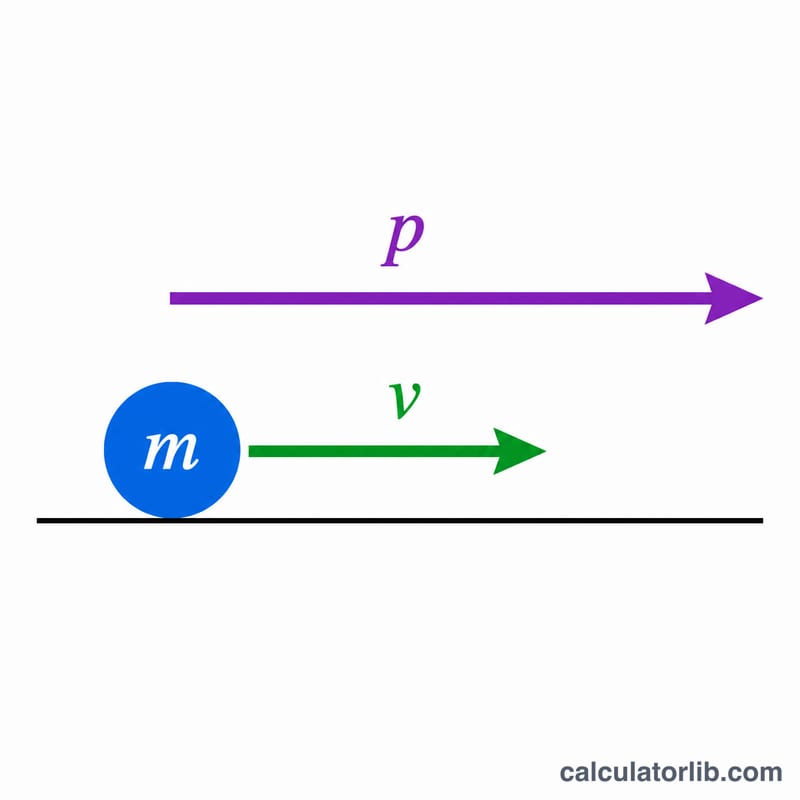
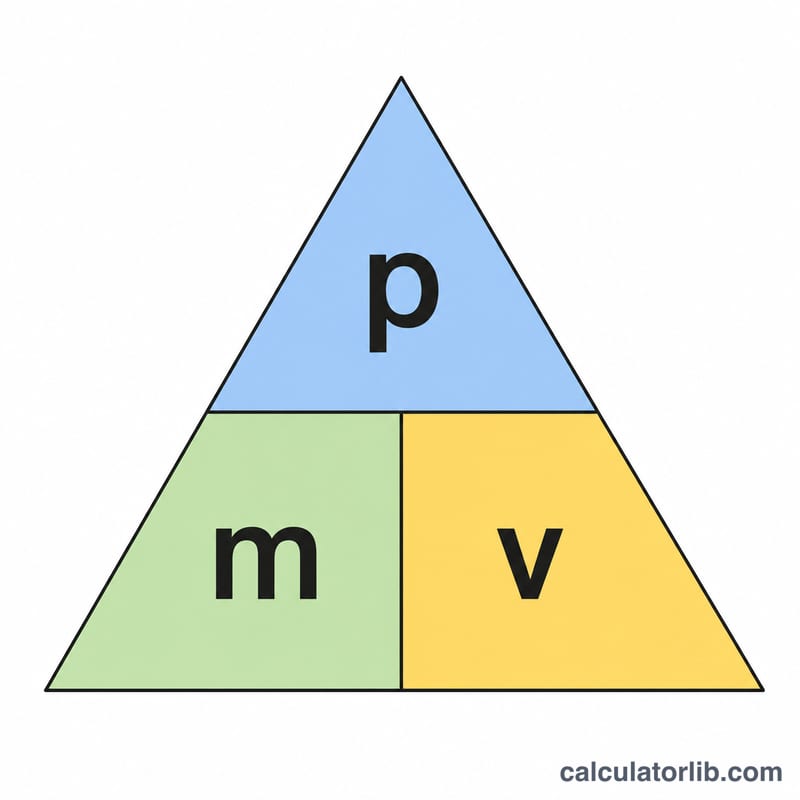
Linear momentum is a vector quantity defined as the product of an object's mass and its velocity, written \(p = m \cdot v\). It measures "how much motion" an object carries and is conserved in collisions and explosions. This calculator solves the relation for any one of the three quantities — momentum \(p\), mass \(m\), or velocity \(v\) — given the other two, and converts freely between common unit systems (SI, CGS, and US customary).
How to use it
Choose what you want to solve for in the "Solve for" menu. The tool then shows the two known quantities as inputs and computes the third. Each field has its own unit dropdown, so you can mix units such as grams with kilometers per hour. Enter values normally or in scientific notation (for example 3.45e22). Optionally pick a number of significant figures for the displayed answer; "auto" keeps full precision.
The formula explained
The core relation is $$p = m \cdot v.$$ Rearranging gives \(m = p / v\) and \(v = p / m\). Internally every input is converted to SI base units (kilograms, meters per second, kilogram-meters per second), the chosen formula is applied, and the SI result is converted back into the unit you selected for the output. Because mass mode and velocity mode involve division, the calculator guards against a zero divisor and reports an error instead of returning infinity.
Worked example
A 5 kg object moves at 10 m/s. In momentum mode: $$p = 5 \times 10 = 50 \ \text{kg}\cdot\text{m/s}.$$ Now switch to mass mode with \(p = 50 \ \text{N}\cdot\text{s}\) and \(v = 36 \ \text{km/h}\). Converting velocity, \(36 \ \text{km/h} = 10 \ \text{m/s}\), so $$m = 50 / 10 = 5 \ \text{kg},$$ which equals about 11.0231 lb if the output unit is pounds.
FAQ
Can momentum be negative? Yes. Momentum is a vector, so a negative velocity (opposite direction) produces a negative momentum.
Why is mass required to be positive? Mass is a physical scalar that cannot be negative; only direction (carried by velocity) can be negative.
Are N·s and kg·m/s the same? Yes — one newton-second equals one kilogram-meter per second, so both use the SI factor of 1.