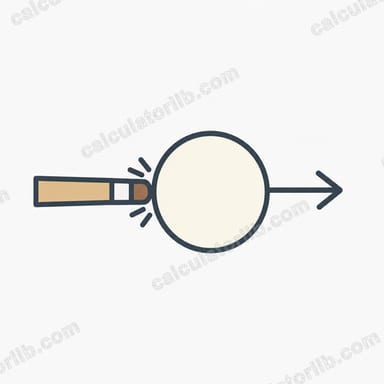

What Is the Impulse-Momentum Calculator?
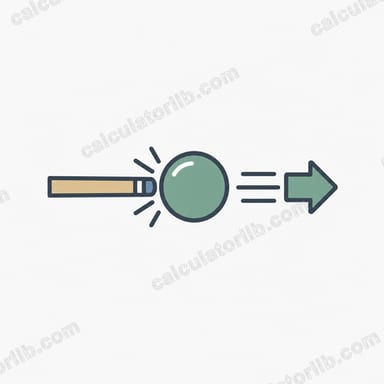
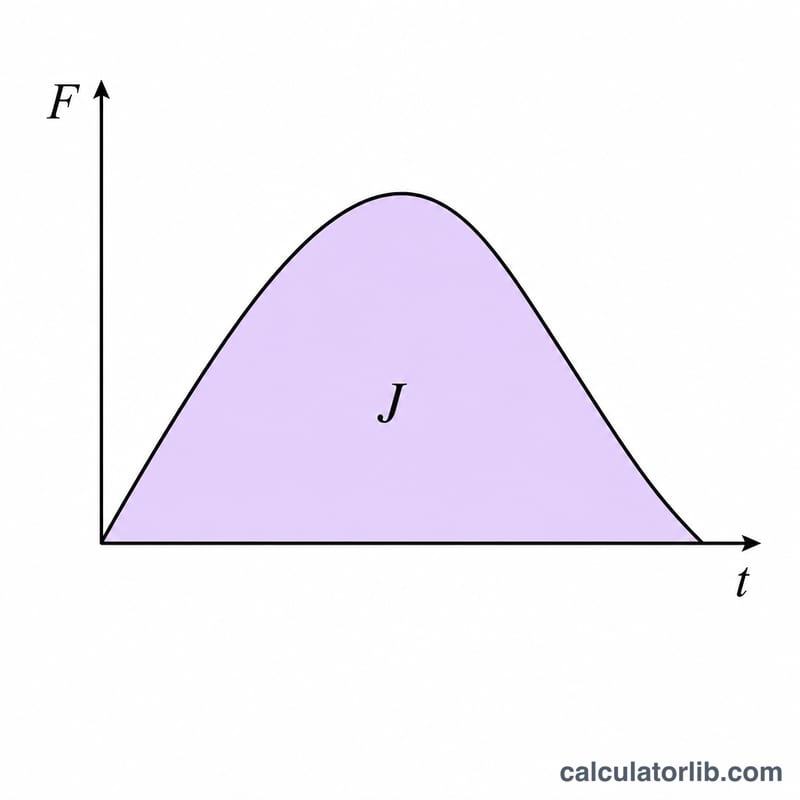
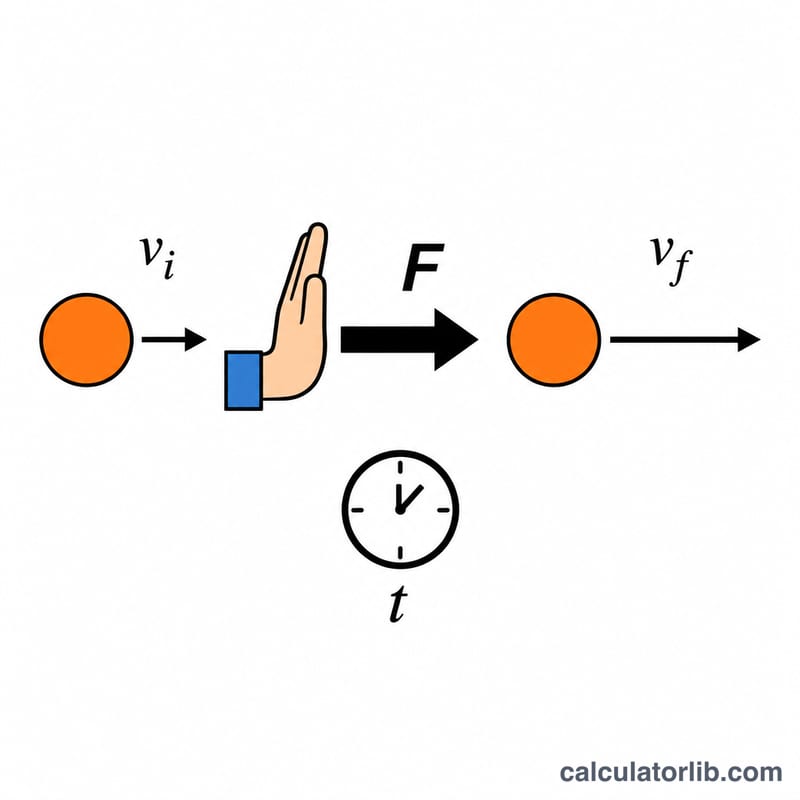
This tool applies the impulse-momentum theorem, one of the foundational results of classical mechanics. Impulse (\(J\)) is the product of the average force acting on an object and the time interval over which it acts, and it equals the change in the object's linear momentum. Enter an object's mass, its initial and final velocity, and the contact time to instantly find the impulse, the initial and final momentum, and the average force involved.
How to Use It
Provide four values: mass in kilograms, initial velocity (\(v_i\)) and final velocity (\(v_f\)) in meters per second, and the time of contact in seconds. The calculator returns the impulse in newton-seconds (equivalent to kg·m/s), the momentum before and after, and the average force in newtons. Use a negative velocity to indicate motion in the opposite direction — for example a ball bouncing back off a wall.
The Formula Explained
The impulse-momentum theorem states $$J = \Delta p = m\,(v_f - v_i)$$ Because impulse is also the time integral of force, for a constant or average force we can write \(J = F \cdot t\). Rearranging gives the average force $$F = \frac{J}{t}$$ Momentum itself is \(p = m \cdot v\), so the initial momentum is \(m \cdot v_i\) and the final momentum is \(m \cdot v_f\).
Worked Example
A 2 kg object accelerates from rest (\(v_i = 0\) m/s) to \(v_f = 10\) m/s during a 0.5 s push. The impulse is $$J = 2 \times (10 - 0) = 20 \ \text{N}\cdot\text{s}$$ The initial momentum is 0 kg·m/s and the final momentum is 20 kg·m/s. The average force is $$F = \frac{20}{0.5} = 40 \ \text{N}$$
FAQ
What are the units of impulse? Impulse is measured in newton-seconds (N·s), which is dimensionally identical to kilogram-meters per second (kg·m/s), the unit of momentum.
What if I don't know the time? Leave the time field empty or set it to zero — the impulse and momentum change are still computed, but the average force will show as 0 because dividing by zero is undefined.
Can velocities be negative? Yes. Use a sign convention: positive for one direction, negative for the opposite. A rebound that reverses direction produces a larger impulse than simply stopping.