
What is an isosceles triangle?
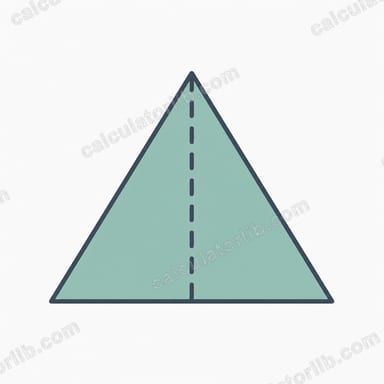
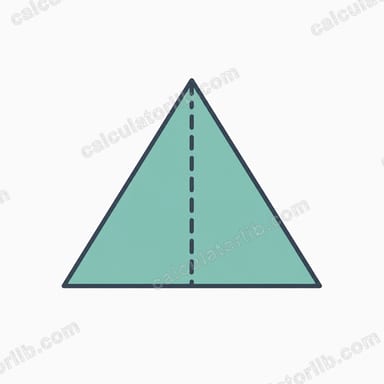
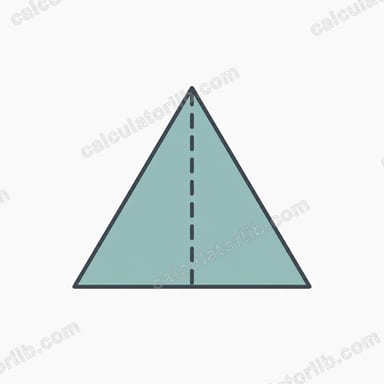
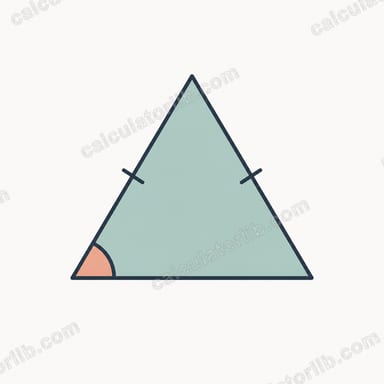
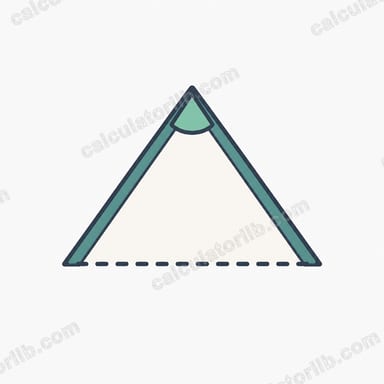
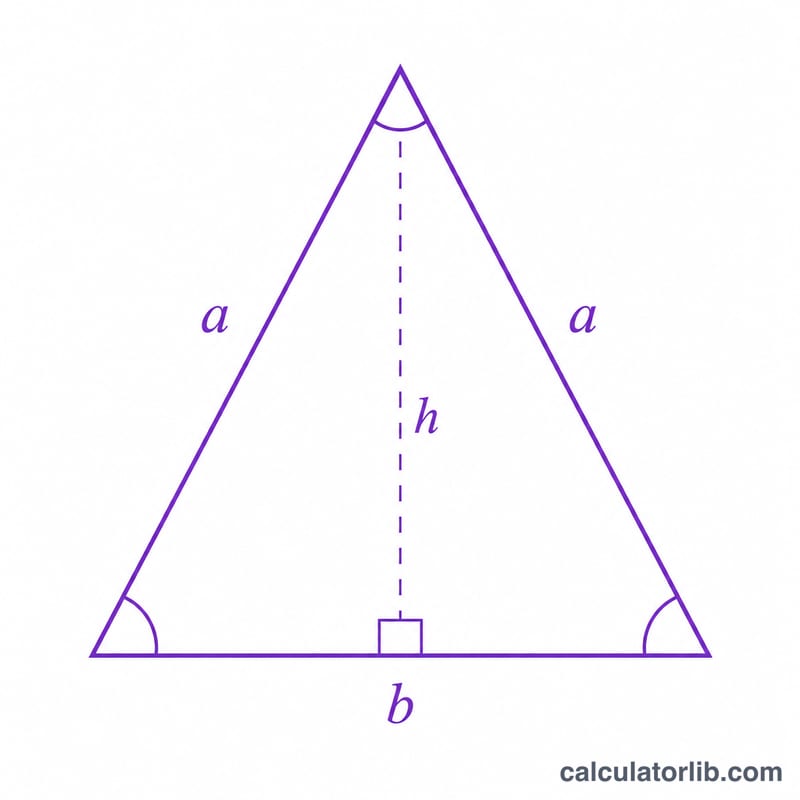
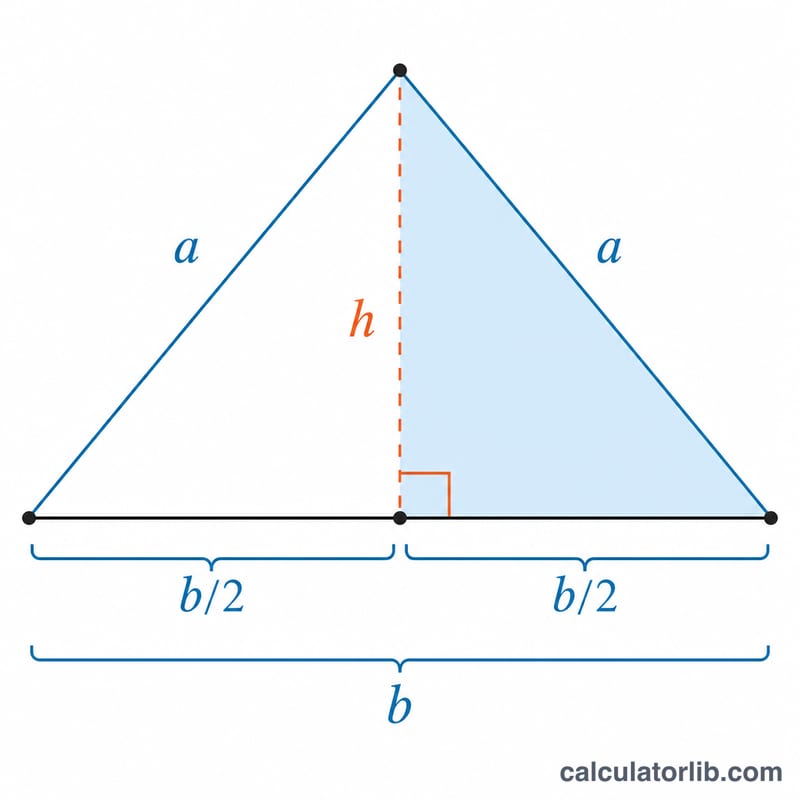
An isosceles triangle has two sides of equal length (the legs, a) and a third side (the base, b). The two angles opposite the equal sides are also equal. This calculator computes the area, altitude (height to the base), perimeter, base angles and vertex angle from just a and b.
How to use it
Enter the length of the two equal sides (a) and the base (b), then submit. For a valid triangle the base must be less than twice the leg (\(b < 2a\)). The calculator returns all key measurements instantly.
The formulas explained
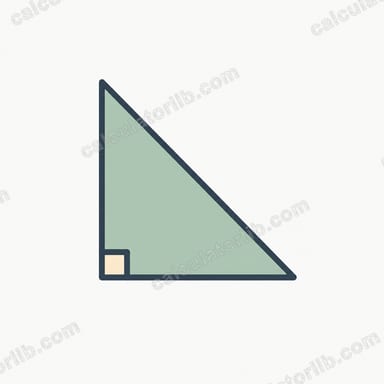
The altitude splits the triangle into two right triangles, so the height is $$h = \sqrt{a^2 - \left(\frac{b}{2}\right)^2}$$ The area is base times height over two, which simplifies to $$A = \frac{b}{4}\sqrt{4a^2 - b^2}$$ The perimeter is \(P = 2a + b\). Each base angle is \(\arccos\left(\frac{b/2}{a}\right)\), and the vertex angle is \(180^\circ - 2\cdot(\text{base angle})\).
Worked example
For \(a = 5\) and \(b = 6\): height = \(\sqrt{25 - 9} = \sqrt{16} = 4\). Area = $$\frac{6}{4}\cdot\sqrt{100 - 36} = 1.5\cdot\sqrt{64} = 1.5\cdot 8 = 12$$ Perimeter = \(2\cdot 5 + 6 = 16\). Base angle = \(\arccos(3/5) \approx 53.13^\circ\), vertex angle \(\approx 73.74^\circ\).
FAQ
What if \(b \geq 2a\)? No triangle exists — the two legs cannot meet. The calculator returns zero for area and height in that case.
Can it handle an equilateral triangle? Yes — set \(a = b\) and all angles will be 60°.
What units are used? Any consistent linear unit; area is in square units and angles in degrees.