
What Is a Mixed Number to Decimal Calculator?
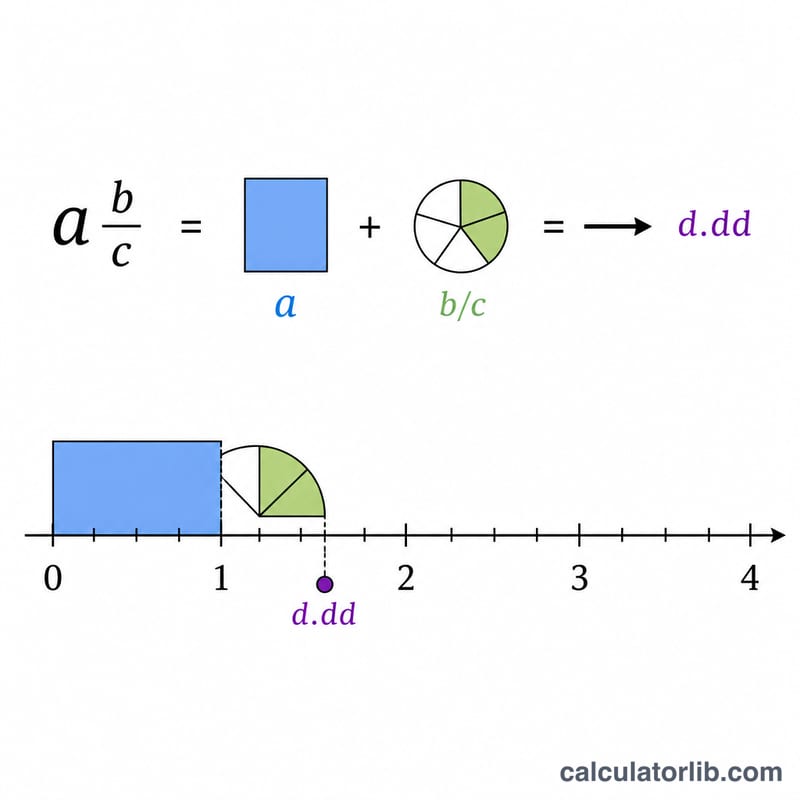
A mixed number combines a whole number and a proper fraction, such as 2 ¾. This calculator converts that mixed number into its equivalent decimal form, like 2.75. It is a universal math tool — useful for students, cooks, woodworkers, engineers, and anyone who needs to turn fractions into decimals for measurement or calculation.
How to Use It
Enter three values: the whole number, the numerator (top of the fraction), and the denominator (bottom of the fraction). The calculator divides the numerator by the denominator and adds the result to the whole number, giving you the exact decimal.
The Formula Explained
The conversion uses a simple rule:
$$\text{Decimal} = \text{whole} + \dfrac{\text{numerator}}{\text{denominator}}$$
First the fraction part is converted to a decimal by dividing the numerator by the denominator. That decimal is then added to the whole number. If the whole number is negative, the fractional part is subtracted so the overall magnitude is correct.
Worked Example
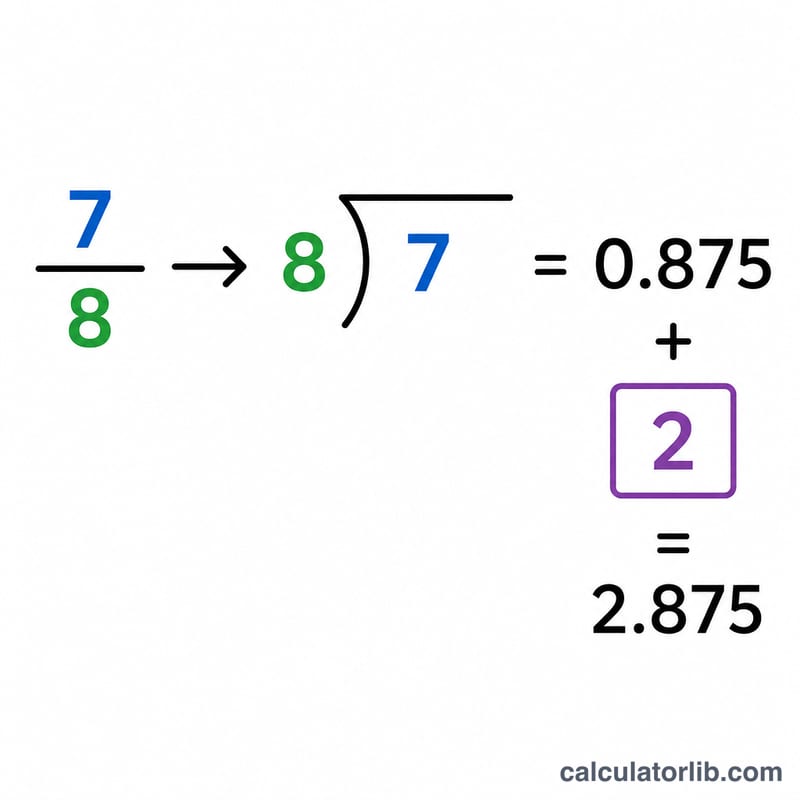
Convert 2 ¾ to a decimal. The fraction ¾ becomes \(3 \div 4 = 0.75\). Add the whole number:
$$2 + 0.75 = 2.75$$
So 2 ¾ equals 2.75 as a decimal.
FAQ
What if the denominator is zero? Division by zero is undefined, so the calculator treats the fraction part as 0 and returns just the whole number.
How do I handle negative mixed numbers? Enter the whole number as negative (e.g. -2). The fractional part is subtracted, so -2 ¾ becomes -2.75.
Is this the same as a fraction to decimal converter? Yes, with an added whole-number term. For a pure fraction, set the whole number to 0.