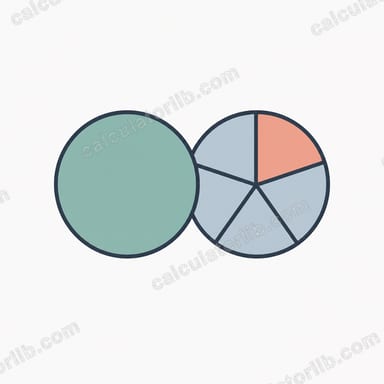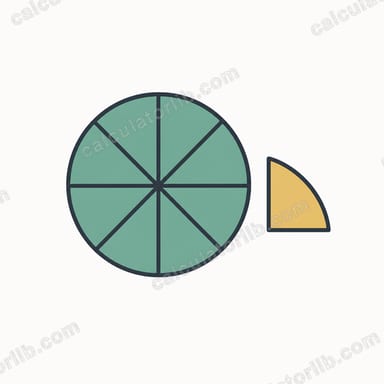

What is an improper fraction to mixed number calculator?
An improper fraction has a numerator that is greater than or equal to its denominator, such as 7/3 or 8/4. A mixed number expresses that same value as a whole number plus a proper fraction, like 2 1/3. This calculator converts any improper fraction into its mixed number form, automatically simplifies the leftover fraction, and shows the decimal equivalent.
How to use it
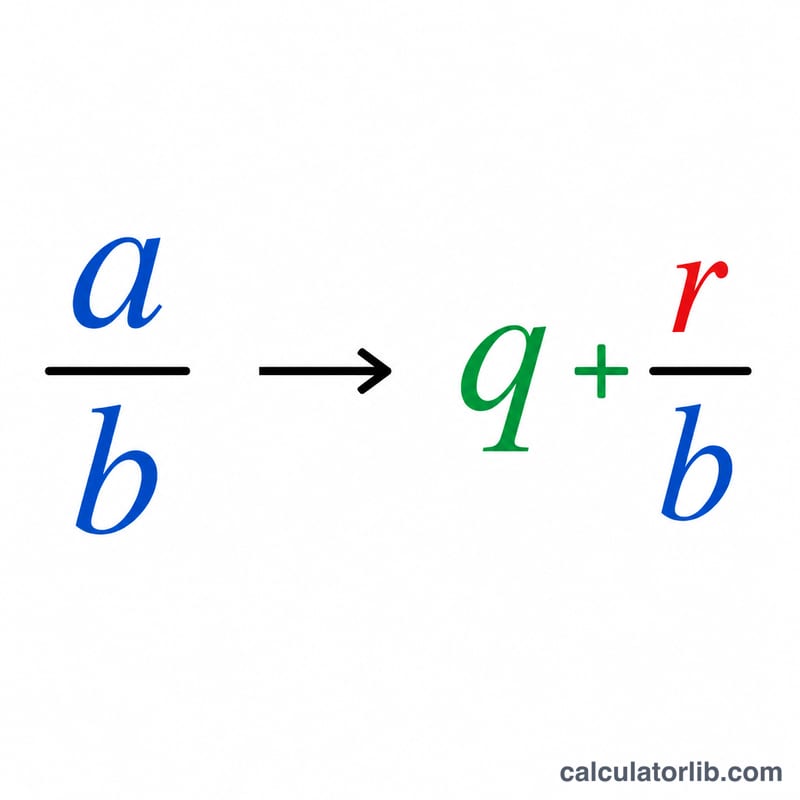
Enter the numerator (the top number) and the denominator (the bottom number), then read the result. The calculator returns the whole part, the remaining numerator and denominator, the fully reduced fraction, and the decimal value. Negative values are supported — the sign is applied to the whole number.
The formula explained
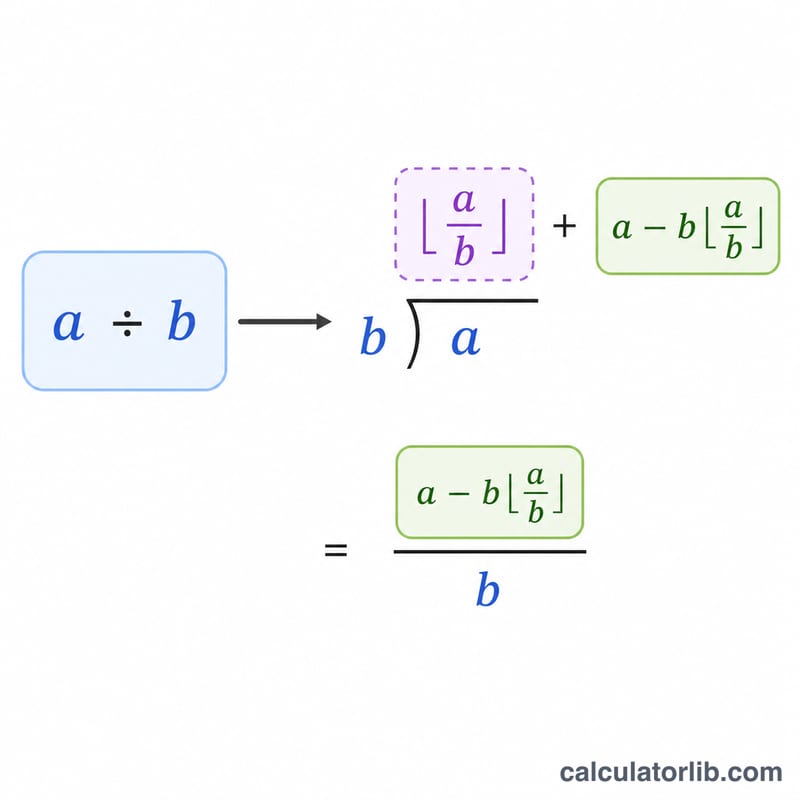
The whole part equals the floor of a divided by b. The remainder is a mod b, which becomes the new numerator over the original denominator b. That fraction is then reduced by dividing both terms by their greatest common divisor (GCD).
$$\frac{\text{Numerator}}{\text{Denominator}} = W\;\frac{R}{D}$$
$$\text{where}\quad \left\{ \begin{aligned} W &= \left\lfloor \frac{\left|\text{Num}\right|}{\left|\text{Den}\right|} \right\rfloor \\ R &= \left|\text{Num}\right| \bmod \left|\text{Den}\right| \\ D &= \left|\text{Den}\right| \end{aligned} \right.$$
Worked example
Take 7/3. Integer division gives \(7 \div 3 = 2\) with a remainder of 1. So the mixed number is \(2\;\frac{1}{3}\). Because \(\gcd(1, 3) = 1\), the fraction is already in lowest terms. For 8/4: \(8 \div 4 = 2\) remainder 0, so the result is simply the whole number 2.
FAQ
What if the fraction is already proper? If the numerator is smaller than the denominator, the whole part is 0 and the result is just the fraction itself.
Does it simplify the fraction? Yes. The remaining fraction is reduced to lowest terms using the GCD.
What happens with a denominator of zero? Division by zero is undefined, so the calculator returns zeros and you should enter a non-zero denominator.