
What this calculator does
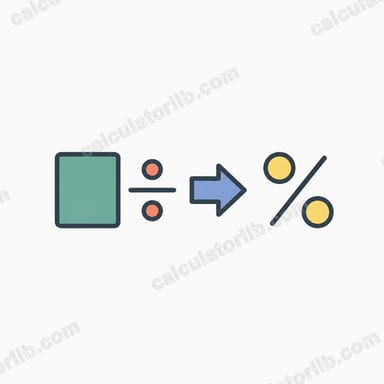
This tool converts in both directions between mixed numbers (or simple fractions) and decimals. Choose "Fraction to Decimal" to turn a whole number plus a fraction such as 2 3/4 into a decimal, or choose "Decimal to Fraction" to turn any decimal like 0.625 into its simplest fraction and the equivalent mixed number.
How to use it
Pick the conversion direction. For fraction-to-decimal, fill in the optional whole number, the numerator and the denominator. For decimal-to-fraction, enter the decimal value. Results appear instantly: the decimal value with the improper fraction, or the simplified proper fraction with the mixed-number form.
The formula explained
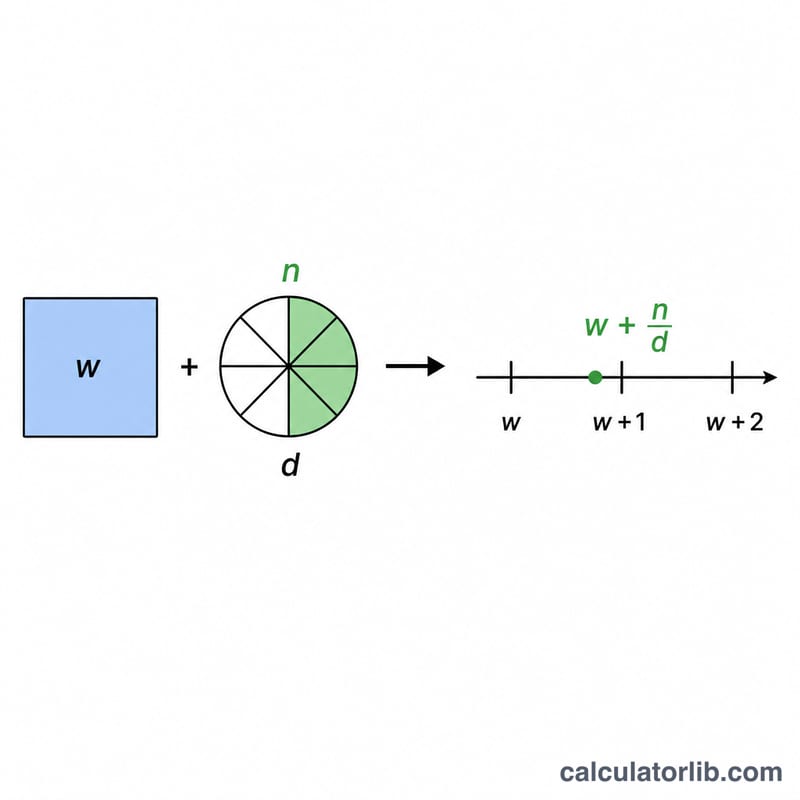
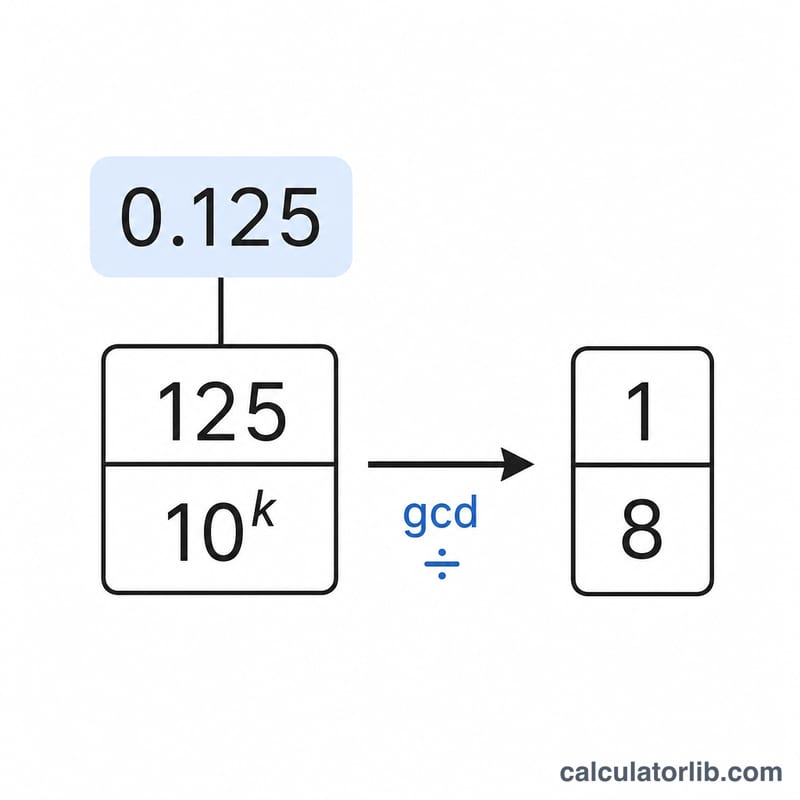
To convert a mixed number to a decimal, divide the numerator by the denominator and add the whole part: $$\text{decimal} = w + \frac{n}{d}.$$ To convert a decimal to a fraction, count the digits after the decimal point (\(k\)), write the value as \(\frac{\text{decimal} \times 10^{k}}{10^{k}}\), then divide both numerator and denominator by their greatest common divisor (GCD) to fully reduce it.
Worked example
Convert 0.625 to a fraction. There are 3 decimal places, so multiply by 1000: \(\frac{625}{1000}\). The GCD of 625 and 1000 is 125, so dividing gives \(\frac{5}{8}\). Since 5 is smaller than 8 the mixed number is simply \(\frac{5}{8}\). Going the other way, $$2\,\frac{3}{4} = 2 + \frac{3}{4} = 2 + 0.75 = 2.75.$$
FAQ
Does it always fully reduce the fraction? Yes, it divides by the greatest common divisor so the result is in lowest terms.
What about repeating decimals? The tool uses up to 9 decimal places, so a true repeating decimal is approximated by its truncated value rather than its exact fraction.
Can I enter negative values? Yes, a negative whole number or a negative decimal carries the sign through to the result.