
What is a repeating decimal?
A repeating (or recurring) decimal is a number whose digits after the decimal point eventually repeat forever, such as 0.333…, 0.1666…, or 0.142857142857…. Every repeating decimal is a rational number, which means it can be written exactly as a fraction. This calculator converts any repeating decimal — with optional non-repeating digits and an integer part — into its simplest fraction.
How to use the calculator
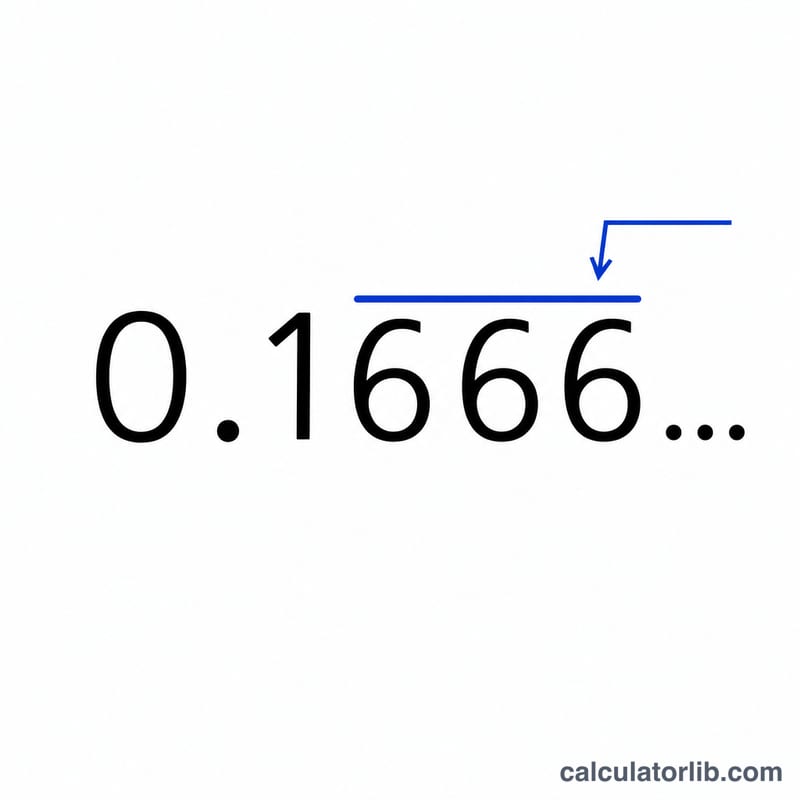
Enter the integer part (the digits before the decimal point), the non-repeating decimal digits (the digits right after the point that do not repeat), and the repeating digits (the block that repeats). For 0.1666…, the integer part is 0, the non-repeating digit is "1", and the repeating digit is "6". Leave the non-repeating field blank for pure repeating decimals like 0.333….
The formula explained
Let N be the non-repeating digit string with m digits and R be the repeating string with k digits. The repeating part of the value equals \((\overline{NR} - N) / ((10^{k} - 1)\cdot 10^{m})\), where NR means the digits of N and R written side by side as one integer. The integer part is then added back and the fraction is reduced using the greatest common divisor.
$$\text{Fraction} = \text{Int} + \frac{\overline{\text{NonRep}\,\text{Rep}} - \text{NonRep}}{\left(10^{k} - 1\right)\cdot 10^{m}}$$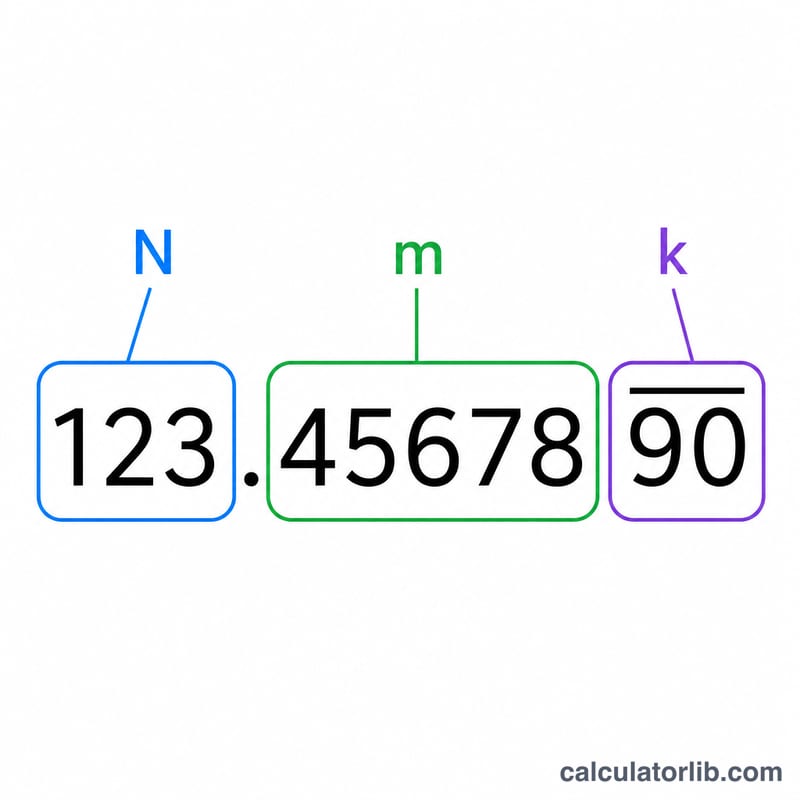
Worked example
Convert 0.1666… Here N = "1" (\(m = 1\)), R = "6" (\(k = 1\)), integer part 0. NR = 16, N = 1, so the fraction =
$$\frac{16 - 1}{\left(10 - 1\right)\cdot 10} = \frac{15}{90} = \frac{1}{6}$$The decimal value confirms \(1 \div 6 = 0.1666\ldots\)
FAQ
What about a pure repeating decimal like 0.333…? Leave the non-repeating field empty and enter 3 as the repeating digit: you get \(3/9 = 1/3\).
Can I convert a terminating decimal? Yes — leave the repeating field blank (or enter nothing) and put the digits in the non-repeating field; 0.25 becomes \(25/100 = 1/4\).
Does it work with an integer part? Yes. For 2.1666… enter 2, "1", and "6" to get \(13/6\).