
What is the surface area of a cone?
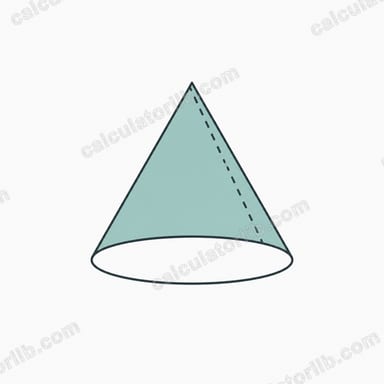
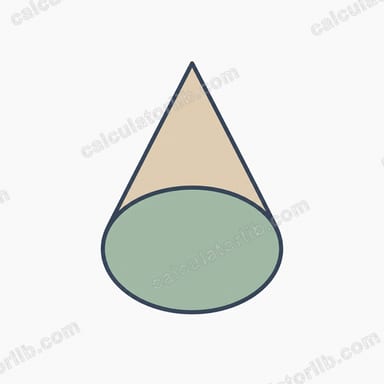
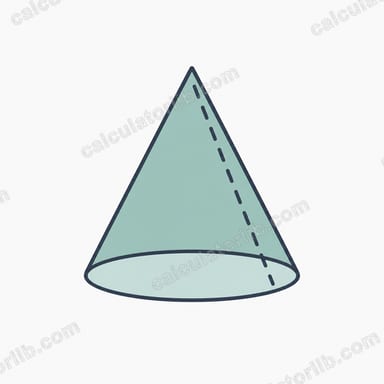
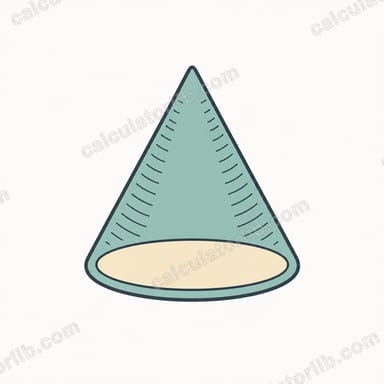
A cone's total surface area is the sum of its circular base and its curved (lateral) side. This calculator computes both parts from the base radius and the vertical height, along with the slant height needed for the side. It works for any units — just keep the radius and height in the same unit, and the result will be in those units squared.
How to use this calculator
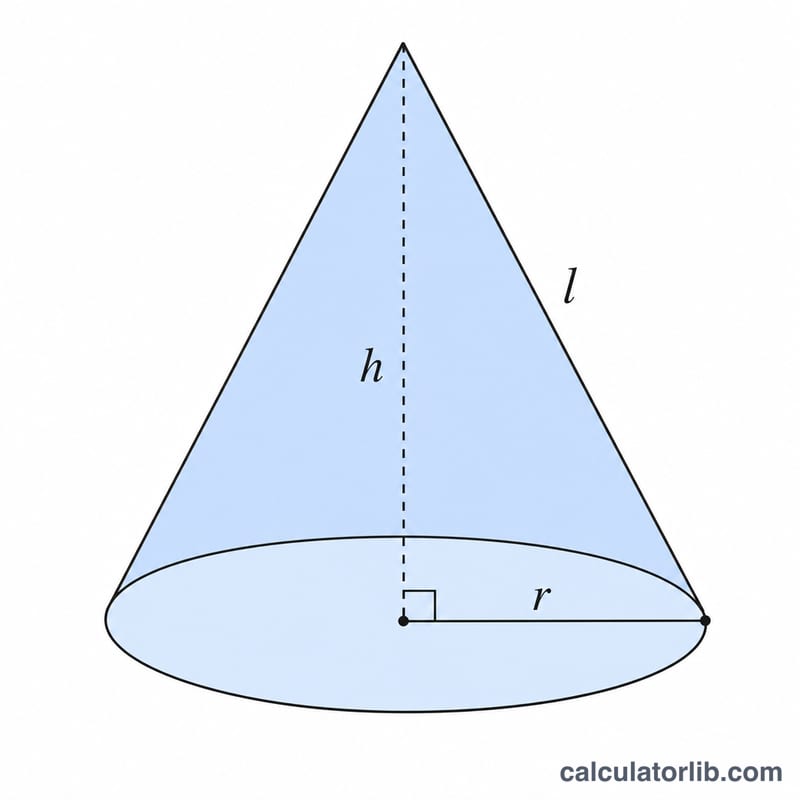
Enter the base radius (r) — the distance from the centre of the circular base to its edge — and the height (h), measured straight up from the base centre to the apex. Click calculate to see the total surface area plus a breakdown of base area, lateral area and slant height.
The formula explained
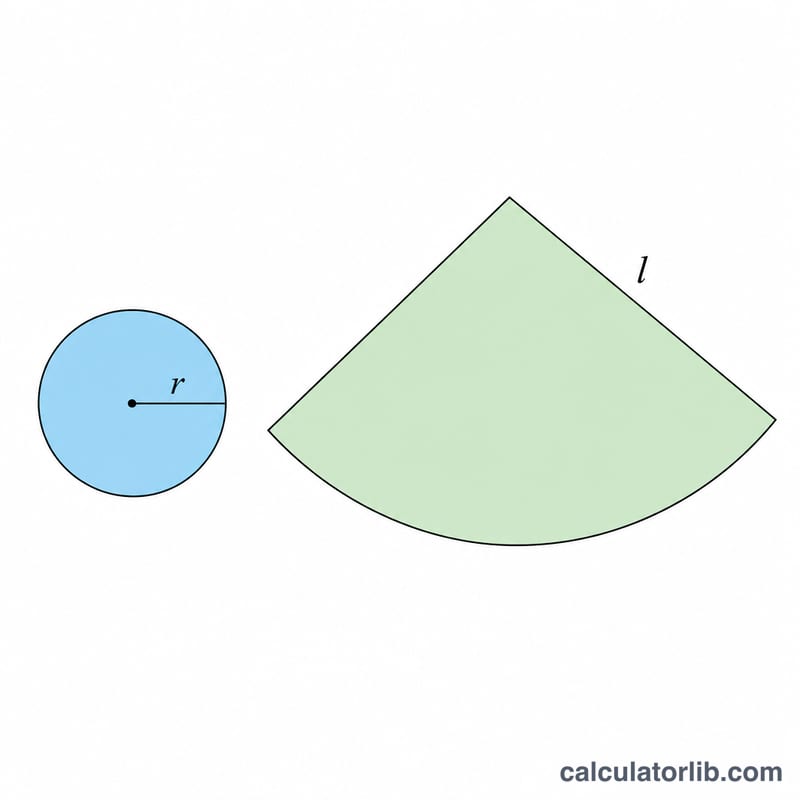
The base is a circle, so its area is \(\pi r^{2}\). The curved side unrolls into a sector whose area is \(\pi r \cdot l\), where \(l\) is the slant height. Because the radius, height and slant form a right triangle, \(l = \sqrt{r^{2} + h^{2}}\). Adding the two pieces gives the full formula $$A = \pi r^{2} + \pi r \cdot \sqrt{r^{2} + h^{2}} = \pi r (r + l)$$
Worked example
For a cone with \(r = 3\) and \(h = 4\): the slant height is $$\sqrt{9 + 16} = \sqrt{25} = 5.$$ The base area is \(\pi \cdot 3^{2} = 9\pi \approx 28.27\). The lateral area is \(\pi \cdot 3 \cdot 5 = 15\pi \approx 47.12\). The total surface area is \(24\pi \approx 75.40\) square units.
FAQ
What if I only want the curved side? Use just the lateral area row (\(\pi r \cdot l\)) — handy for shapes like party hats or funnels that have no base.
Do I need the slant height as an input? No. This tool derives the slant height automatically from the radius and vertical height, so you only enter r and h.
What units does it use? Any consistent length unit. If you enter centimetres, the area is in square centimetres.