
What This Calculator Does
The Drywall Sheet Calculator estimates how many sheets of drywall (also called gypsum board, plasterboard or wallboard) you need to cover the walls of a room. It works from the room's footprint and wall height, the size of the drywall sheets you plan to buy, and a waste allowance for cuts, breakage and offcuts. Measurements are in feet and square feet, the standard used by North American drywall suppliers.
How to Use It
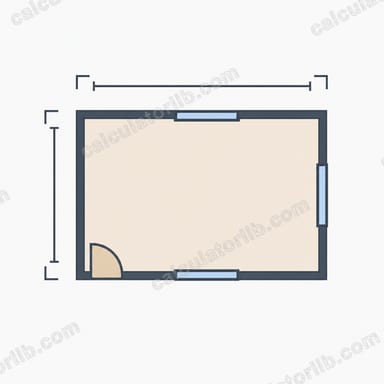
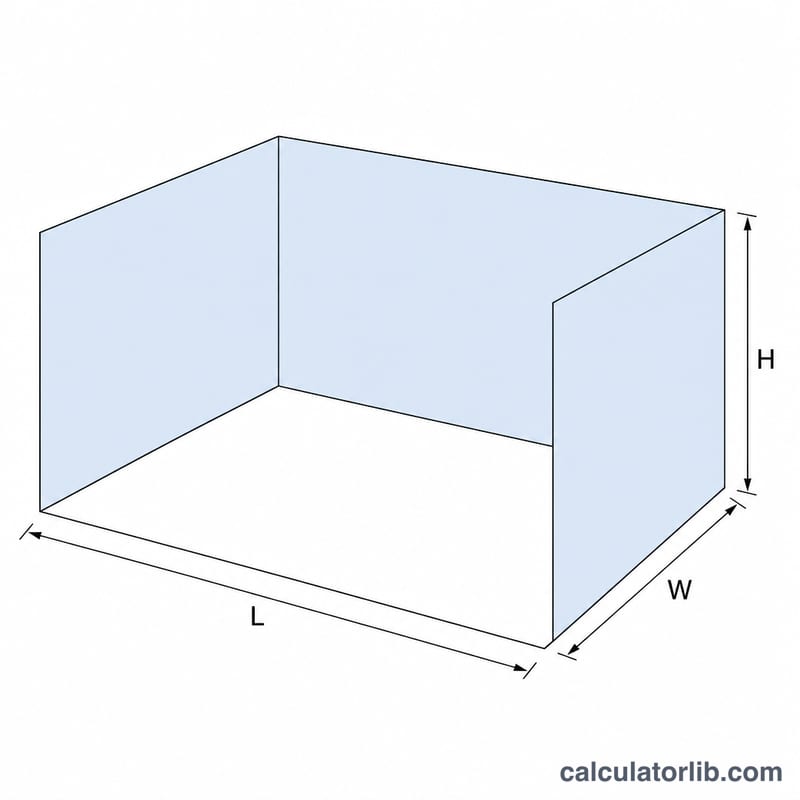
Enter the room's length and width in feet, then the wall height (typically 8, 9 or 10 ft). Choose your drywall sheet size — a 4×8 sheet covers 32 sq ft, a 4×10 covers 40 sq ft, and a 4×12 covers 48 sq ft. Set a waste allowance (10% is a common starting point; use more for rooms with many doors, windows and corners). The calculator returns the number of full sheets to buy, rounded up.
The Formula Explained
First the total wall area is found: \(\text{WallArea} = 2 \times (\text{length} + \text{width}) \times \text{height}\). This treats the four walls as a continuous band around the room. Then $$\text{Sheets} = \left\lceil \frac{2\left(\text{Length} + \text{Width}\right)\,\text{Height}}{\text{Sheet Area}} \times \left(1 + \frac{\text{Waste \%}}{100}\right) \right\rceil$$ Dividing by the sheet area converts square feet into sheet count, the waste factor adds spare material, and rounding up ensures you never come up short.
Worked Example
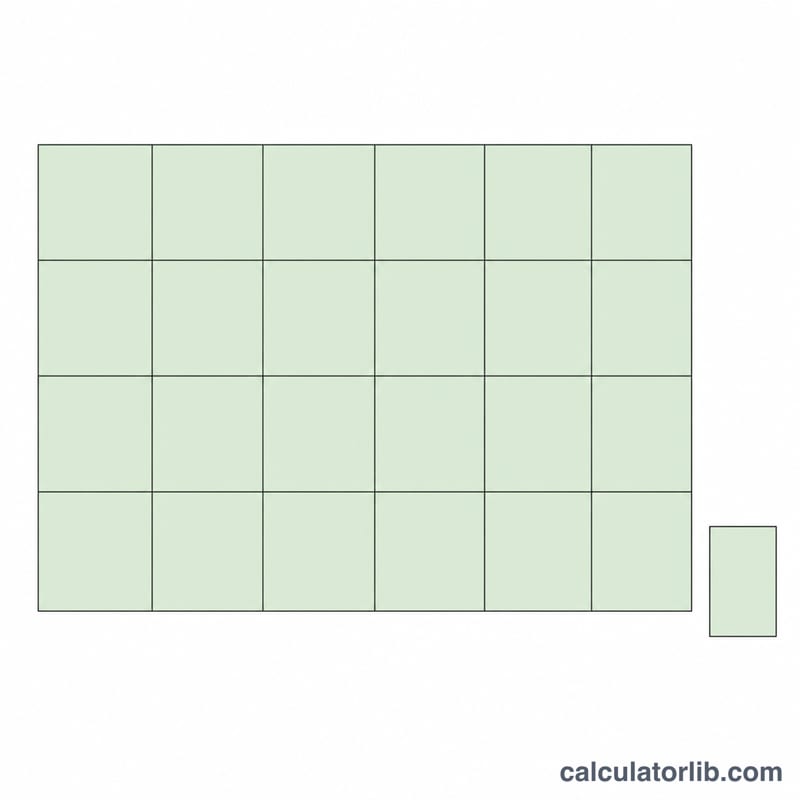
A 12 ft × 10 ft room with 8 ft walls has a wall area of $$2 \times (12 + 10) \times 8 = 352 \text{ sq ft}.$$ Using 4×8 sheets (32 sq ft) with 10% waste: $$352 \div 32 \times 1.10 = 12.1 \text{ sheets},$$ which rounds up to 13 sheets.
FAQ
Should I subtract doors and windows? For a quick estimate, no — leaving them in builds a safety margin. For tight budgeting you can lower the waste percentage instead.
Does this include the ceiling? No. This figure covers wall area only. Add the ceiling area (length × width) separately if you are also drywalling the ceiling.
What waste percentage should I use? 10% is typical for simple rectangular rooms; use 15–20% for rooms with many openings, angles or if you are new to hanging drywall.