
What is the 2x2 Eigenvalue Calculator?
This tool finds the eigenvalues of a 2×2 matrix [[a, b], [c, d]]. Eigenvalues are the scalars \(\lambda\) for which there exists a non-zero vector \(v\) such that \(Av = \lambda v\). They reveal how a linear transformation stretches, shrinks, or rotates space, and they appear throughout physics, engineering, statistics, and differential equations.
How to use it
Enter the four matrix entries: a and b in the first row, c and d in the second row. The calculator returns both eigenvalues. If they are real you get two real numbers; if the discriminant is negative you get a complex conjugate pair written as \(p \pm qi\). The trace, determinant, and discriminant are shown so you can check the work.
The formula explained
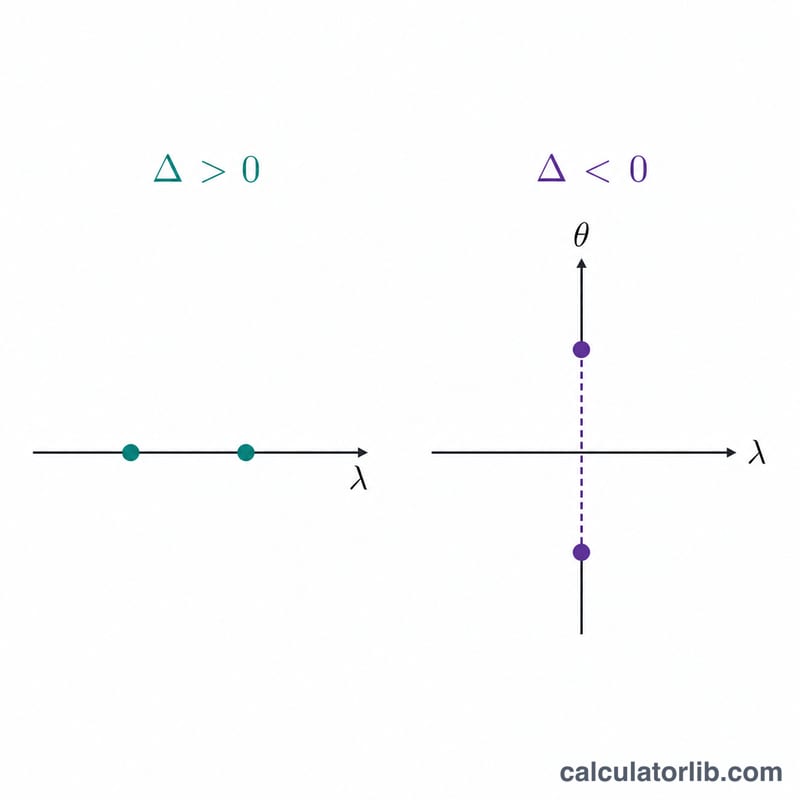
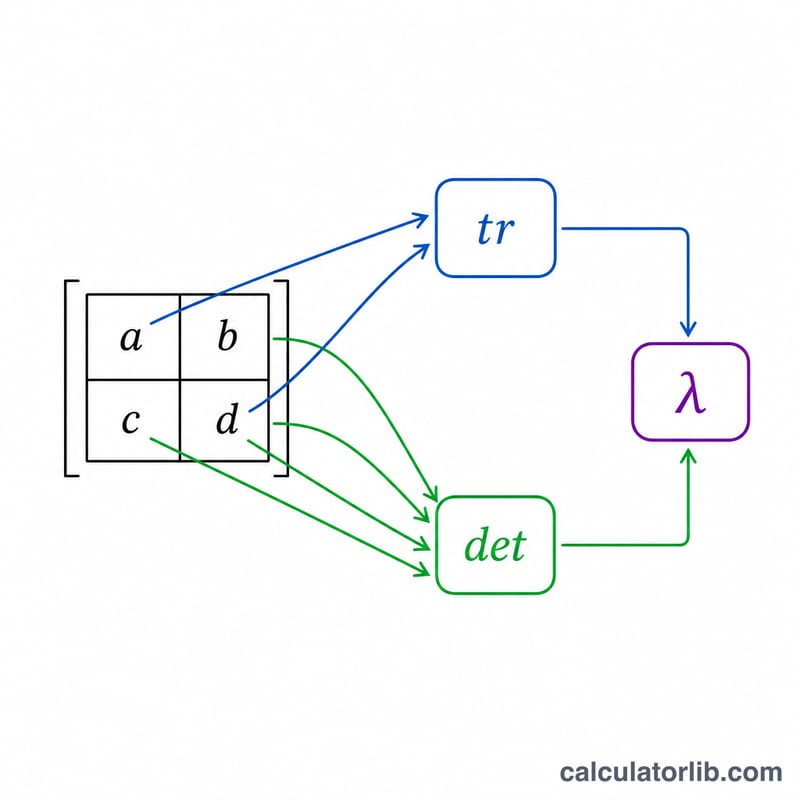
Eigenvalues are the roots of the characteristic polynomial \(\det(A - \lambda I) = 0\), which for a 2×2 matrix simplifies to \(\lambda^{2} - (\text{tr})\lambda + \det = 0\), with trace \(\text{tr} = a + d\) and determinant \(\det = ad - bc\). Solving with the quadratic formula gives $$\lambda = \frac{\text{tr} \pm \sqrt{\text{tr}^{2} - 4\cdot\det}}{2}.$$ The quantity under the root, \(\text{tr}^{2} - 4\cdot\det\), is the discriminant: positive means two distinct real eigenvalues, zero means a repeated real eigenvalue, and negative means a complex conjugate pair.
Worked example
For [[2, 1], [1, 2]]: $$\text{tr} = 2 + 2 = 4,\quad \det = 2\cdot2 - 1\cdot1 = 3,\quad \text{discriminant} = 16 - 12 = 4,\quad \sqrt{4} = 2.$$ So \(\lambda_1 = (4 + 2)/2 = 3\) and \(\lambda_2 = (4 - 2)/2 = 1\).
FAQ
What if the eigenvalues are complex? A negative discriminant gives a conjugate pair \(\text{tr}/2 \pm (\sqrt{4\cdot\det - \text{tr}^{2}}/2)\cdot i\). The rotation matrix [[0, −1], [1, 0]] has trace 0 and determinant 1, giving \(\lambda = \pm i\).
Can both eigenvalues be equal? Yes — when the discriminant is exactly zero, the matrix has one repeated eigenvalue \(\text{tr}/2\).
How are eigenvalues related to trace and determinant? Their sum equals the trace and their product equals the determinant.