

What is the 2x2 Eigenvalue Calculator?
An eigenvalue of a square matrix A is a scalar \(\lambda\) for which there exists a non-zero vector v with \(Av = \lambda v\). This calculator finds both eigenvalues of any 2x2 matrix A = [[a, b], [c, d]], handling the case where the eigenvalues are real as well as the case where they form a complex conjugate pair.
How to use it
Enter the four entries of your matrix: a and b on the first row, c and d on the second row. The calculator computes the trace, the determinant, and the discriminant, then returns the two eigenvalues. If the discriminant is negative the result is shown as a complex conjugate pair \(x \pm yi\).
The formula explained
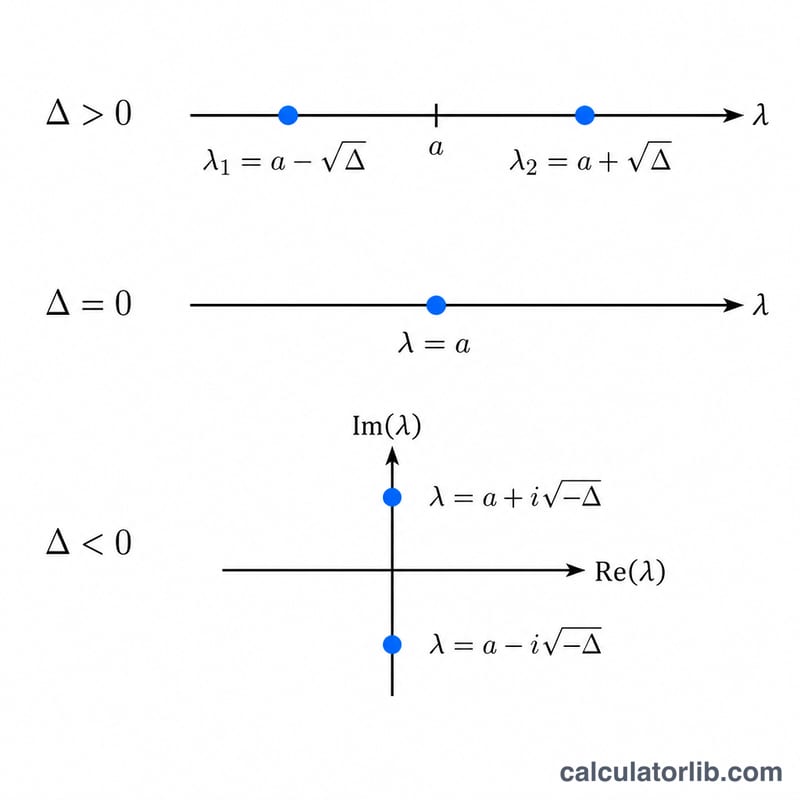
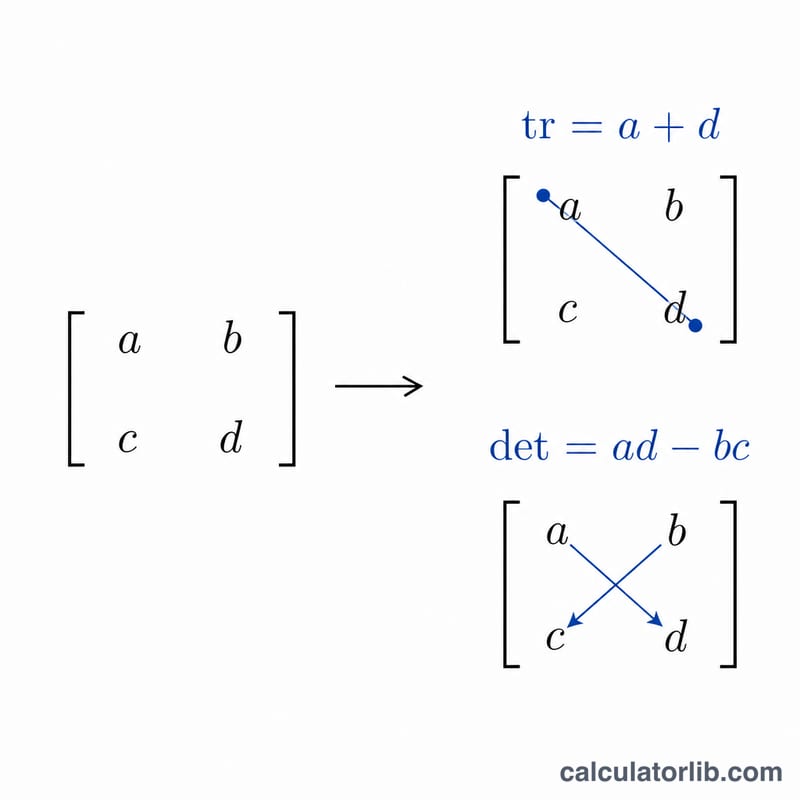
The eigenvalues solve the characteristic equation \(\det(A - \lambda I) = 0\), which for a 2x2 matrix expands to \(\lambda^2 - (\text{tr})\lambda + \det = 0\), where the trace \(\text{tr} = a + d\) and the determinant \(\det = ad - bc\). Applying the quadratic formula gives $$\lambda = \frac{\text{tr} \pm \sqrt{\text{tr}^2 - 4\cdot\det}}{2}.$$ The quantity under the root, \(\text{tr}^2 - 4\cdot\det\), is the discriminant: when it is positive the eigenvalues are distinct reals, when zero they are a repeated real, and when negative they are complex conjugates.
Worked example
For A = [[2, 1], [1, 2]]: \(\text{tr} = 4\), \(\det = 2\cdot 2 - 1\cdot 1 = 3\), discriminant \(= 16 - 12 = 4\). So $$\lambda = \frac{4 \pm 2}{2},$$ giving \(\lambda_1 = 3\) and \(\lambda_2 = 1\).
FAQ
What if the discriminant is negative? The matrix has no real eigenvalues; the calculator returns the complex conjugate pair \((\text{tr}/2) \pm (\sqrt{-\text{disc}}/2)i\).
Can eigenvalues be equal? Yes. When the discriminant is exactly zero, both eigenvalues equal \(\text{tr}/2\) (a repeated eigenvalue).
What do eigenvalues tell me? They describe how the linear transformation A stretches space along its eigenvector directions and are central to stability analysis, PCA, and differential equations.