
What this calculator does
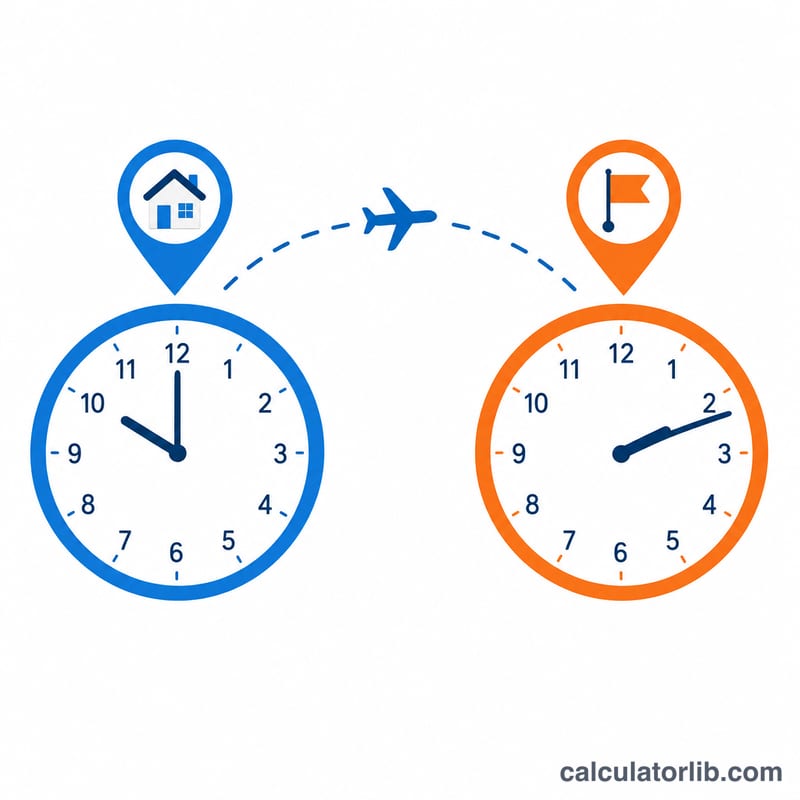
The Flight Arrival Local Time Calculator tells you what the clock will say at your destination when your plane lands. Crossing time zones makes mental math tricky: a flight that lasts 7 hours can appear to "lose" or "gain" hours depending on which direction you fly. This tool removes the guesswork by combining your local departure time, the flight duration, and the UTC offsets of both airports into a single clear arrival time.
How to use it
Enter your departure time in 24-hour format (hour and minute). Add the scheduled flight duration in hours and minutes. Then enter the UTC offset of your origin airport and your destination airport — for example New York is UTC−5, London is UTC+0, and Tokyo is UTC+9. Fractional offsets like 5.5 (India) or 9.5 (Adelaide) are supported. The result shows arrival local time plus a "day offset" so you know if you land the same day, the next day, or earlier.
The formula explained
The calculation is arrival_local = depart_local + flight_duration + (tz_dest − tz_origin). All times are converted to minutes. The time-zone term shifts the clock by the difference in UTC offsets — flying east (destination ahead) pushes the clock forward, flying west pulls it back. The total is normalized into a 0–24 hour clock, and any whole days carried over become the day offset.
$$\begin{gathered} \text{Arrival} = \left(\,D + F + Z\,\right) \bmod 1440 \\[1.5em] \text{where}\quad \left\{ \begin{aligned} D &= 60 \cdot \text{Dep. Hour} + \text{Dep. Min} \\ F &= 60 \cdot \text{Flight Hrs} + \text{Flight Min} \\ Z &= 60 \cdot \left(\text{Dest. UTC} - \text{Origin UTC}\right) \end{aligned} \right. \end{gathered}$$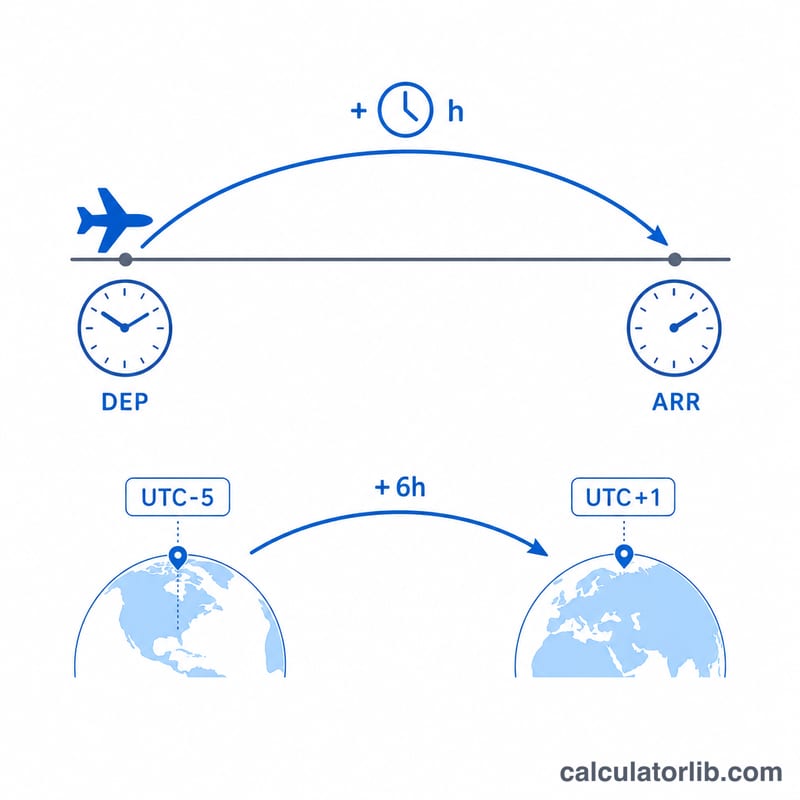
Worked example
Depart New York (UTC−5) at 09:30 on a 7h 45m flight to London (UTC+0). Departure = 570 minutes. Duration = 465 minutes. Time-zone difference = \((0 - (-5)) \times 60 = 300\) minutes. Total = $$570 + 465 + 300 = 1335 \text{ minutes} = 22{:}15$$ Day offset = 0, so you land at 22:15 the same day, local London time.
FAQ
Does it account for Daylight Saving Time? Use the UTC offset that is actually in effect on your travel date (e.g. New York is −4 during DST). The calculator uses whatever offsets you enter.
What does "day offset" mean? +1 means you arrive the next calendar day; −1 means the previous day; 0 means the same day.
Can I use fractional time zones? Yes — enter values like 5.5, 9.5, or 5.75 for half- and quarter-hour offsets.