
What Is the UTC to Local Time Converter?
Coordinated Universal Time (UTC) is the global time standard used by aviation, computing, science, and broadcasting. This converter turns a UTC time into your local clock time for any UTC offset — from UTC−12 to UTC+14 — including half-hour and quarter-hour zones such as India (UTC+5:30) and Nepal (UTC+5:45).
How to Use It
Enter the UTC hour (0–23) and minute (0–59), then type your time-zone offset in hours. Use a negative number for zones behind UTC (the Americas) and a positive number for zones ahead (Europe, Asia, Oceania). For example, US Eastern Standard Time is −5, Central European Time is +1, and India Standard Time is +5.5. The calculator shows your local time on a 24-hour clock and tells you if the result lands on the previous or next day.
The Formula Explained
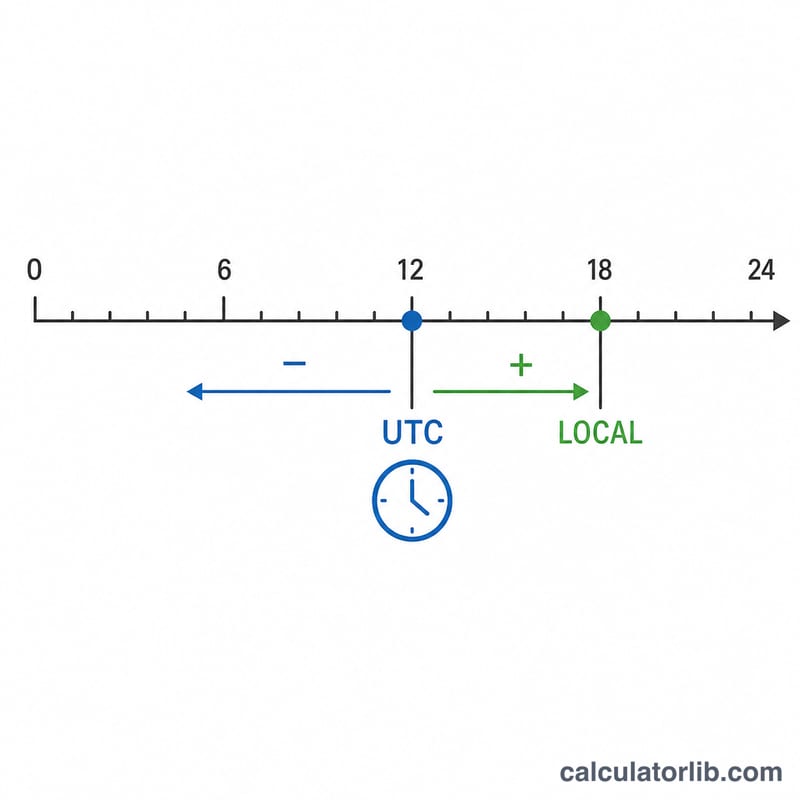
The core rule is simply Local = UTC + offset. Internally the tool converts the UTC time to minutes after midnight, adds the offset (offset hours × 60), then wraps the result into a single 0–1439 minute day. If the total exceeds 24 hours or drops below zero, a day shift is recorded so you know the date changed.
$$\text{Local} = \left(60\cdot\text{UTC Hour} + \text{UTC Min} + \operatorname{round}\!\left(60\cdot\text{Offset}\right)\right) \bmod 1440$$$$\begin{gathered} T = \left(60\cdot\text{UTC Hour} + \text{UTC Min} + \operatorname{round}\!\left(60\cdot\text{Offset}\right)\right) \bmod 1440 \\[1.5em] \text{where}\quad \left\{ \begin{aligned} \text{Local Hour} &= \left\lfloor \tfrac{T}{60} \right\rfloor \\ \text{Local Minute} &= T - 60\cdot\text{Local Hour} \end{aligned} \right. \end{gathered}$$
Worked Example
Suppose the UTC time is 23:30 and your offset is +2 (e.g. Eastern European Summer Time). Convert UTC to minutes: \(23 \times 60 + 30 = 1410\). Add the offset: \(2 \times 60 = 120\), so \(1410 + 120 = 1530\) minutes. Since \(1530 \geq 1440\), subtract a day:
$$1530 - 1440 = 90 \text{ minutes} = 01{:}30$$with a +1 day shift. So 23:30 UTC is 01:30 the next day at UTC+2.
FAQ
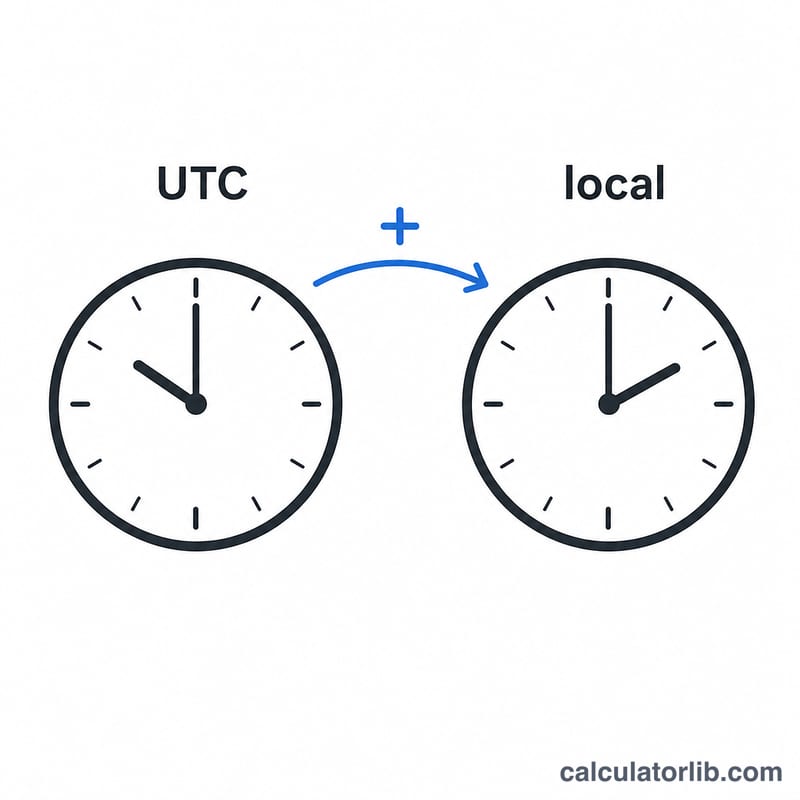
Does this handle daylight saving time? No automatic DST is applied. Enter the correct offset for the date in question (e.g. use −4 for US Eastern during summer instead of −5).
Can I use fractional offsets? Yes. Enter values like 5.5 or 5.75 for half- and quarter-hour zones.
What does "day shift" mean? It indicates the local time falls on a different calendar day than the UTC time: +1 means the next day, −1 means the previous day.