

What Is the Monty Hall Problem?
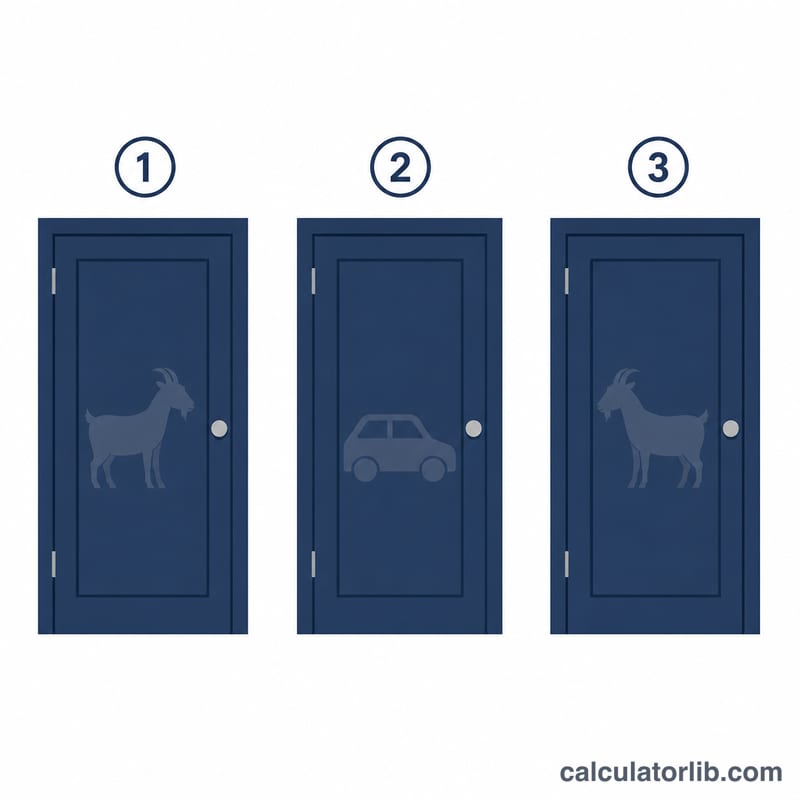
The Monty Hall problem is a famous probability puzzle based on the game show "Let's Make a Deal." You pick one of several doors hoping to find a car; behind the others are goats. The host, who knows what's behind each door, then opens every other door except one to reveal goats, and offers you the chance to switch your choice. Counterintuitively, switching dramatically improves your odds of winning.
How to Use This Calculator
Enter the number of doors in the game (the classic version uses 3). The calculator instantly shows your probability of winning if you stay with your original pick versus if you switch to the remaining unopened door, plus how many times more likely switching is to win.
The Formula Explained
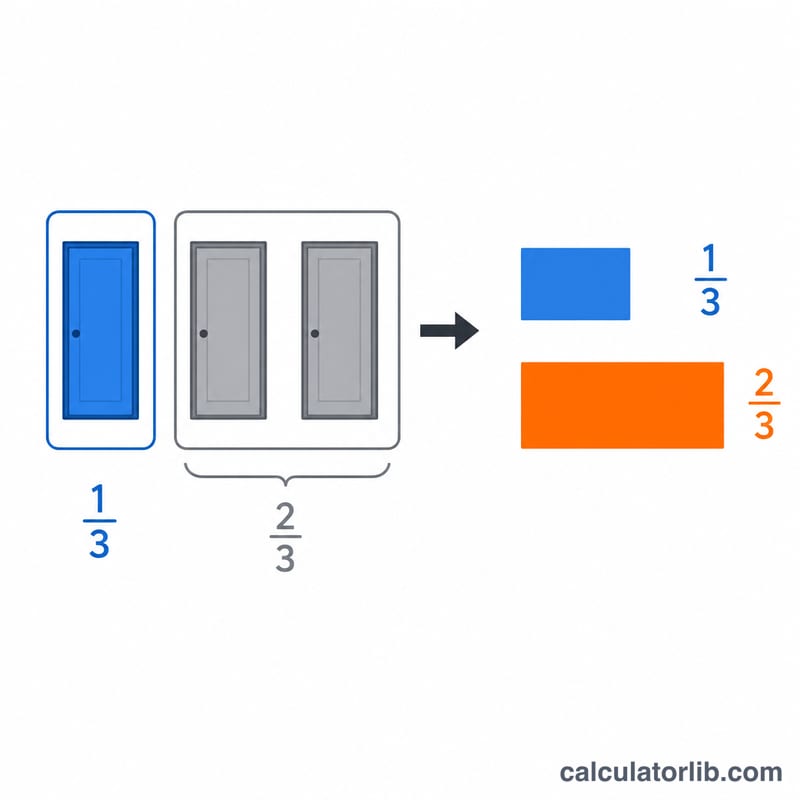
When you first pick, the chance the car is behind your door is \(1/d\). That probability never changes for your original door. The host then eliminates all goat doors except one, concentrating the remaining \((d-1)/d\) probability onto the single other door. So:
$$P(\text{win} \mid \text{stay}) = \frac{1}{d}, \qquad P(\text{win} \mid \text{switch}) = \frac{d-1}{d}$$ As the number of doors grows, switching becomes overwhelmingly better.
Worked Example
For the classic 3-door game: staying wins \(1/3 \approx 33.33\%\) of the time, while switching wins \(2/3 \approx 66.67\%\) of the time — exactly double the odds. With 100 doors, staying wins just \(1\%\) while switching wins \(99\%\).
FAQ
Why doesn't switching give a 50/50 chance? Because the host's choice is not random — he always avoids the car, which transfers probability to the unopened door.
Does it work with more than 3 doors? Yes. The advantage of switching grows as doors increase, since staying always stays at \(1/d\).
Is this gambling advice? No — it's pure mathematical probability under the standard Monty Hall rules where the host always reveals goats and always offers a switch.