
What Is the Poisson Probability Calculator?
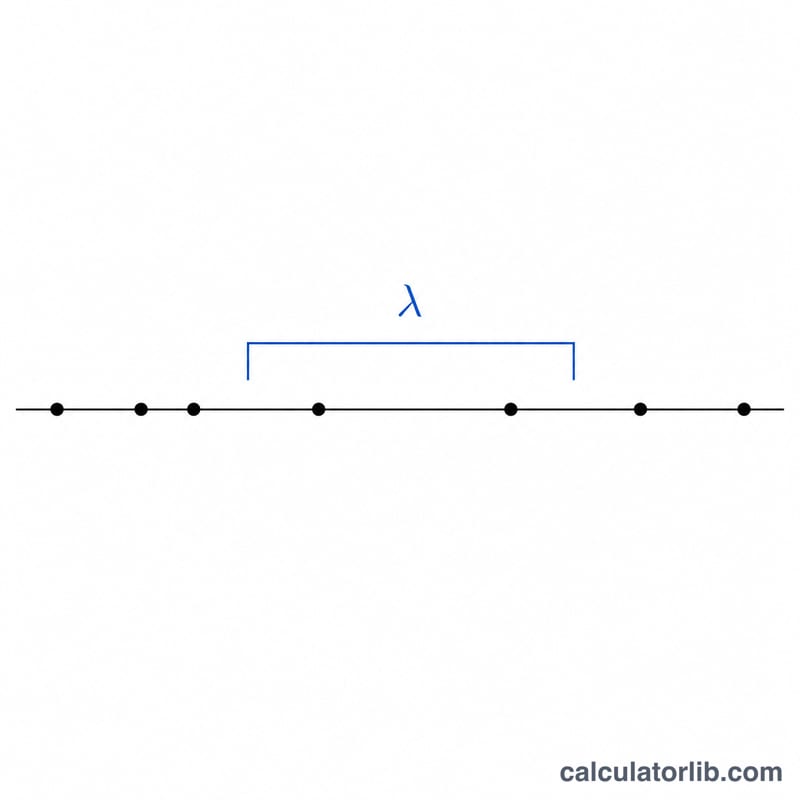
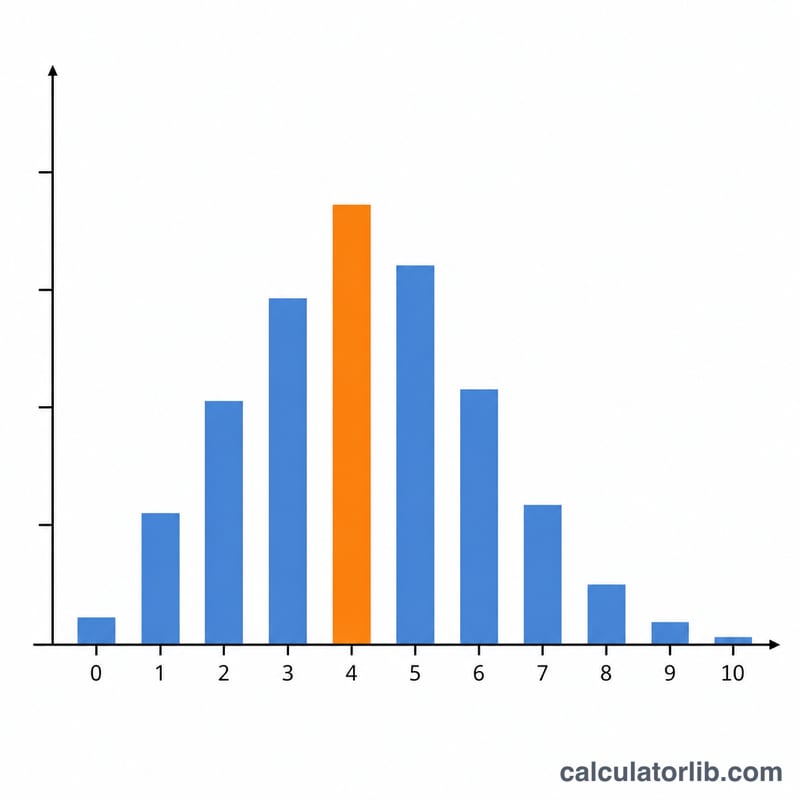
The Poisson distribution models the number of times an event happens in a fixed interval of time, space, or volume when those events occur independently at a constant average rate. This calculator computes P(X = k), the probability of observing exactly k events, along with cumulative and tail probabilities. Typical uses include call-center arrivals, website hits per minute, defects per batch, goals per match, and radioactive decay counts.
How to Use It
Enter the average rate λ (the expected number of events for your interval) and the target count k (a non-negative whole number). The calculator returns the probability of exactly k events plus four related probabilities: \(P(X < k)\), \(P(X \le k)\), \(P(X \ge k)\), and \(P(X > k)\). Make sure λ and k refer to the same interval — if you switch from "per hour" to "per day," scale λ accordingly.
The Formula Explained
The Poisson probability mass function is $$P(X = \text{k}) = \frac{\lambda^{\,\text{k}}\; e^{-\lambda}}{\text{k}!}$$ where \(e \approx 2.71828\) is Euler's number and \(k!\) is the factorial of \(k\). The term \(\lambda^{k}\) grows with more events, \(e^{-\lambda}\) is a normalizing decay factor, and dividing by \(k!\) accounts for the indistinguishable ordering of events.
Worked Example
Suppose a shop receives an average of \(\lambda = 3\) customers per hour and you want the probability of exactly \(k = 2\) customers in the next hour. $$P(X = 2) = \frac{3^{2}\; e^{-3}}{2!} = \frac{9 \times 0.049787}{2} = \frac{0.448084}{2} = 0.224042$$ or about 22.4%.
FAQ
What does λ represent? It is the mean (and also the variance) of the distribution — the expected number of events per interval.
Can k be larger than λ? Yes. k can be any non-negative integer; the probability simply gets smaller as k moves far from λ.
When is the Poisson model appropriate? When events are independent, occur at a constant average rate, and two events cannot happen at exactly the same instant.