
What is a probability calculator?
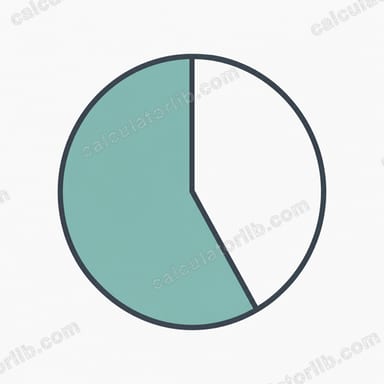
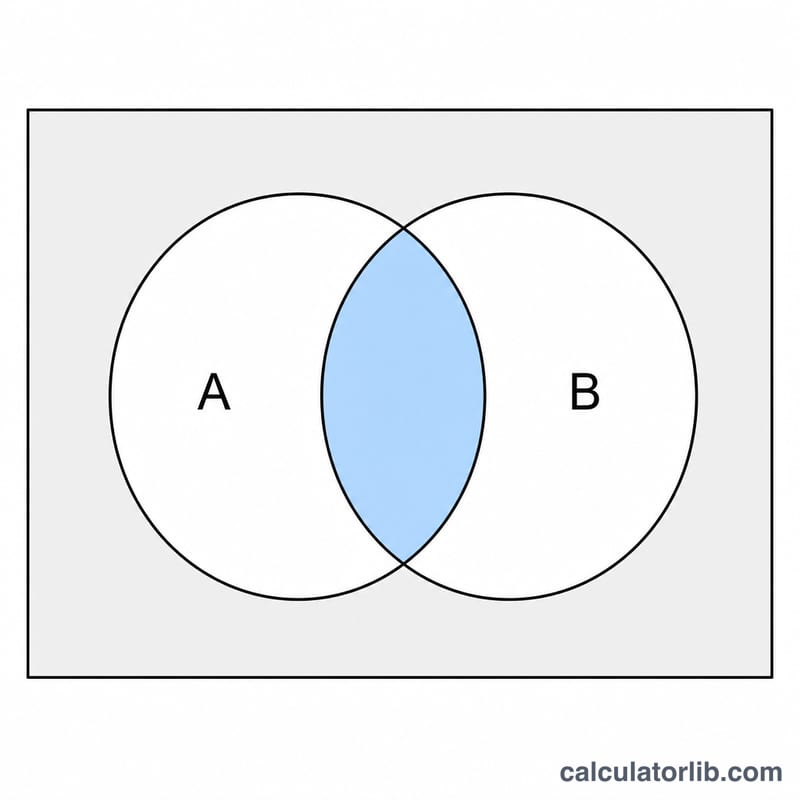
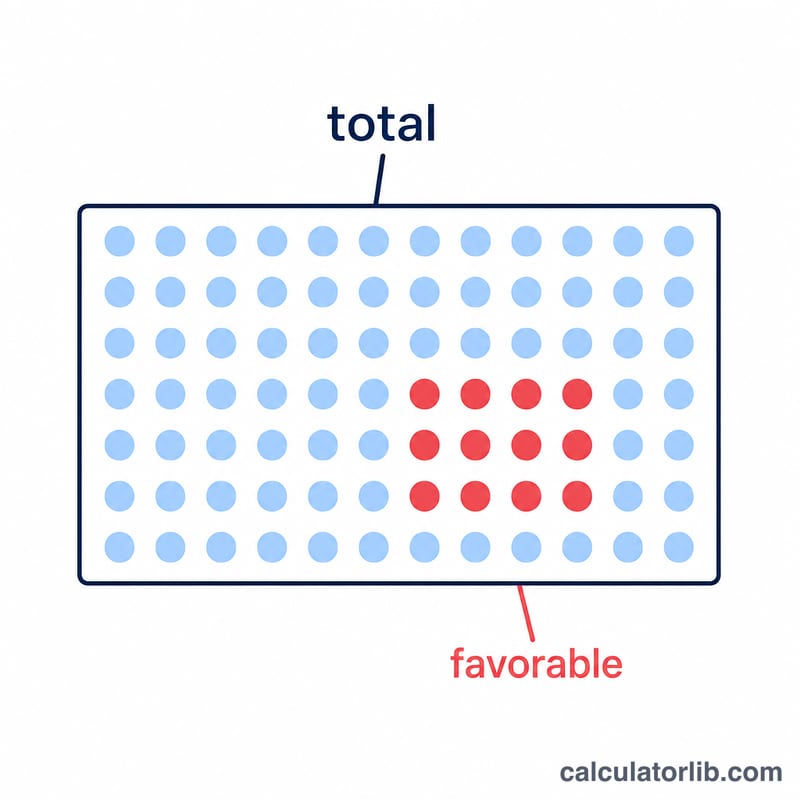
This tool finds the probability of a single event A as the ratio of favorable outcomes to total possible outcomes. It also combines two independent events to find the chance that both occur, that at least one occurs, and that A does not occur.
How to use it
Enter the number of favorable outcomes and total outcomes for Event A, and optionally for Event B. The calculator returns \(P(A)\), \(P(B)\), \(P(\text{not }A)\), \(P(A\cap B)\), and \(P(A\cup B)\), each as a decimal and a percentage. Combined results assume A and B are independent — the outcome of one has no effect on the other.
The formula explained
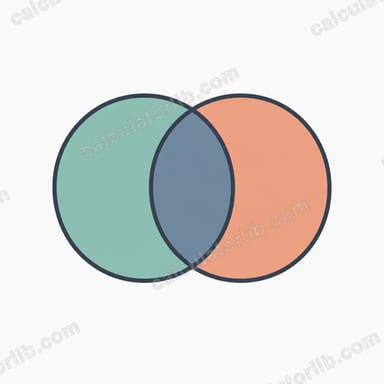
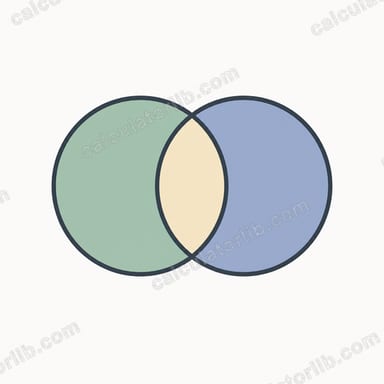
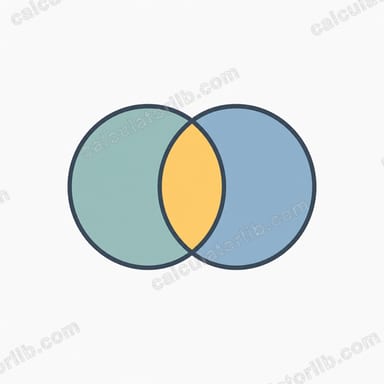
For a single event, $$P(A)=\dfrac{\text{favorable}}{\text{total}}$$ The complement is $$P(\text{not }A)=1-P(A)$$ For two independent events, the intersection is $$P(A\cap B)=P(A)\times P(B)$$ and the union is $$P(A\cup B)=P(A)+P(B)-P(A\cap B)$$ where subtracting the intersection avoids double-counting overlap.
Worked example
Rolling a six on a die: \(P(A)=\dfrac{1}{6}\approx 0.1667\). Flipping heads on a coin: \(P(B)=\dfrac{1}{2}=0.5\). Both happening: $$P(A\cap B)=0.1667\times 0.5\approx 0.0833$$ At least one: $$P(A\cup B)=0.1667+0.5-0.0833\approx 0.5833\ (\text{about }58.3\%)$$
FAQ
What does independent mean? Two events are independent when one outcome does not change the probability of the other, like separate coin flips or dice rolls.
Can probability exceed 1? No. A valid probability is always between 0 and 1 (0% to 100%).
What if the events are not independent? Then \(P(A\cap B)=P(A)\times P(B\mid A)\) and the simple multiplication used here no longer applies.