
What Is a Semester GPA?
Your semester (or term) GPA summarizes how well you performed across all the courses you took in a single academic term. Unlike a simple average of letter grades, GPA is credit-weighted: a 4-credit class influences your GPA more than a 1-credit class. This calculator uses the standard US 4.0 scale, where A = 4.0, B = 3.0, C = 2.0, D = 1.0, and F = 0.0 (with +/- variations such as A- = 3.7 or B+ = 3.3).
How to Use It
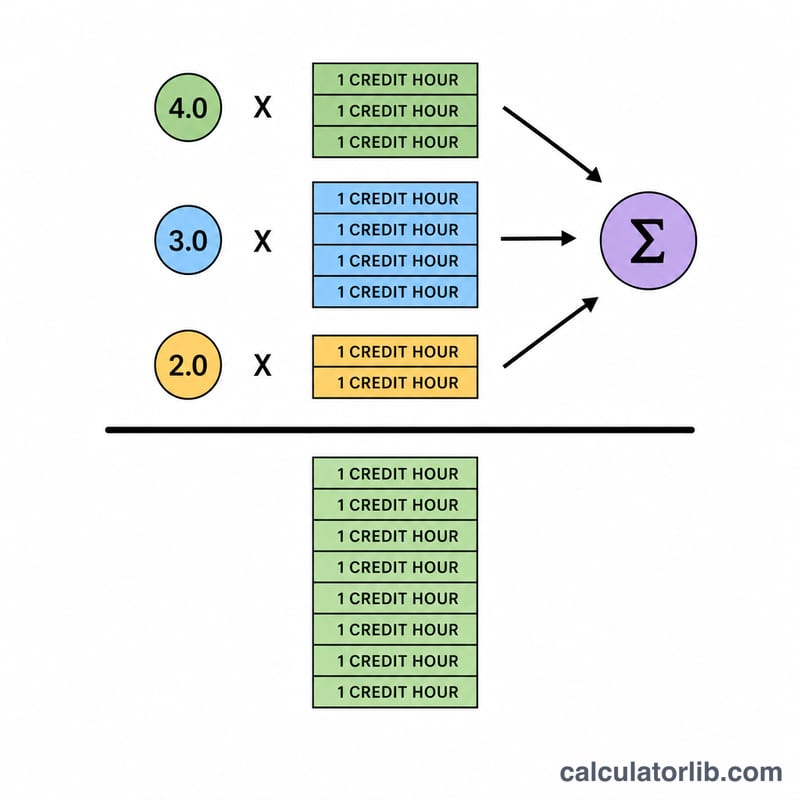
For each course this term, enter the grade points earned (the numeric value of your letter grade on the 4.0 scale) and the number of credit hours the course is worth. Leave unused rows blank. The calculator multiplies grade points by credits for every course, adds them up, and divides by your total credits.
The Formula Explained
The equation is $$\text{GPA} = \dfrac{\sum (\text{grade points} \times \text{credits})}{\sum \text{credits}}$$ The numerator is your total "quality points" for the term; the denominator is the total credits attempted. Dividing the two gives a weighted average that reflects the relative importance of each class.
Worked Example
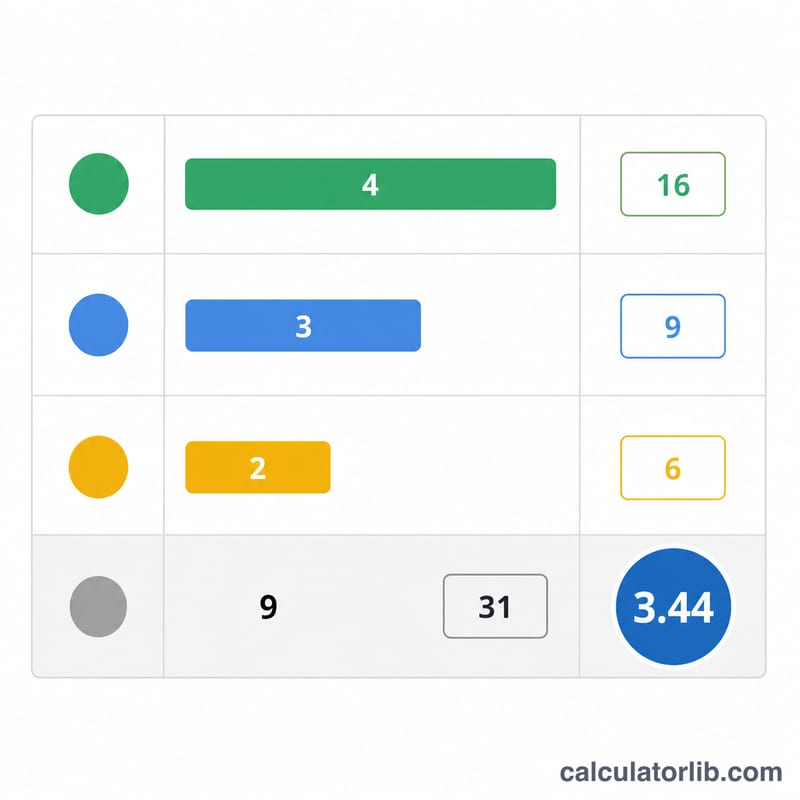
Suppose you took three courses: an A (4.0) worth 3 credits, a B (3.0) worth 4 credits, and an A- (3.7) worth 3 credits. Quality points = $$(4.0 \times 3) + (3.0 \times 4) + (3.7 \times 3) = 12 + 12 + 11.1 = 35.1.$$ Total credits = \(3 + 4 + 3 = 10\). GPA = \(35.1 \div 10 = \textbf{3.51}\).
FAQ
What grade points should I enter? Use your school's 4.0-scale value: A=4.0, A-=3.7, B+=3.3, B=3.0, B-=2.7, C+=2.3, C=2.0, and so on.
Why is GPA credit-weighted? Because a high grade in a heavier course should count more than the same grade in a lighter one. Weighting by credits reflects the workload of each class.
Does this give my cumulative GPA? No — this tool computes one term's GPA. To find cumulative GPA, combine quality points and credits across all terms.